Myall Creek Memorial Commemoration Weekend

Myall Creek and Beyond  Symposium
 

IMG_5498

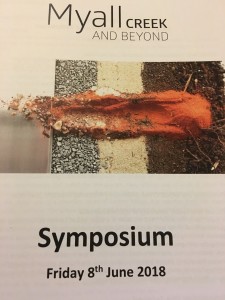
Myall Creek 1838 and beyond symposium  at University of New England in Armidale was a very full day, with papers from many academics . It featured a great line up of  artists, writers, poets, song writers and dancers, historians, lawyers and commentators. This word  beyond  to mean not  just moving on but deepening and spreading the story like roots deep into the soil become the anchor of a tree.

Of course this weekend was especially focused on the 180th anniversary of the Myall Creek Massacre but many spoke of seeing beyond 1838 to find its significance in history, law and culture. And it is seen hopefully, as a reaching out to many other killing fields identified and unidentified and  both still in pain.

It was especially important to meet Lyndall Ryan from Newcastle University whose paper explained the online map in which she is compiling details of massacre sites, as they meet the criteria to be designated as a place of a massacre. We have to memoralise all the sites,  acknowledge and be aware, find the evidence for ordinary Australians to understand. This is an important part of the story of who we are as Australians. It can no longer he secret, hidden, whitewashed.  Australia has a black history.

It is white fella business and black fella business to move forward.  If we do not know and acknowledge our past we cannot be present to move into the future. Again it is like a tree, if it does not have its roots planted deeply into the earth, its present cannot be health giving and its future is one of weakness.

Myall Creek is part of a National project,  a very important movement towards Reconciliation.  It is a catalyst.  It acknowledges Australia has a black history, and that we are prepared finally to listen.


IMG_5212

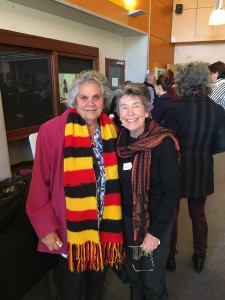
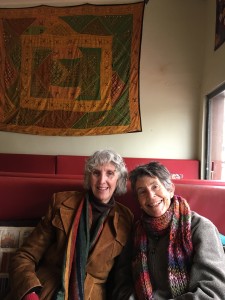
Bruce Pascoe, and myself.  Bruce is the author of Dark Emu and he gave the keynote address ‘Australian’s Failure to Know its History’

My highlight was meeting the historian Bruce Pascoe, author of the well known Dark Emu and I was able to buy a new updated edition as more and more  evidence comes forward and he updates the history.

His key note address was titled “Australian’s Failure to Know its History”

This is not a summary it is just my notes from his inspirational speech. ( Michael wrote notes too and comparing our noted,we realise everyone picks up different things.

Aborigine knowledge is all around us, deep in the earth, in the waters, the rivers and the lakes and high in the sky, if you but change your perspective and listen and look around . 
Sometimes i sit and watch mother earth my mother talking to me: she teaches me how to behave.
We  have to shift our understanding of Indigenous life. In the future the young ones, will please God learn the truth of history.
Aboriginal people  had a fishing and agricultural life. They were the first agriculturalist .  They had the first tools: Picks have been found ,  grooved where a wooden handle was held probably by reeds and spinifex glue.
Grinding stones have been found. They are the rosetta stone in telling the story of culture  for starch in embedded in grooves up to 65, o00 years old. Impregnated grain in stone .
 They were the first bakers. They made a nutritional  bread from a grass seed.  
They irrigated the springs to catch a  eels high in protein .  They built the first traps to catch the fish.  Google fish traps of Bewarana for illustrations,detailed fishing weirs across rivers. (from diaries of Leichhardt)
They sowed seed,
 they harvested crops, 
they irrigated the earth. 
The seed of the kangaroo grass does not need plowing, 
it needs no extra water, 
it needs no superphosphate 
no insecticides . 
Like early Australian’s old rice it was valuable. Kangaroos nibbled it for food but the first herd of sheep that came through trampled it to the ground and ate it to the bare earth. They ate the heart out of it and their hard hooves pounded the ground. So it did not rise again. 
Aborigines were the first inventors of tools,  the first agriculturalist with their seed 
the first chemist creating dough  and the first scientists, that they heated the dough making a chemical change to cook it , to make it light and sweet.
In a diary written “for 9 miles the stooked grass in bundles of sheaves stood”  and Mitchell saw fields of yams stretching to the horizon, 
he said’
“It was as if God had prepared the land for for me”
The aborigines traded along a great web of songlines. Trade, gossip and journey followed these lines, intricate connection of Australia. 
Much research is done by Biomolecular, GIS maps, oleography and palaeography. 
Much was so quickly destroyed by British occupancy. It was gone with the first herd of sheep, before records.  It was gone before the reality was recognised. If we had  but listened.
 
“ Breath there a man with soul so dead
who never to himself has said 
this is my own , my own sweet country “
 A British slogan yet the British went out and and took others land and pillaged their culture and their language.   They needed credence, so a Papal Bull  was found that said they could invade any land that did not know Jesus Christ,  so occupation of soil took place under the banner of bringing the LIGHT.
Change language:  
We no longer speak of bush tucker and damper and other diminutives . This is BREAD
No longer huts or humpies these are HOUSES 
No longer speak of camps but TOWNS
They had the oldest towns on earth. 
So you see our beautiful country is a lot more then, 
‘put another shrimp on the barbie’  or 
‘where the bloody hell are ya’
We have here the oldest people, oldest culture , oldest civilisation on the earth.

By the end of the Symposium I felt the grit in the oyster grinding around in our struggles and our deafness to the truth of our history. Through our mutual LISTENING it will become the the pearl of our story.  And the story of Myall Creek in time is a beacon of hope. Our nation depends on us, working and walking to a shared history

IMG_5194

Aunty Marg and myself enjoying a break at the symposium


Myall Creek Memorial Commemoration Weekend

Myall Creek Memorial CommemorationWeekend

In memory of the Wirrayaraay people who were murdered on the slopes of this ridge in an unprovoked but premeditated act in the late afternoon of June 10th 1838.


DAY 1

Left Sydney early heading north to Scone to have lunch with  Sharon our dear friend. 


 IMG_5063

Then up over the Liverpool Range to Tamworth for the night.

Here are a few moments of beauty from the window of our car as we drove the New England Highway with sun setting in the west. 


IMG_5082 IMG_5109


DAY 2

Today from Tamworth the journey is like a poem in itself. 

tell me about the magpies

their song croons our picnic table 
our soul knows the song 
it plays the strings of our heart 
we leave  the cracked aroma 
of the pepper tree but not the magpies
sadly farewell the tamed Peel River
but not the magpies
they come with us
climb the Liverpool range 
windmills, tanks, cattle and sheep
Goonoo Goonoo, Wallabadah 
Moonni Range, 
Thunderbolt and Hanging Rock
Katingle, Bendemeer, Uralla  
and massive boulder and grass trees 
along the way
and in Armidale the magpies welcome us.
Tell me about the magpies 
and I’ll tell you about me.

Turn west onto the New England Tableland into Armidale. 
Autumn is lingering in the cool crisp highland air. 
The gardens of our motel are stunning with their late rich autumn dress.

IMG_5137 IMG_5142


The Aboriginal Cultural Centre and Keeping Place

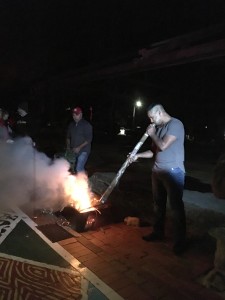
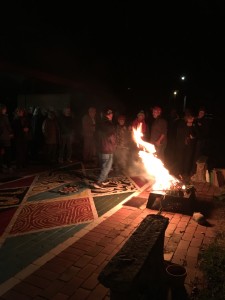
Our evening began amidst smoke with a eucalypt aroma 
a smoking ceremony and deep earthy sound of the didgeridoo 
under a dark starry sky around an open fire.
IMG_5153  IMG_5150


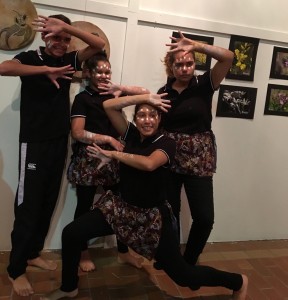
The young people dancing the echidna dance 
and to more modern music 

IMG_5149

then to the opening of the exhibition  Looking Beyond the 1838 Massacre.

IMG_5165

WE REMEMBER THEM
Ngiyani winangay ganunga


IMG_5157

Leonie who gave the welcome to country and her dancers from Duval  High School,
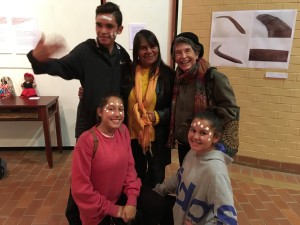
with me at the Opening of the exhibition Myall Creek


Wild: Anthology of Ginninderra Press


wild-cover

So thrilled to be included in the new Anthology of Ginninderra Press  called WILD

My poem Caged  has been announced as one of the included poem and i will be reading it at the launch. 

The Anthology has been edited by Joan Fenney and includes 159 talented poets from across Australia exploring the many facets of WILD – human, environmental and metaphorical. The book will be launched on the 7th July as part of the Ginninderra celebrations in Adelaide. 

Michael and I have got flights and accomodation to be part of the fun and celebrations, the  Launch , to read my poem,  and hear fellow poets read, being part of the book shop session to sell books and a great celebratory dinner to meet all the fellow poets and the publishers.


GINNINDERRAPRESS.COM.AU                               wild-cover

WILD:

Poems selected and edited by Joan Fenney 

Fire on Water: A Book Review

 BOOK REVIEW by PETER F PIKE 


Keating Cover

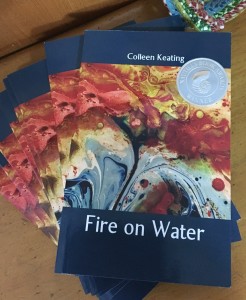
Fire on Water   by Colleen Keating

Fire on Water—what a strikingly impressive title: and after reading this collection of Colleen’s poems, how apt and appropriate. I remember when I was quite young we purloined some dry-ice from a cold storage facility and put some in a pool of water left in the gutter after a shower. We were fascinated by the bubbles of gas and cloud of vapour that resulted from the chemical reaction. We were just about to leave when an older chap came along, squirted some cigarette lighter fluid onto the puddle and ignited it. Fire on water we were impressed then as I was yesterday when I read Colleen’s poetry book. 

A small suite of poems on downsizing especially resonated with me as we sold our family home last April after 45 years. On page 41 belongings one day my heart unlocked / I donated some and ordered a skip / emptied the garage returned the key / it felt like a heavy pack moved / off my back after a long hike I walked / lightly feeling so much had owned me … 

Colleen’s interest and observation of the minutiae of life is fascinating—only a poet of some standing could record 

‘a tiny brown sparrow in the gutter defies fragility / as it tackles a twig too big for its flight’… taken from choice on page 108. part of the section entitled Exultation. From the same section on page 110, this gem: 

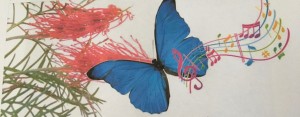
the vicissitudes of a blue butterfly  

she lavishly opens her wings
teal-blue fans quiver  
playing warm still air
motley light from the trees

she darts and dives 
ah with what precision                        IMG_5051
dodges the many hazards 
with angular flight 

creole-eyed she alights to sip
from sweet honey-dewed 
red-dressed grevilleas
moves like notes of music 
up and down around and in me
with lightness and freedom

i think of shy miss butterfly 
sprawled in Eliot’s poem 
pinned and wriggling on the wall

I know dull blue of wings 
etherised   
silver-pinned under glass

today her iridescent triangles of blue
flash with the sun   like flying jewels
intoxicated with life

The vivid images conjured up by Colleen’s poems are spectacular word-pictures that impress themselves on the reader’s mind. They are recalled with ease long after reading.

The appealing illustration on the front cover is by Colleen’s daughter Elizabeth. 

Colleen’s poetry exposes us to a large range of emotions. Stillborn on page 75 forces us to face up to a situation that as Australians we are, in the main, still reluctant to address. 

winter darkens our land
the tree outside my window
is stark and bare
close up new life is tightly budded 

the news says
our country has turned back refugees at sea people seeking asylum
returned to face those they flee 

history like a drawbridge is pulled up closed off
humanity is stillborn 

hearts are cold
fear deadens minds 

the everywoman in me weeps for the birthing 

the woman with child is weeping the woman in every woman
if you are not weeping
ask why 

Colleen’s book is 122 pages, Perfect Bound published by Ginninderra Press ISBN 978-1-76041-351-4 and is priced at $22.50 and is highly recommended. 

Page 26 FreeXpresSion– March 2018 

Thank you Peter Piper for a great review of Fire on Water and thanks for your dedication to poetry and poetry writers.


IMG_5052


Last Swallows: A Poetic Journey

For Hildegard, health and healing sought balance in all aspects of life. She honoured interconnectivity – of spirit, mind, body; of humanity, the earth and the universe. This is the heart of Hildegard’s healing philosophy, though not unique to her. Buddha emphasised the middle way as the path of moderation and the path of wisdom. The Tao always reminds us to move towards finding the balance as with dark and light.

What would eventually set her apart, however, was how she chose to embrace the middle ground set forth in the Rule of St. Benedict. This enabled her to engage in her individual passion while serving the stringent institutionalism of the Church.

It was within this middle ground that she pressed her will and intellect into the interconnectivity of the physical and spiritual worlds, culminating in her foundational work in natural medicine.

From her early years Hildegard worked with  garden plants and herbs for healing. This can be seen in the following poem when Jutta is dying. ( from Book 111 of Hildegard of Bingen: A Poetic Journey)    


IMG_4230

Some of the books of the 21st century I have that are inspired by Hildegard of Bingen


 Last Swallows  

Hildegard’s world stands bleak, 
bare.    The last swallows long gone.
In cold light 
dew drops hang on a blade of grass.
Lingering dread 
knots her stomach.

She enters the anchorage 
sighs deeply,
lights Advent’s second candle.
Its smoky glow 
reveals the pale beauty of Jutta’s face,
she lies stilled. 
Hildegard puts down some bowls, 
kisses her forehead.

 Jutta, my mother,
your ascetics are too harsh.
Your imprisoned cell here 
is mortification enough.

Let our spirits give praise 
with rhythm of music,
with song of jubilation.
Our God, the Just One, is she who offers life 
with all its bountiful gifts.

She nurtures Jutta, 
urges with sips of fennel tea,  
warmed broth, mulled honeyed wine. 
Oil from the olives, freshly pressed, 
she heats over the smouldering hearth,
gently massages Jutta’s hands and feet.
Her flesh wasted.
Jutta has her mind only  
on heaven, 
to be remembered as a saint. 
Hildegard kneels beside her
holds her cold hands,
listens to her trailing breath.
She loves this broken woman.


Colleen Keating

from Hildegard of Bingen : A Poetic Journey


Hildegard-Medieval-Diet-Healthiest
Later Hildegard came to understand everything is given us
for our wellbeing. She would write later about the interconnection of all things.
There is no creation that does not have a radiance, 
be it greenness or seed, blossom or beauty, 
it could not be creation without it.  Hildegard of Bingen

In 1150, Hildegard left the Monastery at Disibodenberg and led her sisters to set up the new Abbey at Rupertsberg. There she embarked on deep and valuable work in lifestyle, nutrition, and well being for her sisters. Word spread around the  of her healing ways.

When Hildegard left the Monastery at Disibodenberg and led her sisters to set up the new Abbey at Rupertsberg in 1150 she embarked on deep and valuable work in lifestyle, nutrition, and well being for her sisters. And word spread around the Rhineland of her healing ways.

Hippocrates, the father of modern medicine, declared “let food be thy medicine, and medicine be they food.” The concept of food as medicine is ancient. Hildegard was one of the first in Mediaeval Western civilisation that connected health and nutrition. 

Food as medicine is the core for Hildegard of Bingen. Her notion that a kitchen is also a pharmacy reflects a common theme among ancient traditions of healing: food is the first medicine. Medicines at the time were all plant based or specific combinations of foods prescribed according to their unique healing qualities.

Hildegard’s original work, was eventually split into two treatises, Physica  and   Causae et Curae –

“Physica” represents the history of natural remedies, which Hildegard had intended for public use. and in Causae et Curae Hildegard describes healing and treatment methods using humoral techniques along with traditional creation teachings, combined with ancient mystic Cosmologies.


IMG_3028iIMG_3015

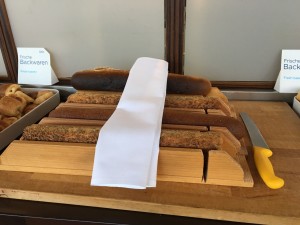
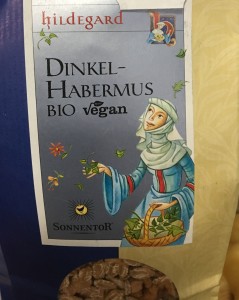
The wonderful selections of breads at breakfast, in our Bingen Hotel overlooking the Rhine. It felt very much as if hildegard is present.


Today especially in Germany, Hildegard’s healing treatments have found a resurgence in holistic health and wellness.

Within this renaissance Hildegard’s philosophies around health and nutrition provide concrete ways to achieve a healthy spirit, mind, and body, which ultimately lead to a healthy lifestyle. From this healthy lifestyle we harvest many benefits, not the least of which is avoiding illness and unnecessary suffering.

Spring: A poem by Thomas

IMG_4164


SPRING

by Thomas Keating-Jones


IMG_3978


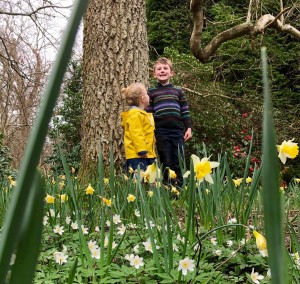
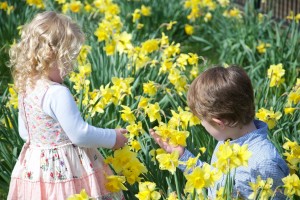
Daffodils dancing.

Snowdrops swaying.                  snow bells

In the spring sunshine

the flaming winter fire branches

were erupting

from flowerbeds like a volcano. 

Spring was coming for us

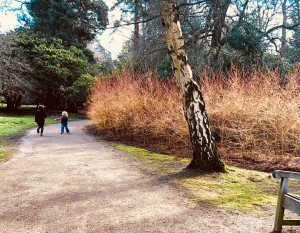
as we wandered the winding paths. 

Thomas Keating-Jones

Age 7

27400022_10159988751120486_1246975367_nIMG_4167 2 


Photos by Elizabeth Keating-Jones

Expansion to Eibingen: A Poetic Journey

IMG_2952 2


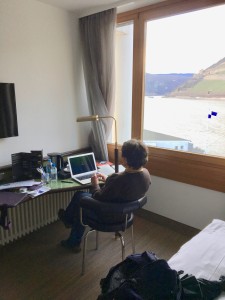
From my writing desk, in Bingen, looking down the Rhine


IMG_2975

At Bingen, looking down the Rhine.


Expansion  to Eibingen  

Hildegard’s fingers tap restlessly 
on the refectory table. 
A new plan consumes her mind.
She moves to the podium
tucks back some loose strands of grey hair,
smoothes her veil
waits for her sisters to end supper.

She looks around.
A hundred sisters sit close in lines
share their own produce, 
freshly baked spelt bread,
honey, warmed grape wine. 
Hildegard breathes the aroma 
of the delicious broth, 
a recipe she has created 
for their health. 

Her mind holds a bold horizon
as the shape of Rupertsberg
grows its silhouette into the sky.
Its soul is their singing, her music.  

Hildegard inspires their hearts 
again with the bravery of St Ursula.
Her voice lowers,

My gaze is drawn across the Rhine
to the hamlets and people of Eibingen.
To a destroyed, abandoned convent.
How the local people beckon 
for our sisters.

Chatter buzzes, hums
like a hive of  Odelia’s bees.
Excitement palpable.

They imagine the old buildings 
brought to life again 
by their efforts.

On the first Sunday of Lent

Hildegard crosses the busy Rhine 
with thirty volunteer sisters 
to found a new convent 
amongst the people of Eibingen.

Sister Inez,  chosen the new Magistra. 
The monk Volmar comes to bless them.
Carpenters and stone masons
follow, enthusiastic about a new project.

On the return journey,
the smell of the river captivates Hildegard.
Undeterred by the rough swell,
she turns to Volmar,
We will visit twice a week
to encourage and support them

The buildings and spires of Ruperstsberg
from the  perspective of the Rhine
catch warm rays of a sun, deep in their hearts.


Schwester Raphaela (l) und Schwester Maria Magdalena von der Abtei St. Hildegard bei Rüdesheim (Rheingau) lesen am Mittwoch (30.09.2009) Spätburgundertrauben im Weinberg. Das Kloster bewirtschaft 6,5 Hektar Rebfläche, die zu 83 Prozent mit Riesling und zu 17 Prozent mit Spätburgunder bepflanzt ist. Die geschichtlichen Wurzeln des Klosterweingutes reichen bis ins Mittelalter zurück, in die Zeit der Gründeräbtissin dieses Klosters, Hildegard von Bingen (1098-1179). Schon damals betrieben die Schwestern Weinbau. Foto: Arne Dedert dpa/lhe +++(c) dpa - Bildfunk+++
Abtei St. Hildegard bei Rüdesheim (Rheingau) 2009  ( in 12th century situated at Eibingen

Touch of Silk: A Poetic Journey

IMG_4100

A happy photo of a Benedictine sister picking the grapes at  the  Eibingen Abbey.

This poem in Hildegard’s poetic journey  Touch of Silk is a transitional moment when she is inspired to showcase her sisters, singing, and her music, with her sisters dressing in beautiful gowns and flowers. It is a fact many of the women were quite wealthy and did bring jewellery maybe as part of a dowry,which they used to adorn themselves on special feast days. One must remember the 12 th century was a moment of Renaissance. Many frowned on her actions but it was still able to be done. In less then 100 years this would not be allowed.


Touch of Silk

There must have been a moment
when the idea arose.
Maybe it was the visions
when holy virtues spoke to her.

Maybe when all fifty sisters spent time
laughing together as they picked grapes,
for the winepress,
to make the sacramental altar wine,
and their sweet wine
to give warmth and strengthen blood,
as Hildegard says.

Maybe it was the day
the cousins Bertrude and Agnes
from a noble family joined her sisters,
proudly announcing they were seamstresses,
and donating reams of silk
for priestly albs and vestments.

Just maybe, the touch of the silk
gave Hildegard the idea.

Excitement drives her thoughts and words,
as she muses and then reflects out loud,
My sisters will wear silk gowns
as they sing our opera.
We will have it ready to perform
for the Bishop and his entourage
at the consecration of our new Church.

After Matins,
Hildegard gathers her sisters,
My sisters, God loves beauty.
For our concert we will dress,
as noble regal souls.
We will wear silk gowns that flow.
Gold wreaths and flower-circlets will crown us.
Let our hair loose under light translucent veils.
Our hair is our glory,
not a temptation to cut or hide.

Feverish as excited children
the sisters sing and sew
and with every practice
Hildegard watches their confidence grow.

Below is some special mementos I brought home from Bingen.
The wines I shared with Michael were special and my Hildegard candle energises me and the whole room while I write.

wine from Abbey

Hildegard’s wines from Eibingen

Epiphany: A Poetic Journey


tulip bud in Liz garden

Tulip bud by Elizabeth Keating -Jones


Epiphany


In the garden, Hildegard sings
of the soft hills
curved as a mother’s breast,
The earth is at the same time mother,
She is mother of all that is natural,
mother of all that is human.
She is the mother of all,
for contained in her
are the seeds of all.


She sings of trees and plants
ferns, herbs, flowers and stones.


The greening power of God’s love
surges through her
palpable holiness
surging with vitality.


Hildegard learns
names of the plants, herbs
their healing properties.
The sisters’ garden explodes
a paint box come to life
spilling across a landscape.


Richardis follows her
discerns culinary and medicinal plants
bubbles intensely,
alive with the world.

Image may contain: plant, flower, nature and outdoor
 Photo taken by Elizabeth Keating-Jones in her spring back-yard garden, which we began while visiting in the past autumn.

Thomas in Greece


thomas writing at greece 2

Thomas in Greece

The Acropolis

You can see the cracks in the marble 

from the battle for Greece. 

 Who would lead Athens?

There is power here.

I can feel the ancient power 

in every step.


Poseidon surely did strike his trident here!

When you sit your mind can hear 

echoes of the ancient battle.

You can picture the Gods inside the temple.

You can feel the shadow rising upon you 

as you walk in the footsteps of the Gods.

 By Thomas  Keating-Jones

March 2018   aged 7


thomas writing