Hildegard of Bingen by Colleen Keating – an 2026 update.

The verse novel Hildegard of Bingen: A Poetic Journey by Australian poet Colleen Keating uses biographical poetry

to bridge medieval history with contemporary ecological spirituality.

By retelling the saint’s life across 100 chronological poems, the book focuses heavily on Hildegard’s concept of viriditas

(the divine “greening” and interconnected power of nature). It has evolved from a literary work into a functional tool used

in both European pilgrimages and American research. 

1. Use in Local Pilgrimage

The verse novel is highly integrated into the culture of the Hildegard of Bingen Pilgrimage Way (Hildegard von Bingen Pilgerwanderweg),

a 140-kilometre trail in Germany that runs from Idar-Oberstein through the ruins of Disibodenberg to Eibingen.

  • Meditation Companion on the Trail: Dr Annette Esser, the founder of the Scivias Institute for Art and Spirituality in Germany,
  • explicitly endorses and uses Keating’s poetry to guide walking meditations. The book is used by pilgrims while sitting in places
  • like the Disibodenberg basilica ruins to match the topography with the text.
  • Bridging Language and Experience: Because it captures the sensory landscape of the Nahe and Glan river valleys
  • (such as the specific flora Hildegard studied), local tour operators and pilgrim groups use sections of the verse novel
  • to provide English-speaking hikers with an intuitive, emotional connection to the physical terrain. [1]

2. Use in US Academic Research & Eco-Spirituality

In the United States, the verse novel is utilized across academic and clinical research circles focused on medieval literature, feminist theology,

and ecological psychology: 

  • Eco-Theology and “Greening” Studies: US institutions and spiritual networks—such as Dr Christine Valters Paintner’s Abbey of the Arts
  • —frequently use the book to analyze how medieval mysticism aligns with modern environmental conservation.
  • Researchers study Keating’s verse to examine how Hildegard’s ancient theological worldview can be translated into modern eco-justice framing.
  • Intuitive and Narrative Research Models: Rather than relying solely on dense, translated Latin texts like Scivias,
  • US researchers in narrative medicine and creative writing programs use this verse novel as a template for “poetic inquiry”.
  • It serves as a prime case study for how poetry can synthesize historical data, medical history, and spiritual biography into an accessible text. 

Some example

Australian author Colleen Keating’s biographical novel/poetry collection, Hildegard of Bingen: A Poetic Journey, the author maps

Hildegard’s life backward, capturing her transition from her later life as a magistra back to her early, hidden years.

The poems focusing on her time at the Disibodenberg monastery dive into her profound connection to viriditas

(the greening power of God) and her struggle to reconcile her stifling, early monastic life with her vibrant visions.

Specific poems and themes that explore her time at Disibodenberg include:

1. “Last Swallows” (The Anchorage Era)

  • The Context: This poem focuses on Hildegard’s early, cloistered years at the Disibodenberg monastery.
  • She was enclosed in a dark cell as a young woman alongside her mentor, the ascetic Jutta von Sponheim.
  • The Focus: Keating vividly contrasts Hildegard’s love for the healing, life-affirming properties of herbs
  • and gardens with Jutta’s extreme, life-denying penance. In the poem, Hildegard tends to the dying Jutta
  • with nurturing physical care—warmed broth, olive oil, and fennel—capturing a tension between
  • rigid medieval asceticism and Hildegard’s innate, vibrant spirituality. [1]

2. “Voice of the Living Light” (The Seeds of Vision)

  • The Context: Set during her mid-years at Disibodenberg, before she receives the divine mandate to share
  • her visions and leave the monastery.
  • The Focus: This poem explores the agonizing beauty of her visions while trapped within the patriarchal
  • and restrictive confines of the monastery. She begins experiencing the “Fiery Light” but is forced to quietly
  • cradle her ache for expression. These poems emphasize her developing sense of viriditas, hearing
  • the cosmic web of creation and the “choir of hosannas” from the surrounding landscape while
  • she secretly navigates her mystical gifts.

3. “Ordo Virtutum” (The Greening Through Music)

  • The Context: Reflecting on her time as the teacher (Magistra) of her community of nuns at Disibodenberg,
  • before their eventual migration to the newly founded monastery on the Rupertsberg.
  • The Focus: The poems spanning this period explore her use of music and writing as an outlet for her divine messages.
  • Keating’s poems in this section highlight how Hildegard’s poetic, musical plays allowed the sisters to burst into song,
  • softening their tired, discouraged hearts and walls of stone. It is here that her mystical theology—
  • centering on the interconnectedness of all life and humanity being “a feather on the breath of God”—truly takes root.

Colleen Keating’s lyrical storytelling captures how Hildegard’s quiet, oppressed decades at Disibodenberg ultimately

acted as fertile soil—the necessary viriditas incubation period—for her later life as a celebrated visionary, composer, and mystic.

You can read excerpts of these poems and find out more about the collection on the Colleen Keating Poet Official Website. [1]

Written by Colleen Keating with the help of AI

Vanessa Proctor: On Wonder review by Colleen Keating

I feel very proud to have two reviews  in the latest edition of  SWW Women’s Ink Magazine,  Spring- Summer November 2025.

Thank you Janette Conway for your very professional edition of our Women’s Ink.

Jan does it all joyfully and with comfort and ease.  It shows that  it is a labour of love
but it still is very demanding on time and energy and I appreciate this.

 A final wonderful edition for our Centenary Year.  

___________________________________________________

   On Wonder 

   Vanessa Proctor

    reviewed by Colleen Keating

This striking new book is filled with wonder, a delight to read either from cover to cover
or to dip into poem by poem. Full of original images it begins with family, unfolds from autobiographical
to the rich cacophony of visual arts, music, architecture, many as ekphrastic poems
and others using the powerful technique of taking on the persona such as a medieval gargoyle
in the poem Le Stryge .

I believe awe and wonder can sustain us; how taking time for awareness of the beauty
around us helps us and especially our children to grow in spirit.
At this time of increasing conflict and fraught demands on our attention, how uplifting it is to read
this collection of contemplative poetry.

On Wonder, a first collection of free verse from Vanessa Proctor, was published by Walleah Press
in late December 2024.
Vanessa is an award–winning Sydney poet and is highly acclaimed as a haikuist with three haiku
publications and co-editor of  under the same moon, Fourth Australian Haiku Anthology .

Vanessa Proctor’s poetry “encompasses an intimacy of living with minutely observed details of nature and time”.
These affirming words by Marcelle Freiman, on the back cover,  come from an appreciation of the rich use of imagery
and memory where time is all present.

Each poem is a bead of beauty, of lightness, of memory as in the wistful Cicada shells, their song,

thick with promise
of long afternoons
and lingering summers/which inevitability end
far too soon.

Vanessa writes gently of tragedy, a friend dying, a shipwreck, the desperation in Budapest 1944
where the pen is power. 

Memory as a way of living with the present and the telling of stories is succinctly expressed in Vanessa’s early poems;
sharing a bowl of steaming pho with her son, times with her father as a young girl , with her mother in Weberg 1980
and its hint of unease, with her sister

in a carefree summer spilling over
with sunshine and salt spray;

with her daughter,a poem any of us who have had a teenaged daughter will identify with.

One of my favourites is the poignant poem, Emergence about a new baby in the special care nursery,

Soon I’ll take you home
hold you,
get to know you,
from the outside in. 

Vanessa writes of an experience in an English cathedral, with the singing of a Hildegard of Bingen song,
O Quam Mirabilis Est 
(How Wondrous it is) we are touched with an abundance of spirit, carried across nine centuries
in praise of the beauty of creation,

the transformation of breath
into the energy of sound,
one expansive voice rising up,
visionary and numinous.

We were privileged to hear Vanessa talk about her new book at our SWW August meeting
and I hope this review encourages you to enjoy On Wonder. As in her poem Dragonfly,
may your reading her poetry,

“become a stillness
that dissolves into the morning


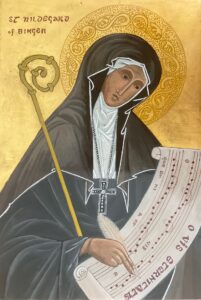
Icon of Hildegard of Bingen brings my story alive once again by Colleen Keating

Icon Of Hildegard of Bingen created by Iconographer Kevin  Dilks. ( Brother to my friend Julie Thorndyke).

Thank you Kevin. It was a most beautiful gift to receive this icon . It took me back into a contemplation with Hildegard.

I played my CD “Feather on the Breath of God “as I took time to  gaze on Kevins icon, allowing myself to be lost in it.

Hildegard’s eyes  are beautiful. They are lowered in her humble way. They are  focused  on scribing her musical notes and creating poetry to sing, and  I feel those eyes are showing  her mind is singing as she notates.

The feather has the double meaning of the quill for her scribing and the reminder for us that she calls herself “The Feather on the breath of God ”

From my poem of the same name,  pgs 57-58, a young  Hildegard races in from the field, from picking herbs for Jutta to  prepare the tonics  for the sick , Hildegard exclaims,

Jutta, Jutta, she calls
it is so beautiful.
I see the Light and beyond to the heavens, 
not as in ecstasy but with my eyes wide open.

I want to express myself,
I feel so blessed.

She plucks a feather
from under her coarse, homespun cape,
and look . . .  a gift. I know there are always feathers,
but this was special, as I watched it drift,
I felt a ‘yes’ to life.
Ah, I am a feather on the breath of God.

She turns both hands in the air,
eyes to the heavens,
a twirl of gratitude,
a dance of light.

The words Hildegard is writing in Kevin’s icon are the uplifting promise for her women living and working in their Abbey at Rupertsberg.

. O vis eternitatis                                                              O power within Etenity
que omnia ordinasti in corde tuo,                                All things you hold in your heart
per Verbum tuum omnia creata sunt                           And through your word were all created
sicut voluisti,  et ipsum Verbum tuum                        according to your will.


And finally in my meditation with Kevin’s icon, I paused on the golden halo. Many icons use this to portrait a holy person. Several thoughts came to mind. To think Hildegard was called a saint at her death by her communities and by the local people, east and west, all along the Rhine River wherever her influence had reached in the 12th century.* and Rome rejected their request for Sainthood. Three hundred years on the Abbess of the Benedictian Community applied for her to be made a saint again and it was again  rejected by the Vatican. When the Abbey asked later, the paperwork had been lost ! And so she was lost to the world for hundreds of years . Only at the beginning of the  late 50’s  and early 60’s,  the Environmental Movement when Mother earth was beginning to be in pain from the damage done to her, did a Dominican Priest Father Matthew Fox rediscover her and had her writings translated finding her an Environmental Mystic.

Hildegard  had been forgotten for 900 years !!! and then others began to discover her music, her paintings , her poetry and bring her back to our world.

If ever there was a time for her to speak it is now. Of course the Vatican saw her being a spokesperson for so many and the German pope canonised her in 2012 not only canosied her  but made her A Doctor of the Church. To me it was too  late. However in a way, I guess it  introduces her to another layer of people in the Churches and hence increases her influence, so that is good.

Finally i traced, in my mind the Infinity symbols that are softly embedded in the halo. The Infinity Symbol (A Christian symbol of God’s eternal and infinite nature) I wonder if the fish (Ichthys symbol) was an early attempt to show this, before a Mathematician claimed it firstly in the 16th century.

*(Many Monasteries and Abbeys bought her music which encouraged their communities . By the way this is one of the ways that Rupertsberg received money so her Scriptorium was invaluable as she taught her women to dictate and scribe the many works that she sold. )


With music, we have the memory of paradise lost”- Hildegard von Bingen”.

Hildegard created over 77 unique songs. She considered music the point where heaven and earth meet. She believed harmony to be more than the combination of voices and instruments,. For her it represented the balance of body and soul, the interconnectivity of humanity with the universe. 

Hildegard composed secular music, sacred polyphony, hymns, and chants. She used music and art to express her visions; in fact, it has been said that Hildegard composed in pictures and painted with words. 

Oliver Sacks, the great neuroscientist and admirer of Hildegard, observed that humans naturally keep time to music, using hypnotic sounds to enter trance-like states of meditation. Further, music has been found to contribute to synchronicity between the two brain hemispheres, resulting in more effective whole-brain thinking.

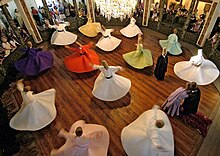
Hildegard used music as a way to a third state of consciousness. She did not express it in this 21st  century vernacular but Hildegard knew its importance for her women, physically, mentally, emotional and spiritually. Some of her music written  for the eight breaks in the Benedictine Day  helped with breathing and well being. Severl pieces have notes that rise to high A which can give a sense of transcendence  similar to other religions like the  Sufi’s  Whirling Dervish. *

Along with sleep and dreams Hildegard viewed music as the key to opening a third state of consciousness, a trance-like state. Her firm mooring in faith, combined with openness to the metaphysical, enabled Hildegard and her contemporaries to use music as an auto-suggestive relaxation technique. This meditation was based on the belief that music provides the human organism with positive influence in the healing processes.

To think that her music was banned towards the end of her life .** In the winter of her days she inspired her women in their silence under pain of their Abbey being destroyed :

Let us find purpose in our day,

Hildegard counsels after matins

find music in the fields

in the sun’s warmth,

in glints of gold on boughs of trees.

Rejoice in the aroma of the damp earth

and viriditas.

Spring is at the node of every greening branch.

May even the wind be our song.

. . . . . . and in the silence they learn,

in Hildegard’s words,

to search out the house of their hearts. 


  *  Whirling Dervishes is a form of physically active meditation which originated among Sufi groups, and which is still practiced by the Sufi Dervishes in some places.

** From the poems Struggle in Exile  pg 210  and Endurance  pg 212 in Hildegard of Bingen A Poetic Journey by Colleen Keating 2019©️


Hildegard today at the Abbey and the ruins of her original Abbey at Disibodenberg


Hildegard composed secular music, sacred polyphony, hymns, and chants. She used music and art to express her visions; in fact, it has been said that Hildegard composed in pictures and painted with words. 

Oliver Sacks, the great neuroscientist and admirer of Hildegard, observed that humans naturally keep time to music, using hypnotic sounds to enter trance-like states of meditation. Further, music has been found to contribute to synchronicity between the two brain hemispheres, resulting in more effective whole-brain thinking.


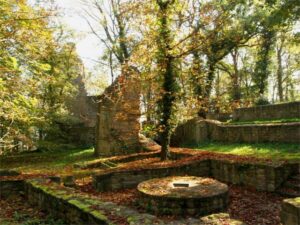
Ruins of Disibodneberg in Germany . Hildegards first Abbey.

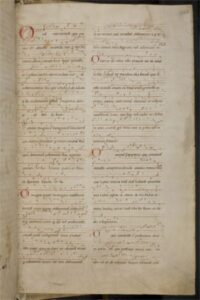
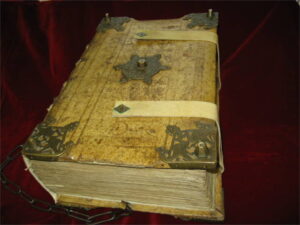
Riesencodex

In Search of Hildegard goes from strength to strength by Colleen Keating

I am thrilled to learn my original poem  In Search of Hildegard goes on  from strength to strength. Originally short listed and commended by the Society of Women Writers  Giving Women a Voice National Poetry Competition in 2019, then included in  the amazing new book Hildegard Speaks by Dr. Annette Esser for the Hildegard Pilgrimage in Germany, translated into German by the talented Dr. Annette Esser, the founder of the Scivias Institute  for Art and Spirituality See below  . . (love to hear it spoken in Hildegard’s mother tongue) and now short listed as a short film in the Bogota,  Columbia Short Film Festival “I Am Peace.”

All exciting as the Pilgrimage is on at the moment through the Pilgrims Way to arrive at the Benedictan Abbey overlooking the Rhine River and Bingen . on Hildegard’s Feast Day 17th September.


in search of Hildegard of Bingen

I take a train out of Bingen
through the Rhine Valley
on this sweaty summers day
trek up a steep hill
relieved to find an old sign klosterruine
which points to a verdant track
into a cool shady grove

here remnants of the twelfth century monastery
moss-mottled stone walls
mostly buried by vines
and embedded tree roots
is Hildegard’s world

standing in this moment
with the outlines of another world
time is shapeless
the divide of centuries a blur

only my mind’s eye can see
a spirited young woman
flourishing herb gardens

she prepares salves and tonics
attends the sick
listens to the breeze
and finds God in the hills above her

kairos time
for her visions writings mandalas and music
later a powerful feminist voice
against corruption patriarchy and senseless war

the earth is our mother she would sing
revere and care for her
if we exploit and savage her
she will be out off balance
and the price will be high

then silence for nine hundred years
in our time
the scales are tipped loudly out of balance
the all ords and the dow are the measure
a daily intake of massacres crowds our entertainment
soul mutilation makes soldiers unable to cry

I lean against the wall marked Hildegard’s cloister
in the lush shade of an almond tree
hanging fruit voluptuous now
is falling to emptiness
the void
the nothingness
how human to fear the waiting
for fullness to return

scattered around me
are rotting almond fruits
flies enjoying their feast
the decay fodder for the soil

my eyes scan for her presence

a maiden hair fern
grooved into a crumbling niche
catches my eye
delicate and tenacious
I feel a quickening
like a first flutter of new life

too often the fragile the intimate whisper
the lightness of touch
the flicker of a sanctuary lamp
like the breath are portals and easily missed

I ponder the rise and fall of my breathing
listen to the rhythmic heart beat
hear veriditas chants in the crumbling walls

veriditas murmurs hildegard

hildegard is here
I do not flinch i expect her

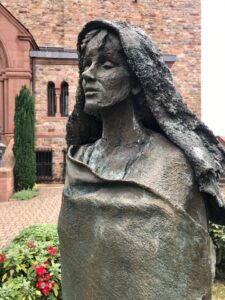
nothing like the grey statue at the abbey
holding the orb and feather

her presence is intimate
light glows luminous
her arms full of herbs from the garden
and her muddy hand-made sandals
make me laugh


Congratulations, Michael Conti!

Your talent and enthusiasm for our initiative are heartwarming and changemaking.  We have reviewed your film submission and appreciate announcing to you and our world that your film, In Search of Hildegard of Bingen, is part of the Official Screening Selection of the I AM PEACE GAMIP Global Short Film Forum 2022.
 
 
Michael Conti, Colleen Keating
In Search of Hildegard of Bingen
OFFICIAL SELECTION - I AM PEACE - GAMIP GLOBAL SHORT FILM FORUM 2022-2.png


Colleen Keating translated by Annette Esser

in search of Hildegard of Bingen

… auf der Suche nach Hildegard von Bingen

… ich nehme einen Zug aus Bingen

durchs Rheintal

an diesem Sommertag

steige auf einen steilen Hügel

erleichtert ein altes Schild zu finden Klosterruine

das auf einen grünen Pfad führt

in einen kühlen schattigen Hain

Überreste des Klosters aus dem zwölften Jahrhundert

moos-gefleckte Steinwände,

die meist von Rebstöcken bedeckt sind,

und eingebettete Baumwurzeln

das hier ist Hildegards Welt

in diesem Moment 

in den Umrissen einer anderen Zeit zu stehen,

Zeit ist formlos,

die Einteilung in Jahrhunderte unscharf.

nur das Auge meiner Seele sieht

eine lebendige junge Frau 

und blühende Kräutergärten

sie bereitet Salben und Säfte

steht den Kranken bei

hört auf den Wind

und findet Gott in den Hügeln über ihr

Kairos Zeit

für ihre Visionen, Schriften, Mandalas und Musik

später eine mächtige feministische Stimme

gegen Korruption Patriarchat und sinnlosen Krieg

die Erde ist unsere Mutter sie würde singen

ehre sie und sorge für sie

wenn wir sie ausbeuten und über sie herfallen

gerät sie aus dem Gleichgewicht

und der Preis wird hoch sein

dann gab es neunhundert Jahre Stille

zu unserer Zeit

ist das Maß lautstark aus der Balance geraten

das wer bietet mehr und der Dow sind die Maßstäbe

ein tägliches Reinziehen von Massakern trägt zu unserer Unterhaltung bei

Seelenverstümmelung belässt Soldaten unfähig zum Weinen

Ich lehne mich gegen die Mauer, die als Hildegards Frauenklause bezeichnet wird

im üppigen Schatten eines Mandelbaums

hängende Früchte nun lustvoll

die Leere

das Nichts

wie menschlich das Warten zu fürchten.

dass die Fülle zurück kehrt

meine Augen skandieren nach ihrer Gegenwart 

das ferne Haar eines Mädchens

eingefercht in eine zerbröckelnde Nische

zieht meinen Blick an

fein und zäh

Ich fühle eine Erregung

Wie ein erstes Flattern neuen Lebens

Allzu oft sind das zerbrechliche intime Flüstern

die Helligkeit der Berührung

das Flackern einer heiligen Lampe

Tore, die wie das Atmen leicht übersehen  werden

Ich sinniere über den Anstieg und Abfall meines Atems

Höre auf das Murmel n des Herzschlags

viriditas murmelt Hildegard

Hildegard ist hier

Ich zucke nicht zusammen ich habe sie erwartet

nichts wie die graue Statue an der Abtei

die Globus und Feder hält  

ihre Gegenwart ist intim

Licht glüht leuchtend

ihre Arme voll Kräuter aus dem Garten

und ihre matschigen handgefertigten Sandalen

lassen mich lachen 


Flannel Flower Heaven by Colleen Keating

Flannel Flower Heaven


Here’s me in Flannel Flower heaven. 

In Wyrrabalong National Park North . 

It is along  the Coast Walk from Crackneck Lookout to  the Trig Station. 

This is now a pilgrimage experience for me ( i will explain later)  

This pocket of  White Flannel Flowers  attracts many walkers each October. 

The walk includes wonderful ocean vistas and a few vegetation environ-changes

along the way. 

The show of flannel flowers begins slowly, and in the early stages can be easily missed . . . one here, one there,  and suddenly once you have seen these few you begin to see them everywhere.. . . .their presence, breath-taking. 

They clump gracefully together and move gently in the breeze. 

They cluster in masses growing from unobtrusive grey furry wavy leaves.

Stems grow  up and buds appear and then the flowers emerge and blossom.

Ten star petals velvety to the touch each with a delicate pointed tip, exposes a downy pin cushion centre conducive to  bees, butterflies, beetles to land for a feed.

Viewing these plants leaves me with a visceral sense of joy and satisfaction . 

I felt bewildered last year when I snuck along this track during lockdown  (in my 5 km permission radius) to find it had had a back burn, I guess to clear the bush  against fire for the houses further down the hill.  

Now I felt uplifted  this year, 2022, that I had returned with hope for this Flannel Flower Pilgrimage. 

This is not an illusory emotional response but a physiological one

triggered  by the sense in my brain of well being,   

given by the release of neuro-chemicals, endorphins and dopamine.

I wanted more.   I could not get enough.

Every corner I turned and I was not disappointed.

A walk in this Wyrraablong National Park with its Spotted Gums, its few old river Gums (one i take my grandchildren to, for it has the most generous arms for climbing and holding little kiddies,)   for the its banksias, Acacias and wattles and for its Flannel Flowers this week

is one of the places, 

special places for Michael and I, 

that encourages ‘Forest breathing:’  the Western term

for what Japanese call ‘shinrin yoku’. 

This is the practice of  walking and being mindful of the surroundings, letting your senses take in the sights, sounds, smells ,tastes and feel of the forest and bushland.

The health and well-being benefits of ‘forest bathing’ are well documented. There are good research  articles about this.  Today  walking here, reminding each other to be aware is enough, to be very present . The small white nodding heads of the flowers seem to be speaking to us.

They take us out of ourselves and for an uplifting and refreshing time,

we are with them in the world of nature.  

Of course we do not need this marvellous stand of Flannel Flowers or even a forest or the bush to  find ourselves immersed in ‘forest breathing’. 

The mystic and Abbess, Hildegard of Bingen said as far back as the 12th century,  that nature and the green colour in our eyes is very healing.  She was speaking well before modern medicine and she found this way for women who came to her for help. She would say to those feeling depressed, feeling down, feeling overwhelmed:

“Go out into nature ,  find the green: into a park, a paddock, even to a tree  . . .
Feast your eyes on the green, the thousand shades of green.

for its healing powers.  and now japanese Doctors even prescibe a wlk in a forest for healing and for well being. 

(The story for those who have read to the end of this.. . )

My mother loved the sea: my father preferred the hills and bush and so they bought a weekender near both, as the saying goes ‘where the forest meets the sea’.

When Mum went off with the family to the beach it turns out my quiet Dad would put our dog, Skipper in the car and drive to Kincumber Mountain.

He told me once that was his favourite place. 

My father  died  suddenly one day while mowing the lawn and he died young. It was a tragedy in our family life. 

Later as healing of loss and grief progressed I decided to visit Kincumber Mountain to help me find something. . . maybe lost . . . I knew not what. . . 

It was a late spring balmy evening,  I got out of the car and found myself immersed in a forest of flannel flowers and my father was there  .  . .we were there together .  His presence filled me mayup for the lostness in spirit we were talking.   it was  i understand an out of mind experience. It might have been a second, a minute or an hour . I do not know but we walked together. Michael came later and took a photo of me in those wild flannel flowers  nearly as tall as me and I seem lost in them and in that photo I feel my father is there. 

When I started my healing business  ‘Touchstone’ that flannel flower photo was one of my motivating photos . . .maybe about the mystery, or the more then . . but it stayed on my self all the years of my work inspiring me.)

Many years later when I was facilitating a retreat, over lunch with a friend who was Artist-in-Residence and one who understood these things, I shared my Flannel Flower experience with my father.  He listened with joy  and understanding . . .and I felt heard.

  He arrived the next day with  a framed painting of his, saying:

I have always wanted a good home for this painting and I now know where it belongs. He presented one of his signature paintings of flannel flowers.

 It was an amazing generous gift I have always treasured.

So this is the explanation why Flannel Flowers are my spiritual flower. 

PS. I have never gone back to Kincumber Mountain. I never wanted to spoil that moment and today I don’t need to go there.  But this walk along the Coast track is a beautiful reminder.


Proud to affirm a new Hildegard book, Forbidden Grace by Shanon Sterringer


Throughout history women are redacted from the story.  The narrative of our grief is still unripe. The green acorn still waits to fruit.  The new song still hammers in the dark in search of the music for our time.  It takes prophets living on the edge to listen for the song, to call us forth, to proclaim the will of God and hold us to account.   Forbidden Grace is a compelling story of just such a prophet. Rev. Shanon Sterringer writes honestly of her story with its struggles, its messiness, its crests and troughs, with the mystic and prophet Hildegard of Bingen as the wind that carries her.  The juxtaposition of the two words in the title is a paradox of our time and it takes a brave woman to carry that.  I was captivated by her journey.

Learning to consciously live in the light which is sometimes bewilderingly dark (how else can one see the stars?) Shanon reminds us of the lone falcon ‘turning and turning in the widening gyre.’  As the poet, WB Yeats continues, ‘Things fall apart, the centre cannot hold’

What Shanon knows – it is in the ‘fall apart’ comes the song of a new way, as it is the invisible sap running in the veins that ripens the fruit . . . what Hildegard called veriditas, that brings humanity to its fullness.  Even as the hammer pounds, the prophet in Shanon sings us forth. For what is this song if not hope?

Reincarnation? We cannot know these things. However, for those who are open we do know Spirit abides us. And for us Hildegardians we know Hildegard is speaking today.

COLLEEN KEATING, Poet and author of Hildegard of Bingen: A Poetic Journey

Forbidden Grace is an extraordinary account of the lives of two women separated by 900 years, yet touched by the same divine grace. Sterringer offers readers a front row seat as she examines the synchronicities that connect her faith story to that of Hildegard of Bingen. The thematic treatment of their journeys allows a forward and backward movement like the waves of an incoming tide that allows ideas and events to seep into one’s consciousness. The reader comes away with a deep recognition of the spiritual bond between two women who have both wrestled with God.

This memoir is a stunning tapestry woven of two parallel lives. Throughout, the author assures us that God’s grace is forbidden to no one despite over 2,000 years of history that has often maintained otherwise. As an ordained woman priest, Rev. Sterringer has joined the ranks of women who refuse to participate in erecting barriers against divine energy.     — JOYCE RAY, award-winning author of Feathers & Trumpets, A Story of Hildegard of Bingen

This beautifully written book recounts the compelling spiritual journey of a young woman whose love for God moves her to seek ordination to the priesthood. Autobiography and biography meet as the Rev. Shanon structures the account of her life’s itinerary with parallel episodes from the Life of Hildegard of Bingen. With humility and good humor, Shanon draws us into her candid memoir of call, courage, and commitment, with its blessings, disappointments, and upheavals. Retreat from her goal never surfaces as an option for this strong, courageous woman. Her energy, like her faith, radiates from the pages of this book. Readers will wonder how she keeps going, and they will not want to put the book down until reaching the end. Buoyed by the ever-renewing vitality of the Holy Spirit, Rev. Shanon learns, in Hildegard’s words, “to be carried like a feather on the Breath of God.”

-BEVERLY KIENZLE, professor emeritus, Harvard Divinity School, author of The Gospel Homilies of Hildegard of Bingen.

This is a fascinating and innovative book weaving a number of different themes into a many-layered tapestry.  The story of the medieval mystic Hildegard von Bingen is interwoven with the author’s own journey into the priesthood. The significance of role models who are like you is clearly charted, along with the search for a theology to challenge the dominant culture. Both women’s stories are told in a lively way that will draw readers in and enable them to find their own story in both contemporary culture and in history – or should it be her story?   The author likens both stories to chipping away at a tunnel into a seemingly forbidden cave. This book is a significant addition to the clearing of the rubble that has blocked women’s entry into positions of authority within the Christian church.

THE REV. DR JUNE BOYCE-TILLMAN MBE PhD, MA, LRAM, FRSA, FHEA, FISM, Professor Emerita of Applied Music University of Winchester, UK; Extraordinary Professor at North-West University, South Africa

Two photos of Rev. Shanon Sterringer a presence of Hildegard in our world today. Doing what Hildegard would struggle to do in the 21st century.

Two Hildegardians today

BEVERLY KIENZLE, professor emeritus, Harvard Divinity School, author of The Gospel Homilies of Hildegard of Bingen. and

 Shanon Sterringer, Rev. and Dr. Pastor and Professor, Pastor of Hildegard Haus,  Owner of The Green Shepherdess

Hildegard of Bingen by Colleen Keating just keeps giving.

One of my favorite books is Hildegard of Bingen, A Poetic Journey by Colleen Keating.

It is a brilliant approach to sharing St. Hildegard’s story.
(I have a few copies of it in The Green Shepherdess!)
Today, I was reading the poem, “A New Earth” from this book and I just love the following: 

“Hildegard looks across the gardens 

pleased to see Guda with her workers, 

breathes in the scented blooms of jasmine. 

Raspberry leaves catch her attention, 

crunches them between her fingers, 

murmurs approval, 

‘almost ready for the teas.’ “

Thank you Professor Shanon  Sterringer, Pastor of Hildegard Haus and owner of The Green Sheperdess LLC in Fairport Harbour, Ohio.USA
for your affirmation and for the amazing story you are creating for our future. I love Hildegards of the 21st century.

Hildegard of Bingen on the pedestal all week on the ABC Classic with Martin Buzacott

What a tribute to Hildegard of Bingen  being chosen  by Martin Buzacott for the pedestal all this week dedicated to mental health.  Listen to ABC  Classic at 10 am  each day this week to lift your spirits.
Her story,  Hildegard of Bingen: A poetic journey by Colleen Keating is available from Ginninderra Press 
and has been acclaimed ‘ a masterpiece’

As the host Martin Buzacott says :

A week of Hildegard’s music for

Health and healing

Comfort and consolation

Mystic marvel

Musical adventurer

Hildegard of Bingen

delivering eternal hope.

for us in this week 11th to 15th October 2021  . . .also the week we come out of lockdown with all its possibilities and uncertainties.


The story of Hildegard of Bingen as told by Colleen Keating .

Become immersed in her environment, feel her joys and suffering, loves, passions, betrayals and loss. Live with Hildegard, a medieval mystic and prophet  through her more them 80 years and be renewed with hope. It has taken a thousand years for her to be acclaimed. 

What a treat and how wonderful in Mental Health Week Hildegard is being acknowledged for her music, her poetry,  thoughts of health  and healing and caring for her Abbeys conscious of well being and all this in the 11th-12th century.


Countdown to Hildegard’s Anniversary 17th September by Colleen Keating

Countdown : Hildegard’s Anniversary 17th September. She still speaks to us today . Her encouraging words to us to care for our planet, her sacred music, her knowledge of healing plants, love of the cosmos,

is all there for us in the 21st century . . . 842 years after she passed.

We celebrate you Hildegard.

Hildegard writes,
“The earth is at the same time mother, She is mother of all that is natural, mother of all that is human. She is mother of all, for contained in her are the seeds of all. The earth of human kind contains all moistness, all verdancy, all germinating power. It is in so many ways fruitful. All creation comes from it. “
~ Hildegard of Bingen
My photo “Veriditas” was taken of the moist undergrowth in the Wyrrabalong National Park on Darkinjung country Central Coast.
Veriditas – ‘the greening power of the divine’ – or ‘the healing power of green.’ Hildegard believed in the unifying power of the divine as reflected through growth. The “greening” in nature serves as a symbol of spiritual and physical health and reflection the divine in nature

HILDEGARD WINS: Society of Women Writers by Colleen Keating

Hildegard wins.  This is for Hildegard of Bingen.  I was very excited to see the full page spread in Women’s Ink journal of  The Society of Women Writers

Two wins for her .

Thank you to  the judge Margaret Bradstock for judging  Hildegard’s poetic journey the winner as poetry book

Thank you to the judge Judith O’Connor  for judging Hildegard  the winner as non-fiction book.

These wins are for Hildegard of Bingen and her story may her spirit spread across our land.