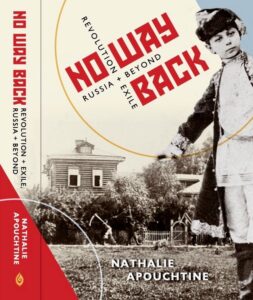
It is always enjoyable to be part of a launch of a new book . There is always the promise of bringing it forth into the world that it will make its mark, inform someone, change someone, help someone to find their way anew and so it is with the launch of
No Way Back
Revolution and Exile ,
Russia and Beyond
by Nathalie Apouchtine.
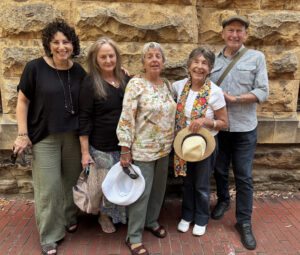
It was a buzzing group of writers and family and friends that filled the Judith Wright Room at the Writing Centre last Saturday to witness this launch and to congratulate her on the final book here and to wish Nathalie all the best.
It is published by Riverton Press 2024
No Way Back: Revolution and Exile, Russia and Beyond by Nathalie Apouchtine spans three generations, three continents and nearly 100 years. Her family left Russia following the 1917 Revolution, some travelled alone, some in groups, many lived in France, very few of them ever returned to Russia. But some of their descendants did, including Nathalie, who has done magnificent research to document the personal telling of her family’s story amid the historical events they witnessed and experienced.
The book includes a photo section where we see the continuity of life: men of one generation dress in military great coats with medals, while the migrating younger generations wear simple worker’s garb, and later, the family finally puts down roots in new lands. As with refugees everywhere, this is no small achievement.
A story of exile and migration, one that continues to resonate in today’s troubled world.
I am very pleased to have a promotion on the back cover which reads
No Way back brings alive the story of the Russian Revolution
and the aftermath of exile, through a wonderfully traced family history.
Apouchtine interweaves a reflective history with world history
in an engaging and captivating way . . . No Way Back
is a valuable addition to our Russian history
Colleen Keating Poet
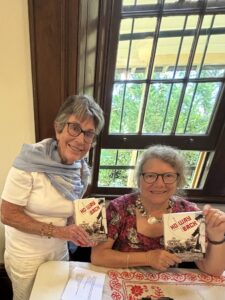
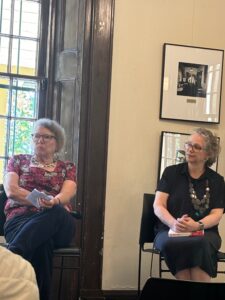

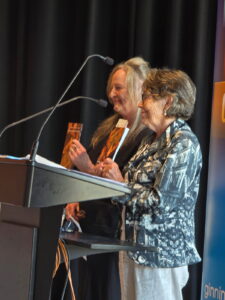
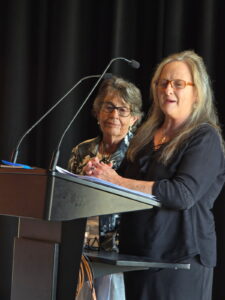
Question and AnswerPanel and Jackie Buswell at the launch.
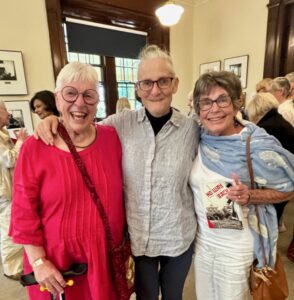
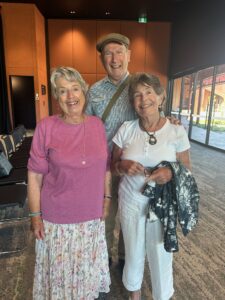
Some friends ctching up at the launch
Review
No Way Back brings the story of the Russian Revolution and the aftermath of exile alive through a wonderfully traced family history. It is better than any ordinary history book as the author, Nathalie Apouchtine, weaves a scholarly historic timeline with her ancestors’ stories, personalised by memoirs, diaries, recorded interviews, eye witness accounts, old photos and keepsakes, letters and postcards from throughout the 20th century. The tapestry even more enlivened as many of the archives have been translated by Nathalie for the first time.
At one level a journey from a family’s life of contentment to face a world changed dramatically and completely and at another an epic history of an all too familiar experience : violent disruption to traditional ways of life, the mass movement of peoples and exile.
The threads of this story, their warp and weft are made even more real by the author’s visits in the 1990’s to trace the footsteps of her ancestors. Visits to Smolny Institute with its checked and bloodied history Nathalie writes,
Seeing the stately architecture with the winged symbol of the tsars and the peaceful trees and lawns around it on a summer visit in the late 1990s, I tried to picture the scene described by Sergei: the cold, the crowds, the weapons, the rushing about. . . a place where my maternal grandmother and three of my great-aunts were students here, music and young female voices would have resonated behind those windows.
Nathalie has the gift of interweaving a personal history with a world history in an engaging and captivating way. In her writing she makes the reader feel we are unravelling the story togethers Never boring. It is a valued addition to history and a good read.
Even where the flight was more orderly and less risky – whether via land or water – the mingled feelings of confusion and fear for the future, and grief at having to abandon the homeland, built on anxiety over the actual logistics of various escapes. 165
No Way Back is one of those rare books that can give a depth of understanding of historic time, recounting the idyllic Russian life at the turn of the century with the unfolding of a changing world before their eyes
. . .the Civil War effectively ended in November 1920 when the anti-Bolsheviks in the south lost their last bit of territory on the Crimean peninsula. This prompted the biggest surge in the exodus. About 150,000 White troops and civilians – though some historians say many more – sailed away on a flotilla of boats of every size, shape and purpose, their overflowing cargoes of people destined mainly for Constantinople. . . . The travellers to Constantinople, as well as to other areas adjacent to Russia, would eventually continue on to various parts of Europe, to China, to the New World, and to countries all around the globe. They were now refugees.
This story will hold you immersed in a tapestry of love and loss of country or Homeland. For any writer a formidable task but here Nathalie skilfully faces the challenge and we the reader are the fortunate ones to read this book and to be forever enriched .
Colleen Keating
Book launch invite pdf 7