White Pebbles Haiku Group Summer Meeting 2024

White Pebbles Haiku Group Summer Meeting 2024

Due to unforeseen circumstances, with weather threatening safe travel, the White Pebbles summer meeting scheduled for December 9th was deferred to January 13th.

Six of our members were present and we were joined by welcome guest, Pip Griffin. Michael Thorley and Samantha Hyde were unable to attend this time and they were missed.

We gathered at 10 a.m. for a catch-up and refreshing cuppa, before setting off on our silent ginko around the garden, looking appreciatively at wider landscapes and into small spaces, listening to natural sounds, sniffing the perfumes of leaves and blossom and alert to the shifting patterns of shadows and reflections.

At 11 a.m. we gathered at an oval table in a quiet room we hire at each meeting for workshopping.

Each member had heeded the suggested worksheet distributed in advance of the meeting, and shared haiku they brought with them relevant to that, in addition to those jotted on the ginko. As always, the sharing of haiku and respect for each other’s work was paramount to the enjoyment of the day and we look forward to our autumn meeting in the gardens.
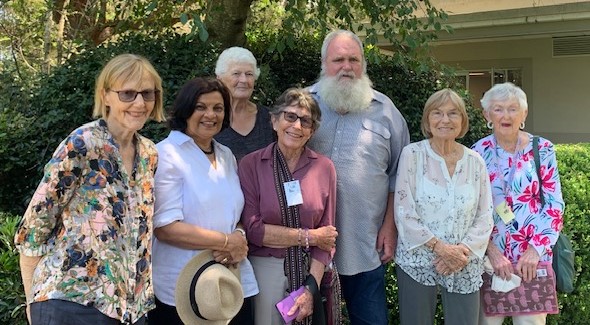
Group photo
left to right: Pip Griffin, Gwen Bitti, Marilyn Humbert, Colleen Keating, Kent Robinson, Beverley George, Maire Glacken

White Pebbles Spring Meeting and Ginko 2023

White Pebbles haiku poets gathered at the Edogawa Gardens at the Gosford Regional Gallery and Arts Centre on Saturday morning, 16th September, 2023. Present were Maire Glacken, Marilyn Humbert, Gwen Bitti, Colleen Keating, Beverley George and Kent Robinson, with apologies received from Samantha Sirimanne Hyde and Michael Thorley.

A glorious spring day greeted us. Ducks and koi carp shared the pond and water features of the gardens. As they fed the ducks, children’s laughter echoed among the beautifully manicured flora. Spring blooms of every hue brightened the walkways.

We met in the Gallery’s cafe for a catch-up before a stroll through the gardens. Over coffee, Marilyn Humbert, advised us that, in order to refine our sense of observation as we strolled, we look into the small spaces – distill whatever we saw, and trust ourselves and our senses as we composed our haiku.  We strolled the garden, feeling the warmth of the spring sunshine on our faces. The scent of blooms bursting all about and the joy of being immersed in birdsong were intoxicating.

Now it was time for a round table meeting in the niche beneath the art gallery. At the beginning of the meeting our dear friend and valued member of White Pebbles, Gail Hennessy, who sadly recently passed, was remembered fondly. The round table about which we gather is extremely significant to our group. Around it we may share ideas and each single poet is as one with all others. How fortunate we feel, that White Pebbles is such a mutually supportive group!

Beverley George distributed for purchase “under the same moon”, the Fourth Australian Haiku Anthology, in which several White Pebbles members have haiku. (Many thanks to Vanessa Proctor for furnishing Beverley with copies of this fine anthology in advance of our meeting.)

Echidna Tracks 11 was spoken of, with congratulations to all White Pebbles poets who feature therein.

We then moved on to the business of the day. Beverley had asked that we each bring a haiku that had inspired us in the early days of our haiku journey, as well as one of our own that we had composed in those early days. Matsuo Basho featured strongly as an early influence to many.

Next, we considered the haiku and images that had been gathered on the garden walk earlier. This proved an extremely productive exercise. Beverley presented some haiku that Michael Thorley had sent in. Thank you, Michael. Your sensitive haiku were a fine addition to our meeting and very much appreciated by all.

Marilyn Humbert had prepared a presentation entitled “The Art of Discovery”. She advised us in composing haiku to observe light and shade at different times throughout the day, different seasons, different weather conditions, different sounds and different moods. And to be aware of the ephemeral things – feathers, stones, bird calls, the shapes of twigs and leaves, tree trunks and bark, rough and smooth. To trust our senses. Helpfully, Marilyn supplied a number of examples of haiku written from different points of view. Many thanks to Marilyn for a most informative and thought provoking presentation.

At this point, towards the end of our meeting, we acknowledged our members who have recently had books published.
* Gwen Bitti has had a novel entitled “Between Two Worlds” published by Ginninderra Press. Gwen spoke of the writing of “Between Two Worlds” and furnished each White Pebble poet with a sachet of fragrant herbs, a snippet of silk and one of hessian to enhance sensory perception, as she spoke.
* Colleen Keating’s carefully researched book, “The Dinner Party” was also published by Ginninderra Press and we enjoyed hearing about it.
* And we recalled that only recently, in 2022, Samantha Sirimanne Hyde’s book “The Lyrebird’s Cry” was published.
Congratulations All!

This concluded the White Pebbles Spring meeting 2023. The general sentiment was all are looking forward to our summer ginko.

Kent Robinson
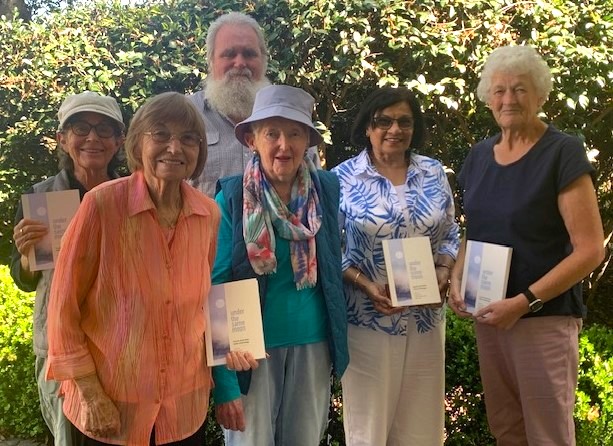
Group photo
Back, L to R: Colleen, Kent; Front, L to R: Beverley, Maire, Gwen, Marilyn


Author: leanneausthaiku

Secretary, Australian Haiku Society

Echidna Tracks Issue 11 Elements and Haiku


Echidna Tracks No 11 has just concluded

Echidna Tracks Issue 11  edited by Gavin Austin and Marilyn Humbert. Thank you to them  for the time and passion for haiku and thanks especially to Lynette Arden  for the  joy Echnida Tracks gives us daily  at 6.30 am as a new gift arrives in our inbox

roosting lorikeets
chatter into the night
moon glow

Colleen Keating

among clouds
spoonbills
sweep the shallows

Colleen Keating

sickle moon—
barefoot around
a crescent beach

Colleen Keating

an ocean
to the other side
refugees

Colleen Keating

Love this direction for The Elements

Whether you are drawn to the ancient categories of Earth, Air, Fire and Water or are more at home with chemistry and current ideas in physics and cosmology; our theme deals with nature in the raw, the fundamentals of existence. Stone, soil, sea, wind and sky come to mind, as do energy, light, matter, electricity, space and time. Perhaps your world is an enchanted one; animated by spirit and containing magical and miraculous elements. You might also be open to the idea that the universe is composed of mind stuff, the stuff of which dreams are made, or is it all a mystery beyond words (though as aspiring poets we shall try). There is scope here to explore our place as thinking, feeling and social beings immersed in immensities and carried along in the flux of it all; the possibilities are endless and go to the heart of haiku. Take us into the heart of your universe, share your visions and wonder – leave us adazzle, quietly reflective and moved in one way or another…

Editors for Echidna Tracks Issue 11: Elements will be Gavin Austin and Marilyn Humbert.


Fourth Australian Haiku Anthology: under the same moon edited by Lyn Reeves, Vanessa Proctor Rob Scott

Today it is exciting to receive this equisite Haiku Anthology, under the same moon  and so proud to  have  three of my hailu included with many well known haikuists.  

‘Alive with birds and frogs, suffused with the threat of bushfires and floods, these haiku sing with the uniqueness of Australian life. The skill on show is breathtaking , as distinctive individul voices lay bare moments of joy, loss, awareness and connection to inner and outer landscapes. ” Esther Ottaway


Colleen Keating   I am excited to have three of my awarded haiku over the past few years published .

on my doorstep
a single rose softens
lockdown

birds and frogs
harmonise at dawn
Kakadu billabong

spring backburn
smells of last summer
waft on the wind

In the blurb on the back cover the well known poet Kevin Brophy writes:  “And just as the butterfly puts so much effort into being light, you’ll wonder, does  the haiku compress or expand the world ?. Does it vanish into its possible meanings or is each haiku, like autumn leaves, competing to be the most strangely beauitful object on the forest floor? “An amazing analogy,  And amazing  how 17 syllables or in the Japanese way 17 beats of sound  can  tell us a cosmic story from the minute nano size story to the universe expanding vision.

An example  of this is from Dr Andrew Hede . His haiku  expresses  the grandness of the moment of experience  ‘virgin forest’  to  the humble minuteness  by  the age read in the time line of growth.
It speaks of the loss of our virgin forests which are disappearing and the reality of the time to grow and the moment of cutting down it with the fresh-cut stump,

virgin rainforest
ninety-four rings
on a fresh-cut stump

Andrew Hede  Page 44.

Below is the back cover with the blurb I qouted from and my page of haiku.

Thank you to the editors for  the new Anthology  for its  beautiful sensitive  presentation and choice of haiku.


Vale haiku by Colleen Keating

Vale Grandma and GGPat

a few new haiku
of loss and sadness while
nature continues to sing

a dim empty room
fragrance of the mock orange
leans in to the space

summer’s golden light
shines from red tips of trees
thawing our winter hearts

spanning a great age
the fallen rock is softened
lush with moss and lichen

shell of a cicada
it chose the blue flower
for its last song

thank you
i believe in angels
nurses and carers


Thank you Grandma for your love and care
all over our growing years.
We knew you always had our back
We will miss that

Now we can only hope
somehow your prayer wheel
will carry on to pray
and you are still there for us
but just in another way

Windfall issue 10 2022 Review by Simon Hanson

Windfall: Australian Haiku, Issue 10, 2022 – Review

The 10th and final issue of the much-loved journal, Windfall: Australian Haiku, was released in January 2022.

Windfall is an annual journal edited by Beverley George and published by Peter Macrow at Blue Giraffe Press. The cover artwork is by Ron C. Moss, with design and layout by Matthew C. George.

Originating in Japan, the popularity of this short poetic genre has spread widely around the globe. Australian interest in haiku dates as far back as 1899 when an Australian haiku competition was conducted(1). Subsequently, in the 1970s, Janice Bostok produced Australia’s first haiku magazine, Tweed(2).

More recently, the Australian journal, paper wasp, ran for 20 years until ceasing publication in 2016 and, with the internet leading to growing interest in the genre, other print and online journals have encouraged and supported the writing of haiku.

For the past ten years, Windfall has focused solely on haiku about Australian urban and rural life, written by Australian residents. These poems have incorporated many elements of our landscapes, seasons, flora and fauna into the haiku form.

spring equinox
over the moonlit creek
a pobblebonk chorus

Mark Miller

leading
into sundown
dingo tracks

Tom Staudt

virgin rainforest
ninety-four rings
on a fresh cut stump

Andrew Hede

Nature haiku such as these enable Australians and others to appreciate images and sounds associated with the birds, animals and plants of this country.

waning moon
in the mangroves
fireflies stir

Maureen Sexton

rising heat
a jabiru crosses
the sun

Cynthia Rowe

winter afternoon —
golden wattle glows
on black sky canvas

Sheryl Hemphill

Windfall has chronicled some of the best Australian haiku for a decade. Issue 10 presents haiku by 63 poets. By my count, 20 of these poets also appeared in Issue 1, which suggests around 40 of the current Windfall poets have emerged in the intervening period. The growing Australian haiku community certainly includes a healthy influx of fresh voices and fresh ideas.

Some poems in Windfall relate to the interaction between nature and the human environment.

opera house steps
a long-nosed fur seal
soaks up the sunshine

Vanessa Proctor

rainforest glade
an empty packet of Smith’s
catches the sun

Nathan Sidney

While others use local flora and fauna to portray aspects of Australian behaviour and culture.

black cockatoos
in tree shadows
he stops treatment

Earl Livings

beachside walk
the roughness of
banksia pods

Nathalie Buckland

dunny
without a door . . .
the Milky Way

Leanne Mumford


Credit for Windfall’s success must go to editor, Beverley George, and to publisher, Peter Macrow. Beverley’s deep knowledge of the haiku form has enabled her to assemble a marvellous selection of Australian haiku for each edition of Windfall, while Peter has supported the journal throughout its life.

Beverley George selected the following haiku to conclude the 10th issue of Windfall. It was a wonderful choice, with the poem capturing a quintessentially Australian scene. But, more than that, the poem does not despair about ending. Rather, the poem celebrates the vitality of birth and renewal.

sheltered paddock
the udder punch
of a newborn

Glenys Ferguson

For ten years, Windfall has made an important contribution in recording the work of Australian haiku poets. Now, we all look to the future.

Review by Gregory Piko

A limited number of back issues of Windfall (No. 4 to No. 9) and of the final issue (No. 10) are available for $10 per copy, postage included. Cash or stamps are welcome, as are cheques payable to Peter Macrow. Please address to:

Peter Macrow
6/16 Osborne Street
Sandy Bay TAS 7005

1) Scott, Rob, “The History of Australian Haiku and the Emergence of a Local Accent,” The Haiku Foundation Digital Library, accessed January 22, 2022

2) Dean, Sharon Elyse , “White Heron: The Authorised Biography of Australia’s Pioneering Haiku Writer Janice M Bostok,” The Haiku Foundation Digital Library, accessed January 22, 2022

Celebrating winter light by Colleen Keating


It was the week before the Winter school break. We decided to come for a few days up the coast before the holiday. We believe the best kept secret is the Winter Beach.
And the past few days are the proof of that . . .
Rugged up and out walking we have enjoyed the soft landing of light on the lake, on the waves, on the birds’ wings, at dawn and at dusk .
The icing for us on our break is the waxing moon and the climax last night of the full moon, called the Strawberry Moon. We walked along the beach by the cold June sea to wait and watch for its appearance like one waits for a much anticipated celebrity. And she did not disappoint. In rich strawberry and cream she rose trailing clouds of salmon-pink, hints of saffron.


And Arvo Pärt seem to be with us as a Spiegle im Spiegle music played in colour and sound along the beach the moon with its golden path shimmering along the ocean dappled and rippled at the edge as the incoming tide gave the sand a mirror effect. Yes many have grappled with this celebration of light, One of my favourite artists JMW Turner is such a one with his paintings that burst with light.

Besides us on the beach was a fisherman,  four giggley girls one who told me she had already taken 200 photos, a few photographers up higher , a few seagull feeding from wet sand and a lone pelican, Michael and me.


Strawberry moon
a pelican and us two
drink-in the pink pool 


across the ocean
winter moon
unites us

our local aurora
light runs across the sky
and into my memory

How can I show we were immersed in a painting. Yes it could be a Turner?

Michael has just read a poem by Jack Cooper who calls himself an ‘observational free verse poet inspired by existence’ and this experience is a celebration for a poet.
as Mary Oliver writes about the take off of a swan across the sky,

And did you feel it, in your heart, how it pertained to everything?
And have you too finally figured out what beauty is for?
And have you changed your life?


Winter Solstice and haiku by Colleen Keating

Monday marks the Winter Solstice.

Leading off, here is a haiku by the 17th Century Japanese poet Matsuo Basho.

Like many haikus, it is deceptively simple: each line enacted by the next.

Winter solitude
in a world of one colour
the sound of wind.


What is the Winter Solstice?

The Winter Solstice has been celebrated for centuries and is the shortest day and the longest night of the year. It’s a time that is known for the sun to stand still before moving forwards to the slow progression of longer days. It has carried strong symbolism and some people refer to it as a rebirth of the sun. Occurring sometime between June 21- 22 June ( December 20 – 22 in the Northern Hemisphere).

It’s a time to honour the darkness and celebrate the light. It’s the perfect time for self reflection, putting yourself on pause and going within to connect to your own darkness and let go. I’m in the process of doing just that. Taking the time out that I need to re-group and letting go of thoughts and beliefs that no longer serve me.

The Winter Solstice doesn’t have to be a dark or somber reflective experience—it can be joyful and lighthearted. Winter festivals, fire and light and social gatherings are all part of it too. Celebrate the birth or return of the light

Here are two winter solstice haiku written by one of the haiku masters

snowflakes flitting down
a winter solstice<
celebration

Issa– translated by David G. Lanoue


winter solstice in Japan
plum trees
in bloom!

Issa – translated by David G. Lanoue


Some of my  own thoughts: 

winter stroll 

a celebration dance

willy wag tail         col


winter stroll 

a canteen of spoonbills

filtering the mud         col


winter blues

only a heron and i 

drink in the light     col

ocean squall

a hawk soars 

in a cold up-draught   col


winter solstice 

my grand-daughter rides her bike 

without training wheels   col


winter solstice 

shadow of light turns

 on the nearby hill     col


the year’s shortest day

the sun breaks the horizon

anew    col

winter beach

winds abrasive dance 

keeps it lonely      col


winter lake

a cormorant hangs his wings 

out on the wind    col

wind chilled air 

cormorants sit brooding 

on every post    col


just another day

three pelicans wait for

return of fishing boats  col


winter solstice 

apples crisp for picking 

in the nearby hills          col

winter warmth

minestrone soup served with 

home-made bread    col


winter drive 

to pick apples

childhood memory             col


winter trees

birdwatching

made weasy     col


family gathering

with food laden table

her last meal            col


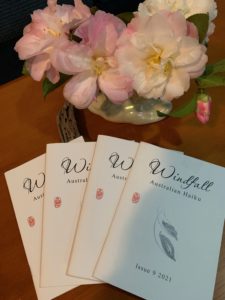
Windfall: Australian Haiku Issue 9 Review by Simon Hanson

A great review of Windfall Issue 9 and I feel very excited to get a mention in the review and feel proud to be mentioed with such good haikuists.

Windfall: Australian Haiku Issue 9, 2021 – Review

Review by Simon Hanson

How fortunate we are  to have a journal like Windfall: Australian Haiku, showcasing as it does, the best of Australian haiku— bringing together familiar and new voices (and the new voices are exciting). This issue, like those before it celebrates many and varied aspects of Australian life in its country, coastal, urban and domestic settings accompanied by a host of perceptive observations around season, landform, flora and fauna and the lives of people.

we slow our stroll
to another time
outback town

Glenys Ferguson

perching magpie
the blackened stump
seamed with ash

Gavin Austin


In reviewing any journal or anthology one is invariably faced with the task of singling out particular poems for mention. There is some discomfort in doing this, made all the more acute in this instance given the quality of the entire collection. Let it be said that one could happily include any of the haiku presented in this issue as worthy of mention here. The inclusions I make here are a means of indicating something of the range of subject and style to be found in the whole issue— and a wonderful issue it is. The real task of selection has of course been done by its editor, Beverley George, choosing and sequencing 63 haiku from some 560 submitted poems, the size of the journal inevitably limiting the number of acceptances to the most outstanding haiku from the many received. We may be assured that the entire process of editing is heartfelt and undertaken with much thought and feeling over many, many weeks— as has been the case with each issue over the past nine years— what a contribution to our haiku community.

colour splashed
on a grey day canvas . . .
rainbow lorikeets

Gwen Bitti


warm breeze from south west
the main and jib on hard
beating to the mark

Brian English

An editor does far more than select and organise work for any given issue.  The challenge and value of quality editing is not only to give the published poets a recognised voice but to produce a publication which offers reader enjoyment and a large measure of inspiration for further creativity. Come June and July each year many of us turn our minds to Windfall: Australian Haiku, becoming perhaps a little more attuned than usual to the “…experience of urban and rural life in Australia…”. In revisiting past issues, we might gather amongst other things a sense of what might appeal, refreshed again by the creativities of others. Of course there is the occasion of ‘that moment’behind what we do in writing haiku, but I know also— there are many haiku that are written because of Windfall. Poets only partly own their creations, much of what we do is done with others in mind and always in the larger context of the broader culture of art and poetry, local and further afield, current and historical— and for this I am grateful.

autumn stroll,
on the cement footpath
a gum leaf’s imprint

Samantha Sirimanne Hyde

outdoor pot plants
a sunshower
from the watering can

Judith E. P. Johnson

There are haiku here that speak deeply to the heart, move us in their poignancy.

op shop –
all the teddy bears
sold out

Lyn Reeves

I watched that day
her last walk by the beach
. . . ebbing tide

Colleen Keating

Others of a lighter note add a touch of humour, yet we recognise them as authentic, set in familiar circumstances.

beach picnic
a dog races past with
a ball in its grin

Norma Watts


country show
the pink stickiness
of a child’s smile

Glenys Ferguson

There are those that speak of deep time and turn our minds to the spirituality of this land and the ancient cycle of seasons

red river gums –
guardians of stone stories
in dry hollows

Susan Grant

frog chorus
the rhythm of raindrops
on the pond

Maureen Sexton

And some that may leave one agasp for their sheer beauty

snowy eve
amid cloud tatter
cold stars gleam

Kent Robinson


wood duck
cracking ice puddles
pink dawn

J L Penn

Then there is this gem that in so few words, brings home once again the fleeting nature of things, the passing of time, as the years flash by, evermore quickly so it seems.

in a puddle
for this moment
fast train

John Low

Windfall: Australian Haiku is literally pocket or handbag sized. It couldn’t be easier to take on the bus or train, to the park or garden bench, or when visiting friends. In fact, to take anywhere. With a handsome cover created by Ron C.  Moss, the whole booklet beautifully designed and laid out by Matthew C. George and the whole enterprise so ably managed and published by Peter Macrow for his Blue Giraffe Press. And as a nice touch the inside back cover lists an annually updated list of recent Australian Haiku Titles.  Pocket sized yes, but huge on stature.

The next issue of Windfall will be the last— it will mark ten years as one of our premier haiku journals; an Australian treasure; something to celebrate…

Simon Hanson
Secretary, Australian Haiku Society