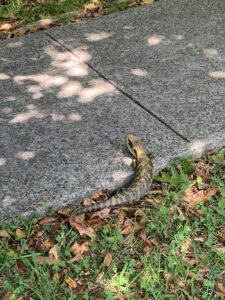
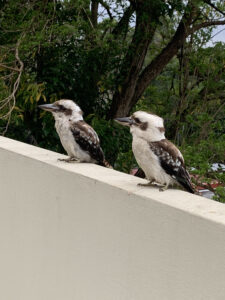
his tiny handprint remains
on my coffee table


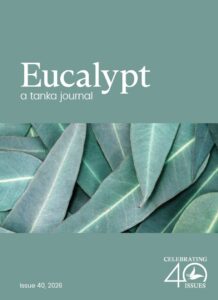
i am honoured to have my tanka on Presence accpted and published in Eucalypt 40 th edition. im. Stephen Matthews
Tnank you to the very experienced editor Julie Thorndyke for her dedication to our tanka and to poetry.
Dear Colleen,
Thank you for your submission to Eucalypt 40, which closed on 31 March 2026.
I have pleasure in accepting the following poem

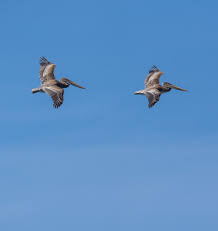
outside the window
as we launch his final book
pelicans circle . . .
no one questions
his presence with us
Colleen Keating
Thank you once again for sharing your tanka with Eucalypt readers.
Julie Thorndyke, editor
To celebrate issue 40 of Eucalypt we have a lovely, refreshed cover design by Matthew George, and a new website to bring together
in one convenient place all the information, e-newsletters, links and scribble award poems.
Twenty years of tanka poetry in a printed journal is a milestone to celebrate.
Eucalypt is going strong and we look forward to another decade of beautiful, original, and timeless poems expressing the wide range of human emotions.
Glad to have you along for the journey!


Feeling very honoured to have my poem Crow included in the latest copy of Australian Poetry Collaboration . Thank you to the editors Lynn Clayton & Les Wicks for their dedication to poetry and poets and for a new fine journal.
Crow
it spoke in three syllable words
sharp, dogmatic
i understood crow dialect
but didn’t agree
ignored its marbling eye
its glassy glare
noted its clawed determination
its groomed coat
of arrogance
now its mortal reality was too much
so I flew off
Hi Colleen,
Thanks for sending your work. We would like to use Crow. You will be contacted later with proofs.
Please send a max 50w bio by 24th May.
Regards
Lynn Clayton & Les Wicks (editors)
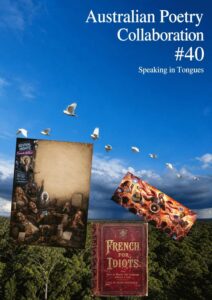
The 40th issue of Australian Poetry Collaboration is now up at https://meusepress.org/apc
The focus for this issue is the very broad “speaking in tongues”. It contains work from a number of newer voices alongside globally recognised poets.
Editors: Lynn Clayton & Les Wicks
For those interested in name similarities, the first issue emerged in 1999. Well before Australian Poetry, its predecessor Australian Poetry Centre & the magazine Australian Poetry Journal.
In its time APC has published work in a host of languages chosen by a diverse range of editors.
It has been recognised & preserved as a part of our nation’s cultural heritage by the National library’s Pandora project while it continues to reach a substantial audience.
There is an open callout for submissions policy, stating theme. Issues usually twice per year.
contact: [email protected]

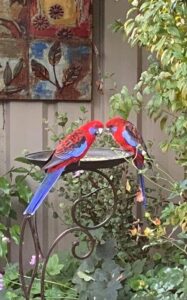
only this matters: this ecstatic baptism this standing on stick- thin legs where the singing creek pools at the lip of the waterfall only this ruby-feathered chest diving to meet its reflection this beak piercing again and again that quivering surface, these wings half- unfolding, a ruffle of joy guiding rivers of light a tumble of droplets dressed in rainbows along your hidden spine shattering all decorum beneath blue branches in quiet assent. . . How could we resist “…a ruffle/ of joy guiding rivers/of light…”? I don’t want to resist it! Thank you for being with me here. I found this ectasy poem in Ivan Granger’s “The Longing in Between”. My copy is always nearby. Share generously. Thanks to Dr Stephanie Dowrick for her initiative in giving us a poem a day for 2026 and for finding this poem to share with us.

I always like to pick up fresh hints to assist me to remember to live fully each day and as much as possible in the present moment.
Here is my latest:
Let morning be your favourite part of the day
Be productive and pleasant
Be fabulous
Let ‘happy’ widen your vision
Here are a few ideas to get you started

Soothing Breath Practice
You can practice it anytime you notice stress or anxiety coming up for you. If you pay attention, you can notice it a couple dozen times a day: you’re feeling anxious about a meeting, a conversation, a difficult task, answer an email, all the things you have to do, an upcoming deadline, an upcoming trip, etc etc.
Anytime you notice even a bit of anxiety or stress, here’s how to practice:
The verse novel Hildegard of Bingen: A Poetic Journey by Australian poet Colleen Keating uses biographical poetry
to bridge medieval history with contemporary ecological spirituality.
By retelling the saint’s life across 100 chronological poems, the book focuses heavily on Hildegard’s concept of viriditas
(the divine “greening” and interconnected power of nature). It has evolved from a literary work into a functional tool used
in both European pilgrimages and American research.
1. Use in Local Pilgrimage
The verse novel is highly integrated into the culture of the Hildegard of Bingen Pilgrimage Way (Hildegard von Bingen Pilgerwanderweg),
a 140-kilometre trail in Germany that runs from Idar-Oberstein through the ruins of Disibodenberg to Eibingen.
2. Use in US Academic Research & Eco-Spirituality
In the United States, the verse novel is utilized across academic and clinical research circles focused on medieval literature, feminist theology,
and ecological psychology:
Some example
Australian author Colleen Keating’s biographical novel/poetry collection, Hildegard of Bingen: A Poetic Journey, the author maps
Hildegard’s life backward, capturing her transition from her later life as a magistra back to her early, hidden years.
The poems focusing on her time at the Disibodenberg monastery dive into her profound connection to viriditas
(the greening power of God) and her struggle to reconcile her stifling, early monastic life with her vibrant visions.
Specific poems and themes that explore her time at Disibodenberg include:
1. “Last Swallows” (The Anchorage Era)
2. “Voice of the Living Light” (The Seeds of Vision)
3. “Ordo Virtutum” (The Greening Through Music)
Colleen Keating’s lyrical storytelling captures how Hildegard’s quiet, oppressed decades at Disibodenberg ultimately
acted as fertile soil—the necessary viriditas incubation period—for her later life as a celebrated visionary, composer, and mystic.
You can read excerpts of these poems and find out more about the collection on the Colleen Keating Poet Official Website. [1]
Written by Colleen Keating with the help of AI
A Journal of Australian & International Cultural Reviews, News and Criticism.

Ring the Bells by Colleen Keating, Ginninderra Press 2025
With great enthusiasm I read Colleen Keating lastest book Ring the Bells because I am aware that she is a brilliant writer. I was not disappointed, this book rings many bells, and each of them touches a part of the reader’s heart and soul. Let me tell you why …
Ring the Bells contains an ‘Introduction’ and four sections titled ‘Embracing Light’, ‘Dark’, ‘Life’ and ‘Love’. In the Introduction the poet explains that bells are significant to her because she loves the idea that ringing bells signify times of joy.
‘Embracing Light’, is a section of the book in which Keating turns the great and small events of life like love, death, drinking coffee in an old cup, or the mystery of a moth into poetry. With enlightening words the poet finds one good thing in the darkest of events. Like in the following poem titled: “resurrection” (the poet did not use capitals letters as a good post-post poet.)
from the dark mysterious swamp
thick with paperbarks lantana and lilieslike a freight train cutting
through air in a country towncloser like individual carriages
clanking pastcloser still. Rumbling
breaking into distinctive croaksyes the swamp is thickly alive
with a merriment of frogsa bass chorus carousing courting
chatting all excited to have ascendedwith the rain
from an underbelly secret world
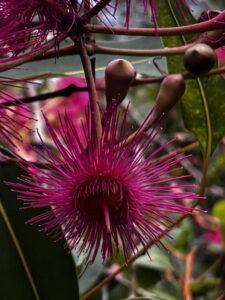
Another of Keating’s skills is the way she poetically describes art, or a Norham Castle, or plants, ferns, mossy outcrops or lanterns of red fuchsias.
It excited me to know that Keating has a close relationship with tress like I do; yes! Think what you like but trees talk to me! In Keating’s case she is invited to caress them, like she describes in the following poem titled “my oracle”:
i visit a special tree
a regular confidante
and ponder
what this new year may bringrooted in place
sturdy strong
calm today
it gazes upwards
and out over the valley
as if it could see
far beyond our horizon
one thing was differentlast visit its trunk was pink
sleek inviting my hand to run
across its smooth dimply skin
today its trunk. Rough
its bark splitting shedding
peeling in strips and curls
burnished as a rusty drum
exposing chartreuse rawness
i square my shoulders stand tall
nod understanding
and thank tree wisdom
for its perfect message
In the second part of Ring The Bells the poet’s creativity is not only evident in her words but also in the style and settings of her poems. In this section we encounter poems about war and other maladies like the abuse of earth and children as well as reflections on how nowadays life impacts us.
It is obvious from the third section of the book titled ‘Embracing Life’ that the poet loves and breathes nature. Each moment in time close to nature the poet turns it into an epiphany. I hope dear reader that you don’t assume that Ring The Bells only contain inspirational and serious poems, no you will find humour as well.
The last section of the book ‘Embracing love’ is very deep and poignant. Keating introduces the chapter with the following tercet:
with family all around
my heart reaches out
to the one missing
I could say so much about this section which with beautiful and inspiring poetry expresses many philosophical thoughts and makes us realise that even with the death of someone we love we can find comfort in even perhaps the simplest of things like smelling flowers in a garden.
Colleen Keating is among the most illustrious and excellent writers and poets, it was an honour for me to review her book. Beautiful, inspirational, true to life, I enjoyed reading every poem. I highly recommend buying and reading Ring the Bells.
– Beatriz Copello
Dr Beatriz Copello is a well-known reviewer, writer and poet, she is also known for her sense of humour. “Her poems are sensuous, evocative and imaginative. Beatriz Copello is one of Australia’s foremost poets,” wrote Julia Hancock, Ex-Editor of Allan and Unwin and Freelance editor and journalist. Copello’s poetry books are Women Souls and Shadows, Meditations at the Edge of a Dream, Flowering Roots, Under the Gums Long Shade, Lo Irrevocable del Halcon and Renacer en Azul (In Spanish), Witches Women and Words, Rambles and No Salami Fairy Bread. Her poetry has been published in literary journals such as Southerly and Australian Women’s Book Review and in many other print and Electronic Publications. Fiction books by author are: A Call to the Stars, Forbidden Steps Under the Wisteria and Beyond the Moons of August (Her Doctoral Thesis).
Ring the Bells by Colleen Keating is available from https://ginninderrapress.com.au/ product/ring-the-bells-b/

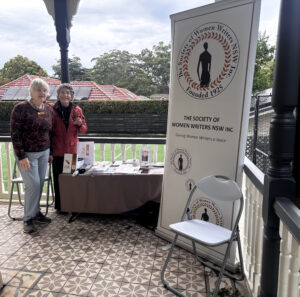
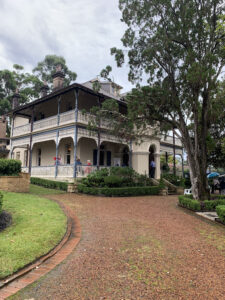
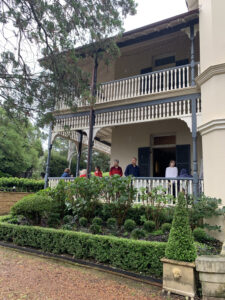
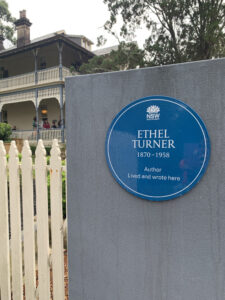
Proud today to represent our Society of Women Writers NSW at ‘Woodlands’ the home of
Ethel Turner and where she wrote Seven Little Austalians.
I joined Our Co-presidents Pippa and Liz and members Terese and Daniella Jones. at the Annual Heritage day
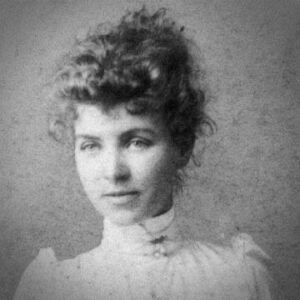
to give honour to Ethel Turner, a founding member of of our society 100 years ago, which we celebrated last year 1925 – 2025.
What a great year we had.
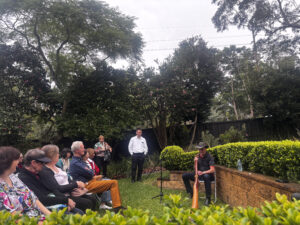
I think Ethel Turner would’ve loved to experience the Smoking Ceremony and the playing of the Didgeridoo in her garden.
Remember she stood up to the English publishers who wanted to take out the Aborigine stories she had in her novels, refusing
to remove them and insisting also the Australian idioms were not to be changed to suit the English readers .
As we have leant Ethel Turner was ahead of her times in recognising the lives, cultures and origins of First Nations People.
Featured also was Abbey Lane with her wonderful Ethel Turner energy, Susannah Fullerton, and a talk with Peter Poole,
Ethel Turner’s Great grandson.

Today a didgeridoo laying in the garden

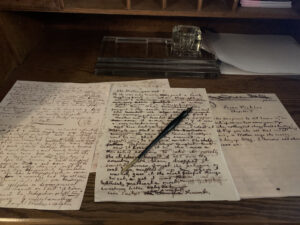
Ethel Turners desk and her writing 1925


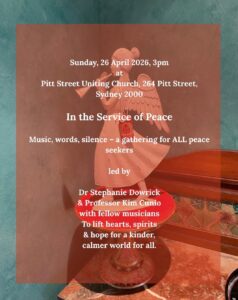
Music, words, silence – a gathering for all peace seekers
led by
Dr. Stephanie Dowrick & Professor Kim Cunio
To lift hearts, spirits and hope for a kinder, calmer world for all.

Peace IS the way.
The only way if we truly care about people, planet and especially the worlds’s children.
Our efforts matter to the world they will inherit.

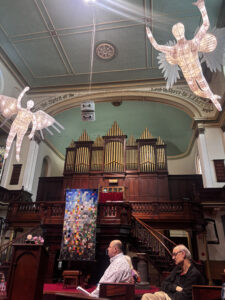
It was a perfect autumn day to travel by train into Pitt Stree Uniting Church for the service.
It was affirming to gather with many other peace seekers for an experience
of sublime music, words from the universal traditions,
time for quiet and twice time for standing and greeting the people around us.
We were caught hypnotically by the music and the readings it worked for both of us .
We left to travel back home with a new seed planed
of peace in our own hearts. There was a new and renewed calmness in both us.

“Peace be with you” There were the first words the risen Christ spoke to his disciples –
words which feel especially important as conflict continues around the globe.
Event at the Pitt Street Uniting Church Stephanie Dowrick 3- 4.30pm.
by Michael Keating
This was a surprisingly rich experience. I found myself physically and mentally involving myself. Unfortunately I had forgotten, at the last, to take my recycled scribble sheets, so here I am trying to bring back some ideas that permeated a meditative state. Colleen has been sharing the Stephanie Dowrick Poem-a-Day from her Facebook as they arise.
I immersed myself in the general ambience of the ‘liturgy’. Stephanie specifically distanced us from the idea that it was liturgical, however I cannot, at present, think of a clearer terminology for myself.
The music was excellent. The vocalists were captivating. The readings (from various belief frameworks) were too numerous and thus too hard to follow – they also needed more context. Fewer readings, read slower and with appropriate pauses would have helped. The only reading I recognised was Wordsworth’s ‘trailing clouds of glory’. However the ambience was such that the readings sort of fitted in well enough.
The following often-quoted maxim on mindfulness came clearly into my mind.
“Watch your thoughts, they become your words;
watch your words, they become your actions;
watch your actions, they become your habits;
watch your habits, they become your character;
watch your character, it becomes your destiny”
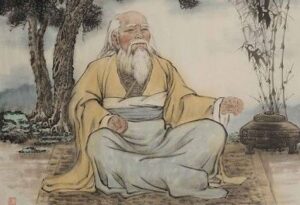
is a popular, often-quoted maxim on mindfulness. It highlights that internal thoughts shape external reality, usually attributed to Lao Tzu.
Lao Tzu: There is no record of this specific sequence in the Tao Te Ching or other classical texts.
The attribution likely grew because the quote’s focus on mindfulness aligns with Taoist philosophy.
Somewhere we have a laminated copy of this maxim, better set out. It will come to light at some later date.
At two points the congregation (mainly mature women and a sprinkling of men) was asked to standup and greet their neighbours.
I was surprised how gracious these were. The group seemed to mainly regular attendees (not necessarily locals)
and invitees through Stephanie Dowrick’s Facebook (or other) contact.
One of the women chatted to us afterwards and alerted us to the quality of of the Jesuit parish at
St Canice’s Parish Church Potts Point.

Lao Tzu
=

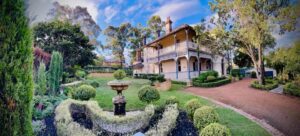
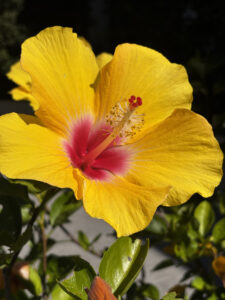
The Autumn Garden
You could think I have my head in the sand
that I am in denial of the world
that I am escaping the noise of reality
to let my garden coax me out to wander here
to stop and capture images
to gaze with a breathtaking gasp
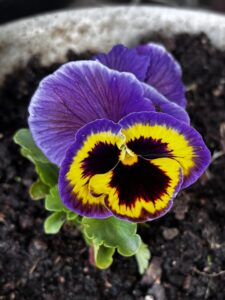
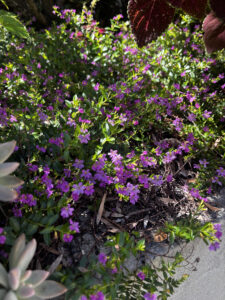
at a nodding purple pansy
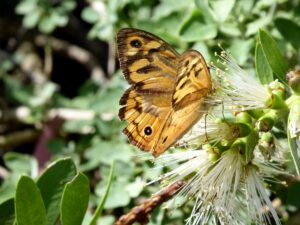
and here I am following the curiosity of an orange-
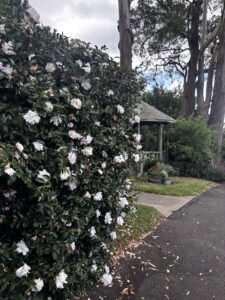
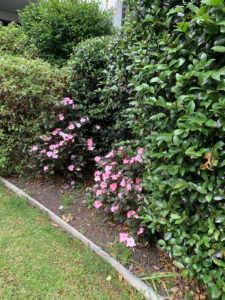
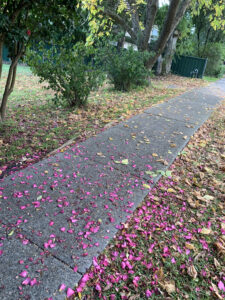
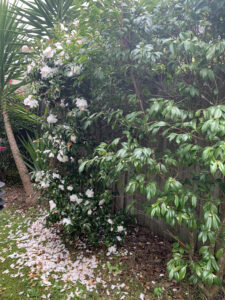
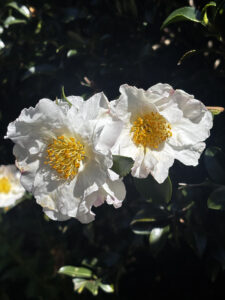
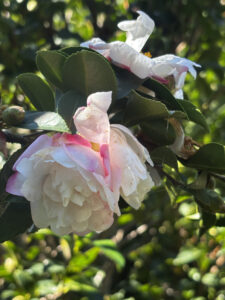
brown butterfly in the sasanqua blooms
and a gold-striped bee nestling like a lover
into the crux of a flower
it is hard to fathom here that the earth community
is in such dire circumstances and that the world
as a garden is a distant almost impossible dream.
Yet here hope for humanity sings with cyclic miracles
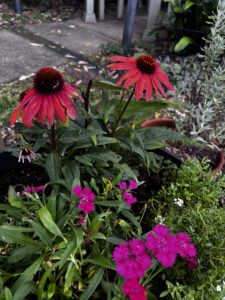
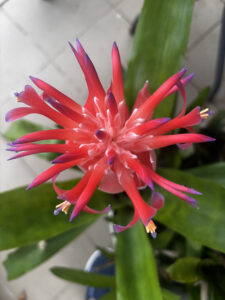
and the bright red echinaeca stand witness to some
gifted seeds planted and forgotten a few months back.
Colleen Keating