Winter Solstice and haiku by Colleen Keating

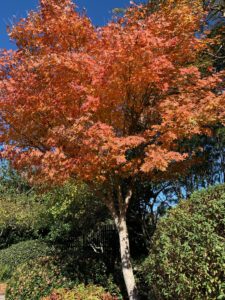
Monday marks the Winter Solstice.

Leading off, here is a haiku by the 17th Century Japanese poet Matsuo Basho.

Like many haikus, it is deceptively simple: each line enacted by the next.

Winter solitude
in a world of one colour
the sound of wind.


What is the Winter Solstice?

The Winter Solstice has been celebrated for centuries and is the shortest day and the longest night of the year. It’s a time that is known for the sun to stand still before moving forwards to the slow progression of longer days. It has carried strong symbolism and some people refer to it as a rebirth of the sun. Occurring sometime between June 21- 22 June ( December 20 – 22 in the Northern Hemisphere).

It’s a time to honour the darkness and celebrate the light. It’s the perfect time for self reflection, putting yourself on pause and going within to connect to your own darkness and let go. I’m in the process of doing just that. Taking the time out that I need to re-group and letting go of thoughts and beliefs that no longer serve me.

The Winter Solstice doesn’t have to be a dark or somber reflective experience—it can be joyful and lighthearted. Winter festivals, fire and light and social gatherings are all part of it too. Celebrate the birth or return of the light

Here are two winter solstice haiku written by one of the haiku masters

snowflakes flitting down
a winter solstice<
celebration

Issa– translated by David G. Lanoue


winter solstice in Japan
plum trees
in bloom!

Issa – translated by David G. Lanoue


Some of my  own thoughts: 

winter stroll 

a celebration dance

willy wag tail         col


winter stroll 

a canteen of spoonbills

filtering the mud         col


winter blues

only a heron and i 

drink in the light     col

ocean squall

a hawk soars 

in a cold up-draught   col


winter solstice 

my grand-daughter rides her bike 

without training wheels   col


winter solstice 

shadow of light turns

 on the nearby hill     col


the year’s shortest day

the sun breaks the horizon

anew    col

winter beach

winds abrasive dance 

keeps it lonely      col


winter lake

a cormorant hangs his wings 

out on the wind    col

wind chilled air 

cormorants sit brooding 

on every post    col


just another day

three pelicans wait for

return of fishing boats  col


winter solstice 

apples crisp for picking 

in the nearby hills          col

winter warmth

minestrone soup served with 

home-made bread    col


winter drive 

to pick apples

childhood memory             col


winter trees

birdwatching

made weasy     col


family gathering

with food laden table

her last meal            col


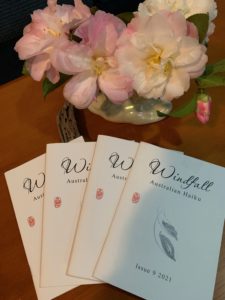
Windfall: Australian Haiku Issue 9 Review by Simon Hanson

A great review of Windfall Issue 9 and I feel very excited to get a mention in the review and feel proud to be mentioed with such good haikuists.

Windfall: Australian Haiku Issue 9, 2021 – Review

Review by Simon Hanson

How fortunate we are  to have a journal like Windfall: Australian Haiku, showcasing as it does, the best of Australian haiku— bringing together familiar and new voices (and the new voices are exciting). This issue, like those before it celebrates many and varied aspects of Australian life in its country, coastal, urban and domestic settings accompanied by a host of perceptive observations around season, landform, flora and fauna and the lives of people.

we slow our stroll
to another time
outback town

Glenys Ferguson

perching magpie
the blackened stump
seamed with ash

Gavin Austin


In reviewing any journal or anthology one is invariably faced with the task of singling out particular poems for mention. There is some discomfort in doing this, made all the more acute in this instance given the quality of the entire collection. Let it be said that one could happily include any of the haiku presented in this issue as worthy of mention here. The inclusions I make here are a means of indicating something of the range of subject and style to be found in the whole issue— and a wonderful issue it is. The real task of selection has of course been done by its editor, Beverley George, choosing and sequencing 63 haiku from some 560 submitted poems, the size of the journal inevitably limiting the number of acceptances to the most outstanding haiku from the many received. We may be assured that the entire process of editing is heartfelt and undertaken with much thought and feeling over many, many weeks— as has been the case with each issue over the past nine years— what a contribution to our haiku community.

colour splashed
on a grey day canvas . . .
rainbow lorikeets

Gwen Bitti


warm breeze from south west
the main and jib on hard
beating to the mark

Brian English

An editor does far more than select and organise work for any given issue.  The challenge and value of quality editing is not only to give the published poets a recognised voice but to produce a publication which offers reader enjoyment and a large measure of inspiration for further creativity. Come June and July each year many of us turn our minds to Windfall: Australian Haiku, becoming perhaps a little more attuned than usual to the “…experience of urban and rural life in Australia…”. In revisiting past issues, we might gather amongst other things a sense of what might appeal, refreshed again by the creativities of others. Of course there is the occasion of ‘that moment’behind what we do in writing haiku, but I know also— there are many haiku that are written because of Windfall. Poets only partly own their creations, much of what we do is done with others in mind and always in the larger context of the broader culture of art and poetry, local and further afield, current and historical— and for this I am grateful.

autumn stroll,
on the cement footpath
a gum leaf’s imprint

Samantha Sirimanne Hyde

outdoor pot plants
a sunshower
from the watering can

Judith E. P. Johnson

There are haiku here that speak deeply to the heart, move us in their poignancy.

op shop –
all the teddy bears
sold out

Lyn Reeves

I watched that day
her last walk by the beach
. . . ebbing tide

Colleen Keating

Others of a lighter note add a touch of humour, yet we recognise them as authentic, set in familiar circumstances.

beach picnic
a dog races past with
a ball in its grin

Norma Watts


country show
the pink stickiness
of a child’s smile

Glenys Ferguson

There are those that speak of deep time and turn our minds to the spirituality of this land and the ancient cycle of seasons

red river gums –
guardians of stone stories
in dry hollows

Susan Grant

frog chorus
the rhythm of raindrops
on the pond

Maureen Sexton

And some that may leave one agasp for their sheer beauty

snowy eve
amid cloud tatter
cold stars gleam

Kent Robinson


wood duck
cracking ice puddles
pink dawn

J L Penn

Then there is this gem that in so few words, brings home once again the fleeting nature of things, the passing of time, as the years flash by, evermore quickly so it seems.

in a puddle
for this moment
fast train

John Low

Windfall: Australian Haiku is literally pocket or handbag sized. It couldn’t be easier to take on the bus or train, to the park or garden bench, or when visiting friends. In fact, to take anywhere. With a handsome cover created by Ron C.  Moss, the whole booklet beautifully designed and laid out by Matthew C. George and the whole enterprise so ably managed and published by Peter Macrow for his Blue Giraffe Press. And as a nice touch the inside back cover lists an annually updated list of recent Australian Haiku Titles.  Pocket sized yes, but huge on stature.

The next issue of Windfall will be the last— it will mark ten years as one of our premier haiku journals; an Australian treasure; something to celebrate…

Simon Hanson
Secretary, Australian Haiku Society
White Pebbles Haiku Group : Winter Ginko 2021

White Pebbles Haiku Group Winter 2021


At our Seasonal  –  Winter Meeting. The Edogawa Commemorative Gardens, East Gosford.

How lucky are we to have this beautiful Japanese gardens adjacent to the vibrant Gosford Regional Gallery. With its white pebbled garden, raked in swirls around feature rocks, it’s Monet style bridge, traditional Tea House, pergola and wonderful topiary of trees and shrubs and we  have a few hours each new season to walk in its peace and tranquillity and using the technique of REGARDE, REGARDE and of course listening and jotting down our observtions to share with the group. And especially a wonderful group convened bythe renowed and award winning haikuist,  Beverly George .

* * * * * * * * * * * * * * * * * *


BEVERLEY WROTE :

At our winter meeting the seven members who attended were joined by two welcome guests, Carol Reynolds and Margaret Mahony. Another member, Samantha Hyde, although unable to be present, sent a completed worksheet well ahead of time and we were glad to include her valued poetry in our workshopping session.

As always we met at 10 a.m. for coffee and informal chat before heading off at precisely 10:30 on our ginko. The weather was cold but fine and the garden so delightful to view from the many aspects its winding pathway affords. A large Japanese maple stirring in the breeze drew the attention of every poet.

Ginko completed, we gathered at the round table in a downstairs room of the gallery premises, so glad to be in each other’s cheerful company. To start our meeting, we asked Margaret Mahony to read aloud a haiku which had appeared on Echidna Tracks that morning, which, accompanied by an apt photograph by Gavin Austin, fitted so well with the koi activity we had just seen in the pond fringed by white pebbles.

autumn deepens
a splash of orange
in the fishpond

Louise Hopewell
(Echidna Tracks, Issue 7)

Brief business of the day included announcing that the closing date of the 13th Yamadera Bashō Memorial Museum English Haiku Contest has been extended this year until August 31st. Six White Pebbles poets had work published in the 12th Contest Collection. (This remarkable Museum is one I visited with 12 Australian friends in 2010 and the curator, Noboru Oba-sensei is still in touch from time to time to remind Australian poets of the contest.)  We also shared recent news of work on Echidna Tracks and remembered that Windfall: Australian Haiku issue 10 (the final one) will be open for submissions in July. More news about Windfall will appear on the Australian Haiku Society web-site very soon.

Our worksheet for this meeting included a brief haibun and three haiku prompted by today’s ginko: The haiku topics were white pebbles or rocks; a seasonal haiku that doesn’t mention the word ‘winter’; something we are hearing. The request for each person to bring a favourite haiku by Bashō sparked enjoyable listening and a relevant discussion about the varying subtleties and differences of translations.

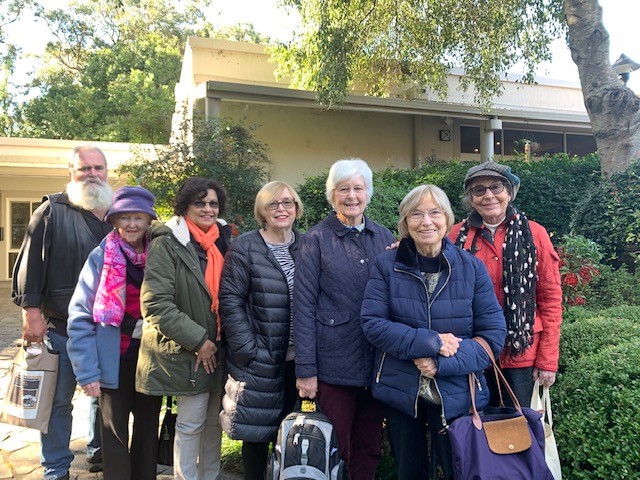
Time went by so fast and unfortunately by the time we thought about a group photograph two of our busy members, Marilyn Humbert and Verna Rieschild, had just left. However here are the rest of us, in a photograph kindly taken by Deb Robinson.

left to right: Kent Robinson, Maire Glacken, Gwen Bitti, Margaret Mahony, Carol Reynolds, Beverley George, Colleen Keating

Report by Beverley George
Convenor White Pebbles Haiku Group

Strands and Ripples by David Atkinson to be launched by Colleen Keating


A great privilege to be asked to launch David Atkinson’s second book of poetry Strands and Ripples, published by Ginninderra Press.  To be launched on Sunday 11 July 2021.

Scan_0105

page1image3513371616
‘In this, his second collection, David Atkinson continues his themes of memory, especially of growing up on a farm in southern NSW, and the natural world, including the wildlife and people that surrounded him then and do so now. In this collection David’s scope is also wider as he extends our perspectives on the human condition. His poems are sharp in their imagery and dramatic in their language. His forms range from the traditional to the stunning use of free verse. This book is highly recommended.’ – John Egan
‘David Atkinson enables us to see things in a new light. Every theme in this collection of poetry challenges us to let him show us aspects of life from a fresh perspective. Widely published in literary journals nationally and internationally, David’s poetry always repays a careful reading. It is with enthusiasm that I welcome this new collection.’
Colleen Keating
‘David Atkinson’s latest collection is a cornucopia of the poetic spectrum; it confirms that he is one of Australia’s finest poets. David brings a deft touch to the human condition, celebrates the wonders of nature and takes a fresh look at memories. This is a worthwhile addition to any bookshelf.’ – Decima Wraxall
David Atkinson is a retired lawyer who lives in Sydney. His poems have been published widely in Australia, the USA and the UK. David’s previous collection, The Ablation of Time, was published, also by Ginninderra Press, in 2018. He is a poet of memory, the human condition and the natural world.
978 1 76109 108 7, 120pp
Now up on the web site and for sale. Highly recommended

Versions

Paperback

9781761091087
$25.00


Eucalypt: A Tanka Journey celebrating 30 issues by Colleen Keating


Exciting to receive the latest Eucalypt: A Tanka Journal in the mail.  This month celebrating 30 issues of Tanka.

(Beverley George always  acclaimed for the first 20 issues.)

Thank you to the editor, Julie Thorndyke and congratulation on her very creative and thoughtful presentation of our tanka. Proud to see my name twice and feel privileged being included in every Eucalypt since I began writing Haiku and Tanka . . . the succinct intimate Japanese form of poetry.

Julie has her own new collection of stories Divertimento: Stories by Julie Thorndyke publ. Ginninderra Press 2021,  just recently published by Ginninderra Press so this is double congratulations  to her.  Julie spoke at Society of Women Writers of NSW last meeting  in Member Bites 

Ginninderra Press sends us exciting mail


You have Mail

How exciting, double exciting,  to receive two emails one after the other, from the award winning publisher Stephen Matthews OAM  at Ginninderra Press regarding our poem entries for  Ginninderra Press’ new anthology Milestones. 

Michael and I are both  thrilled to have our poems:  

cherishing the moments by Colleen Keating

Reset by Michael Keating 

selected for inclusion.

Hello Michael,

Thank you for submitting a poem for inclusion in our 25th-anniversary anthology Milestones. I’m delighted to inform you that your poem has been selected for inclusion in the book. In due course, you will receive a proof to check before publication. Covid permitting, we hope to launch the book later this year.

Regards,

Stephen

Hello Colleen,

Thank you for submitting a poem for inclusion in our 25th-anniversary anthology Milestones. I’m delighted to inform you that your poem has been selected for inclusion in the book. In due course, you will receive a proof to check before publication. Covid permitting, we hope to launch the book later this year.

Regards,

Stephen

(Stephen Matthews  and yours truly at the launch of Mountain Secrets)


Just reflecting . . .

I have been priveleged to have a poem in each of these past Anthologies :

Michael after reading a poem at the Writers Festival in May 2018 at Varuna Writing Centre Katoomba

in the autumnal beauty of the Blue Mountains NSW

The Crow edited by Joan Fenney


I am thrilled to have one of my recent poems  written this last February called Australia Day chosen to be in the next  poetry journal from South Australia called The Crow. Thank you to the editor Joan Fenney for creating this space for Australian poets.  

The Crow is published  biannually – June and December. by Ginninderra Press. Another initiative of the wonderful team there. Thank you Stephen Matthews OAM 

Crow – Ginninderra Press 

Joy Harjo – by Colleen Keating, a Paper prepared for U3A

Joy Harjo

Joy  Harjo is  an American Poet.

She is an internationally renowned performer and writer of the Muscogee (Creek) Nation. 

She is the incumbent Poetic Laureate of United States serving her second term as the 23rd Poet Laureate.

She is the first American Native Indian to be poet Laureate.

She is a musician and saxophonist  and mixes her poetry and music beautifully.

Joy embraces the world .

Her poetry embraces the world every sky sea and stone.

She is an autobiographic poet, informed by the natural world 

 with a cry for the survival of her people and our earth and 

transcend the limitation of words. 

Her poetry inhabits landscape and centres around the need for

 remembrance and transcendence.

 She lives in Tulsa, Oklahoma.

Accolades

She is so well known in America with so many honours 

include the Lifetime Achievement Award from the Native Writers Circle of the Americas, the Josephine Miles Poetry Award, the Wallace Stevens Award the William Carlos Williams Award and the American Indian Distinguished Achievement She has received fellowships from the Arizona Commission on the Arts, the National Endowment for the Arts, the Rasmuson Foundation, and the Witter Bynner Foundation and the Guggenheim award. In 2017 she was awarded the Ruth Lilly Prize in Poetry.  

author of nine books of poetry, including the highly acclaimed An American Sunrise,

She is Exec­u­tive Edi­tor of the anthol­o­gy When the Light of the World was Sub­dued, Our Songs Came Through — A Nor­ton Anthol­o­gy of Native Nations Poet­ry and the editor of Living Nations, An Anthology of First Peoples Poetry, the companion anthology to her signature Poet Laureate project. 

She is a chancellor of the Academy of American Poets, 

Board of Directors Chair of the Native Arts & Cultures Foundation,

and holds a Tulsa Artist Fellowship

Influences

She read the bible a lot

 Pablo Neruda she loved for his integrity to his human beingness 

African poets especially Uganda poet Oket p’ Bitek 

Gwendolyn Brooks

 Audre Lorde (poetry is not a luxury and the litany of survival

and and sometimes she finds herself channeling Walt Whitman.

She draws on First Nation storytelling and histories,

 as well as feminist and social justice poetic traditions, and frequently incorporates indigenous myths, symbols, and values into her writing.

and she says “Most of the poetry available to her generation was set in the New England and North Western regions and was written by men or sometimes women emulating the male experience.

Poetry had become very intellectual we could blame TS Eliot but we won’t  and it had lost touch with the heart and feeling and the voice of the people. 

Joy loves tones rhythm and the musicality of words. 

  • “There is no poetry where there are no mistakes.” …
  • “I’ve always had a theory that some of us are born with nerve endings longer than our bodies” …
  • “To pray you open your whole self. …
  • “I know I walk in and out of several worlds each day.” …
  • “It’s possible to understand the world from studying a leaf.
  • I am the holy being of my mother’s prayer and my father’s song

 She Had Some Horses                                                  

I. She Had Some Horses

She had some horses.
She had horses who were bodies of sand.
She had horses who were maps drawn of blood.
She had horses who were skins of ocean water.
She had horses who were the blue air of sky.
She had horses who were fur and teeth.
She had horses who were clay and would break.
She had horses who were splintered red cliff.

She had some horses.

She had horses with eyes of trains.
She had horses with full, brown thighs.
She had horses who laughed too much.
She had horses who threw rocks at glass houses.
She had horses who licked razor blades.

She had some horses.

She had horses who danced in their mothers’ arms.
She had horses who thought they were the sun and their
bodies shone and burned like stars.
She had horses who waltzed nightly on the moon.
She had horses who were much too shy, and kept quiet
in stalls of their own making.

She had some horses.

She had horses who liked Creek Stomp Dance songs.
She had horses who cried in their beer.
She had horses who spit at male queens who made
them afraid of themselves.
She had horses who said they weren’t afraid.
She had horses who lied.
She had horses who told the truth, who were stripped
bare of their tongues.

She had some horses.

She had horses who called themselves, “horse.”
She had horses who called themselves, “spirit,” and kept
their voices secret and to themselves.
She had horses who had no names.
She had horses who had books of names.

She had some horses.

She had horses who whispered in the dark, who were afraid to speak.
She had horses who screamed out of fear of the silence,
who carried knives to protect themselves from ghosts.
She had horses who waited for destruction.
She had horses who waited for resurrection.

She had some horses.

She had horses who got down on their knees for any saviour.
She had horses who thought their high price had saved them.
She had horses who tried to save her, who climbed in her
bed at night and prayed

She had some horses.

She had some horses she loved.
She had some horses she hated.

These were the same horses.

Joy Harjo  1983  from collection of the same name 

What are the horses

I don’t really want to say and I get asked that question often
I just leave the horses to themselves.In this powerful collection Joy explores womanhood’s most intimate moments 


“The Knowing”

Joy Harjo explains that she has lived her life being guided by “the knowing.” She writes:

The knowing was my rudder, a shimmer of intelligent light, unerring in the midst of this destructive, terrible, and beautiful life. It is a strand of the divine, a pathway for the ancestors and teachers who love us.

She tells us that “the knowing” speaks “softly, wisely,” and that you are always clear on what “the knowing” is telling you, but you don’t always listen.

She tells the reader the truth (she always tells the truth, by the way, you can feel it): she has sometimes listened to “the knowing,” and other times (like when choosing her violent and alcoholic male partners) she has intentionally ignored this guidance, or intuition.

I loved this concept of “the knowing,” and I am guided by my intuition, too, but I wish that she had addressed the application of “the knowing” at more mature ages. I think we often assume that life is more difficult or we are tasked with more challenging issues when we are younger, but now that I’m at midlife, I think it is the exact opposite. I think so much of youth is filled with black and white choices. Midlife is muddier, knee-deep in the grey areas, thicker and more complicated as we age. 


POETRY

Fire

a woman can’t survive by her own breath
alone she must know
the voices of mountains she must recognise
the foreverness of blue sky she must flow
with the elusive bodies
of night winds who will take her into herself
look at me
i am not a separate woman i am a continuance
of blue sky
i am the throat
of the mountains
a night wind
who burns
with every breath
she takes

from What Moon Drove Me to This? 1980.

Remember

Remember the sky that you were born under,
know each of the star’s stories.
Remember the moon, know who she is.
Remember the sun’s birth at dawn, that is the
strongest point of time. 
Remember sundown
and the giving away to night.
Remember your birth, how your mother struggled
to give you form and breath. You are evidence of
her life, and her mother’s, and hers.
Remember your father. He is your life, also.
Remember the earth whose skin you are:
red earth, black earth, yellow earth, white earth
brown earth, we are earth.
Remember the plants, trees, animal life who all have their
tribes, their families, their histories, too. Talk to them,
listen to them. They are alive poems.
Remember the wind. 
Remember her voice. 
She knows the origin of this universe.
Remember you are all people and all people are you.
Remember you are this universe and this universe is you.
Remember all is in motion, is growing, is you.
Remember language comes from this.
Remember the dance language is, that life is.
Remember.

from She Had Some Horses 1983

This land is a poem

This land is a poem of ochre and burnt sand I could never write, unless paper were the sacrament of sky, and ink the broken line of wild horses staggering the horizon several miles away. Even then, does anything written ever matter to the earth, wind, and sky?

Anything that matters

Anything that matters is here. Anything that will continue to matter in the next several thousand years will continue to be here. Approaching in the distance is the child you were some years ago. See her laughing as she chases a white butterfly.

Don’t Bother the Earth Spirit

Don’t bother the earth spirit who lives here. She is working on a story. It is the oldest story in the world and it is delicate, changing. If she sees you watching she will invite you in for coffee, give you warm bread, and you will be obligated to stay and listen. But this is no ordinary story. You will have to endure earthquakes, lightning, the deaths of all those you love, the most blinding beauty. It’s a story so compelling you may never want to leave; this is how she traps you. See that stone finger over there? That is the only one who ever escaped.

all from Secrets from the Centre of the World  1989.  

My House is the Red Earth

My house is the red earth; it could be the centre of the world. I’ve heard New York, Paris, or Tokyo called the centre of the world, but I say it is magnificently humble. You could drive by and miss it. Radio waves can obscure it. Words cannot construct it, for there are some sounds left to sacred wordless form. For instance, that fool crow, picking through trash near the corral, understands the centre of the world as greasy strips of fat. Just ask him. He doesn’t have to say that the earth has turned scarlet through fierce belief, after centuries of heartbreak and laughter—he perches on the blue bowl of the sky, and laughs.

from Secrets from the Centre of the World  1989.  

This Morning I Pray for My Enemies

And whom do I call my enemy?
An enemy must be worthy of engagement.
I turn in the direction of the sun and keep walking.
It’s the heart that asks the question, not my furious mind.
The heart is the smaller cousin of the sun.
It sees and knows everything.
It hears the gnashing even as it hears the blessing.
The door to the mind should only open from the heart.
An enemy who gets in, risks the danger of becoming a friend.  

from Conflict Resolution for Holy Being 2015

Eagle Poem

To pray you open your whole self
To sky, to earth, to sun, to moon
To one whole voice that is you.
And know there is more
That you can’t see, can’t hear;
Can’t know except in moments
Steadily growing, and in languages
That aren’t always sound but other
Circles of motion.
Like eagle that Sunday morning
Over Salt River. Circled in blue sky
In wind, swept our hearts clean
With sacred wings.
We see you, see ourselves and know
That we must take the utmost care
And kindness in all things.
Breathe in, knowing we are made of
All this, and breathe, knowing
We are truly blessed because we
Were born, and die soon within a
True circle of motion,
Like eagle rounding out the morning
Inside us.
We pray that it will be done
In beauty.
In beauty.


from  from  In Mad Lover and War  1990

Perhaps the World Ends Here

The world begins at a kitchen table. No matter what, we must eat to live.

The gifts of earth are brought and prepared, set on the table. So it has been since creation, and it will go on.

We chase chickens or dogs away from it. Babies teethe at the corners. They scrape their knees under it.

It is here that children are given instructions on what it means to be human. We make men at it, we make women.

At this table we gossip, recall enemies and the ghosts of lovers.

Our dreams drink coffee with us as they put their arms around our children. They laugh with us at our poor falling-down selves and as we put ourselves back together once again at the table.

This table has been a house in the rain, an umbrella in the sun.

Wars have begun and ended at this table. It is a place to hide in the shadow of terror. A place to celebrate the terrible victory.

We have given birth on this table, and have prepared our parents for burial here.

At this table we sing with joy, with sorrow. We pray of suffering and remorse. We give thanks.

Perhaps the world will end at the kitchen table, while we are laughing and crying, eating of the last sweet bite.


from The Woman Who Fell From the Sky 1994

Grace

for Darlene Wind and James Welch

I think of Wind and her wild ways the year we had nothing to lose and lost it anyway in the cursed country of the fox. We still talk about that winter, how the cold froze imaginary buffalo on the stuffed horizon of snowbanks. The haunting voices of the starved and mutilated broke fences, crashed our thermostat dreams, and we couldn’t stand it one more time. So once again we lost a winter in stubborn memory, walked through cheap apartment walls, skated through fields of ghosts into a town that never wanted us, in the epic search for grace.

Like Coyote, like Rabbit, we could not contain our terror and clowned our way through a season of false midnights. We had to swallow that town with laughter, so it would go down easy as honey. And one morning as the sun struggled to break ice, and our dreams had found us with coffee and pancakes in a truck stop along Highway 80, we found grace.

I could say grace was a woman with time on her hands, or a white buffalo escaped from memory. But in that dingy light it was a promise of balance. We once again understood the talk of animals, and spring was lean and hungry with the hope of children and corn.

I would like to say, with grace, we picked ourselves up and walked into the spring thaw. We didn’t; the next season was worse. You went home to Leech Lake to work with the tribe and I went south. And, Wind, I am still crazy. I know there is something larger than the memory of a dispossessed people. We have seen it.

from In Mad Love and War,1990 

Ah, Ah

Ah, ah cries the crow arching toward the heavy sky over the marina.
Lands on the crown of the palm tree.

Ah, ah slaps the urgent cove of ocean swimming through the slips.
We carry canoes to the edge of the salt.

Ah, ah groans the crew with the weight, the winds cutting skin.
We claim our seats. Pelicans perch in the draft for fish.

Ah, ah beats our lungs and we are racing into the waves.
Though there are worlds below us and above us, we are straight ahead.

Ah, ah tattoos the engines of your plane against the sky—away from these waters.
Each paddle stroke follows the curve from reach to loss.

Ah, ah calls the sun from a fishing boat with a pale, yellow sail. We fly by
on our return, over the net of eternity thrown out for stars.

Ah, ah scrapes the hull of my soul. Ah, ah.
  from How We became Human  New &Selected Poems 1975-2001

Praise the Rain

Praise the rain; the seagull dive
The curl of plant, the raven talk—
Praise the hurt, the house slack
The stand of trees, the dignity—
Praise the dark, the moon cradle
The sky fall, the bear sleep—
Praise the mist, the warrior name
The earth eclipse, the fired leap—
Praise the backwards, upward sky
The baby cry, the spirit food—
Praise canoe, the fish rush
The hole for frog, the upside-down—
Praise the day, the cloud cup
The mind flat, forget it all—
Praise crazy. Praise sad.
Praise the path on which we’re led.
Praise the roads on earth and water.
Praise the eater and the eaten.
Praise beginnings; praise the end.
Praise the song and praise the singer.
Praise the rain; it brings more rain.
            from Conflict Resolution for Holy Beings. 2015

For Keeps

Sun makes the day new.
Tiny green plants emerge from earth.
Birds are singing the sky into place.
There is nowhere else I want to be but here.
I lean into the rhythm of your heart to see where it will take us.
We gallop into a warm, southern wind.
I link my legs to yours and we ride together,
Toward the ancient encampment of our relatives.
Where have you been? they ask.
And what has taken you so long?
That night after eating, singing, and dancing
We lay together under the stars.
We know ourselves to be part of mystery.
It is unspeakable.
It is everlasting.
It is for keeps.

MARCH 4, 2013, CHAMPAIGN, ILLINOIS  from Conflict Resolution  for Holy Beings 2015


An American Sunrise

We were running out of breath, as we ran out to meet ourselves. 

We were surfacing the edge of our ancestors’ fights, and ready to strike.

It was difficult to lose days in the Indian bar if you were straight.

Easy if you played pool and drank to remember to forget. 

We made plans to be professional — and did. And some of us could sing

so we drummed a fire-lit pathway up to those starry stars. 

Sin was invented by the Christians, as was the Devil, we sang. 

We were the heathens, but needed to be saved from them — thin

chance. We knew we were all related in this story, a little gin

will clarify the dark and make us all feel like dancing. 

We had something to do with the origins of blues and jazz

I argued with a Pueblo as I filled the jukebox with dimes in June,

forty years later and we still want justice. We are still America. 

We know the rumours of our demise. We spit them out. 

They die soon.

from Poetry 2017

Redbird Love

We watched her grow up.
She was the urgent chirper,
Fledgling flier.
And when spring rolled
Out its green
She’d grown
Into the most noticeable
Bird-girl.
Long-legged and just
The right amount of blush
Tipping her wings, crest
And tail, and
She knew it
In the bird parade.
We watched her strut.
She owned her stuff.
The males perked their armour, greased their wings,
And flew sky-loop missions
To show off
For her.
In the end
There was only one.
Isn’t that how it is for all of us?
There’s that one you circle back to — for home.
This morning
The young couple scavenges seeds
On the patio.
She is thickening with eggs.
Their minds are busy with sticks the perfect size, tufts of fluff
Like dandelion, and other pieces of soft.
He steps aside for her, so she can eat.
Then we watch him fill his beak
Walk tenderly to her and kiss her with seed.
The sacred world lifts up its head
To notice —
We are double-, triple-blessed.

Source: Poetry (September 2017

Break My HeartpastedGraphic.png

There are always flowers
Love cries, or blood.
Someone is always leaving
By exile, death, or heartbreak.
The heart is a fist.
It pockets prayer or holds rage.
It’s a timekeeper.

 Music maker, or backstreet truth teller.

Baby, baby, baby
You can’t say what’s been said
Before, though even words
Are creatures of habit.
You cannot force poetry
With a ruler, or jail it at a desk.
Mystery is blind, but wills
To untie the cloth, in eternity.
Police with their guns
Cannot enter here to move us off our lands.
History will always find you, and wrap you
In its thousand arms.

 . . . . . . . 

Someone will lift from the earth
Without wings.
Another will fall from the sky 

Through the knots of a tree.
Chaos is primordial. 

All words have roots here.
You will never sleep again
Though you will never stop dreaming.
The end can only follow the beginning.
And it will zigzag through time, governments, and lovers.
Be who you are, even if it kills you.
It will. Over and over again. 
Even as you live.

Break my heart, why don’t you?                from   An  American Sunrise   2017

The last few lines from My Man’s Feet

My man’s feet are the sure steps of a father
Looking after his sons, his daughters
For when he laughs he opens all the doors of our hearts
Even as he forgets to shut them when he leaves
And when he grieves for those he loves
He carves out valleys enough to hold everyone’s tears
With his feet, these feet
My man’s widely humble, ever steady, beautiful brown feet.

This is the ending to one of .er most popular poems.  entitled “My Man’s Feet,” in her newest collection of poetry, “An American Sunrise.”

The lines are pretty straightforward, but there is a poignancy in them. Her adoration of her “Man,” and the qualities she appreciates about him. His father heart, his tenderness, his grief for the loss of friends and loved ones. The end of this poem is amazing..

The Mozzie – Colleen Keating

THE MOZZIE

I am excited to have a poem in every magazine of The Mozzie this year  (2021)!

summer anguish is in the January edition

water clock is in the February edition

when  you can only take photos from the window is in the March edition

Thank you to Ron Heard for his dedication to Australian poets and poetry. I know for him there have been many hardships, loss and  sadness, and maybe times it is not easy to go on but he

The Mozzie is a small press poetry magazine that publishes the work of established and emerging poets.

An independent poetry magazine, it  publishes over 400 poems a year. 2017 will be its twenty-fifth year of publication.  The Editor Ron Heard lives in Brisbane “among the heat, rain and roof possums”and is  the author of the verse novel The Shadow of Troy which regular readers of The Mozzie  followed episodically  poem by poem , month by month .

It was reminescent of my wonderful Ancient History lessons  at High School. In the final year I studied at the Honours level and our teacher was an elderly nun Mother Oliver IBVM * who had survived throat cancer  and taught our small class of 4 girls by speaking into a megaphone  that rested on the desk. We waited upon every whispered word and we loved our time with the text Peloponnesian Wars by Thucydides, an Athenian historian who served as an Athenian general during the war. His account of the conflict is widely considered to be a classic and regarded as one of the earliest scholarly works of history. The History is divided into eight books and tells the story of the Peloponnesian War which was a war fought in ancient Greece between Athens and Sparta—the two most powerful city-states in ancient Greece at the time (431 to 405 B.C.E.). This war shifted power from Athens to Sparta, making Sparta the most powerful city-state in the region.

  • Besides being a scholar and  lover of Ancient History Mother Oliver was also the author of the story  of Mother Gonzaga Barry IBVM , the founder of the Loreto Order of Religious Sisters in Australia which is called   “Love is a Light Burden” by Mother M. Oliver, I.B.V.M. Published 1950.  My signed copy is very precious and is one of the inspirations  for my writing.


Memorising paragraphs of Thucydides like the above i can see  how I developed  my awareness of justice and deep belief in the following.

Silence in the face of evil is itself evil. Not to speak  is to speak, not to act is to act. Dietrich Bonhoeffer