
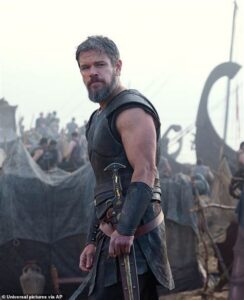
Matt Damon as Odysseus in the new move Odyssey
Sing to me of the man, Muse,
the man of twists and turns
driven time and again of course
once he had plundered
the hallowed heights of Troy” Book 1 The Odyssey
This is a story that focuses on a man of ‘twists and turns” The hero Odysseus is quick, clever and calculating, a master of disguise. The plot often needs his disguise and deception. We see this when he withholds his true identity from Cyclops and using the alias of “Nobody” he is able to save himself and his crew. Also his beggar disguise allows him to infiltrate his palace and set up the final confrontation with the suitors wanting his wife Penelope. It is his old servant Eurycleia who nursed Odysseus when a baby and his dog Argos who recognise him as their beloved King, before he llets go of the disguise.
Nearly three thousand years after they were composed, the Iliad and the Odyssey remain two of the most celebrated and widely read stories ever told .
Yet nothing much is know about their author Homer. He was a Greek bard living in the and 8th and early 7th centuries BC . He is often referred to as the ‘blind bard ‘ and they probably began as part of a long tradition of unwritten, oral poetry – stories of a glorious expedition to the East and the leaders fateful journeys home often were told orally.
They are said to be were written maybe about the 12th century BC, a sublime age when gods still frequented the earth and heroic, godlike mortals often used god like powers. This was the Bronze Age the greeks are often call the Achaeans at that time. But Homer actually was writing probably in 7/6th centuries.
It could be a reflection on the glorious bronze 12th century. BC
It was written down in the Ionic dialect of Ancient Greek but Homer varied the dialect encompassing all of Greece.
Gods and monsters, shipwrecks and battles, Calypso, (a nymph on island of Ogygia), enchantresses, seductresses, Cyclops and a journey across perilous seas: The Odyssey is one of the great epics, a story told and retold for more than 2,500 years.
But for all its monsters and adventures, what has kept us returning to it for so long may be something much more human. At its heart is a story about longing for home, about love and loss, temptation and endurance, and the long, difficult business of finding our way back to where we belong. The poem by Cavafy called Ithaca is a modern take on our journey. (see below)
Through myth and philosophy, the ancient Greeks explored some of the biggest questions we still wrestle with today.
What is the nature of things?
What makes a life well lived?
How do we find our way through uncertainty?
What is justice?
How can I be true to myself?
How should we treat one another?
More than 2,500 years later, those same questions still echo through our everyday lives. We recognise ourselves in Odysseus’ longing for home, Persephone’s journey through darkness and return to the light, and Sisyphus’ determination to keep going despite impossible odds. We still turn to the Stories for perspective when life feels uncertain, and to Aristotle’s reminder that ‘eudaimonia’, a flourishing life, is found not in perfection, but in living with purpose and curiosity.
The Greeks gave us not only unforgettable stories, but enduring ways of thinking that continue to influence democracy, psychology, literature and the way we understand ourselves.
The gods include:
Athena daughter of Zeus goddess of wisdom. She assists Odysseus with giving divine powers.
Zeus King of gods and men
Poseidon god of the sea he is the antagonist as he despises odysseus for blinding his son Cyclops and hampers his journey home
Circe witch-goddess who chanrs men into swinr
Hermes a messeger of the gods, a helper of Odysseus to resist some human traits
Odysseus wants kleos –glory
and nostos – homecoming
Yet as we read in Book 5
But if you only knew down deep
what pains are fated
to fill your cup
before you reach the shore
you’d stay right here.

The Odyssey, translated by Emily Wilson.
If you’ve always felt that Homer might not be for you, Emily Wilson’s brilliant translation is a very good place to begin.
The first woman to translate The Odyssey into English, Wilson brings extraordinary clarity, energy and humanity
to one of the oldest stories in Western literature.
Tell me about a complicated man.
Muse, tell me how he wandered and was lost
when he had wrecked the holy town of Troy,
and where he went, and who he met, the pain
he suffered in the storms at sea, and how
he worked to save his life and bring his men
back home.
Her Odysseus is not simply a great hero, but a complicated man: cunning, flawed, resilient and desperate to find his way home.
The gods, monsters, shipwrecks and adventures are all here, but so too are the questions that have kept us returning to this story
for more than 2,500 years. What does it mean to belong? What are we capable of when we want something badly enough? And after being changed by everything we’ve been through, can we ever truly go home again?
An ancient epic that, in Wilson’s hands, feels really alive.
Exploring the myths, philosophies and timeless ideas we see how they continue to illuminate modern life.
Their lessons remind us to question our assumptions, embrace uncertainty, cultivate resilience, and seek meaning rather than certainty.
In a fast-moving world, they invite us to pause, think more deeply, and discover that many of the challenges we face today are, in fact, ancient ones
—and that some of the oldest stories still have the most to teach us.
Ithaca
C.P.Cavafy (1863-1933)
hope your road is a long one,
full of adventure, full of discovery.
Laistrygonians, Cyclops,
angry Poseidon—don’t be afraid of them:
you’ll never find things like that on your way
as long as you keep your thoughts raised high,
as long as a rare excitement
stirs your spirit and your body.
Laistrygonians, Cyclops,
wild Poseidon—you won’t encounter them
unless you bring them along inside your soul,
unless your soul sets them up in front of you.
and we quickly got to our local cinema before it closed.
It is the story of a treacheous journey that Odysseus (Damon ) and his men take in order to return home to ithaca after the Trojan War.
Christopher Nolan used the newest translation and the first by a woman for his interpretation.
The new book by Emily Wilson has a new take and besides the expected violence and the loudness (Americans can’t help themselves) we loved it.
Wilson caused a stir with her use of “complicated” in Homer’s opening invocation of Calliope, the muse of epic poetry.
Tell me about a complicated man, she begins.
The poem then ends happily ever after the bitterness Odysseus yields .
Finally I have taken a large piece of story from a blog i like by Robin Bates where he has done a lot more work thean I have time for and I want to keep to read at my leisure as you might like to read sometime.
By accepting exile for killing the suitors, Odysseus can end the feud and Telemachus can ascend to the throne with a clean slate. In ending his film this way, Nolan merges Homer’s Odysseus with Tennyson’s Ulysses in his famous poem by that name. Skipping Ulysses’s complaint about having an aging wife and a bureaucratic, non-adventurous son, Nolan tquotes from Tennyson’s poem.
Nolan’s Odysseus doesn’t go into exile alone, however, but is accompanied by Penelope in what feels like a second honeymoon. Together they will sail “beyond the sunset, and the baths/ Of all the western stars, until [we] die.” Perhaps they’ll “touch the Happy Isles and see the great Achilles.”
But back to Homer’s Odysseus being a complicated man. His psychological states are conveyed through his interactions with the gods, as though forces greater than his own individual mind are driving him. The poem begins with a conclave on Mount Olympus in which Athena complains about Odysseus being stuck on Kalypso’s island and Zeus agreeing that Poseidon must allow Odysseus to return home. Put in terms of a dialogue inside Odysseus’s head, the call of duty is finally (after seven years!) triumphing over his fear of setting out on another sea voyage. It’s not an easy decision given that he must, in so doing, abandon the comfort of living with an immortal island goddess.
In the film, Nolan strips away this internal struggle. Combining an earlier adventure–Odysseus’s encounter with the Lotus Eaters–with the Kalypso episode, he has her using the drug’s memory-erasing qualities to treat his PTSD over having lost his crew. (Rather cleverly, Nolan has Odysseus gradually recall what has happened to him, thereby providing us with his backstory. There’s no reason now to include his journey to the Phaeacians, the islanders in Homer’s version to whom Odysseus tells his story.)
It’s not the first time in Homer’s poem that Odysseus has grappled with the decision whether to stay or whether to go. He remains with Circe and her “flawless bed of love” for a full year. (Only a day in Nolan’s version.) Indeed, I read the entire Hades visit, which occurs during his time with Circe, as Odysseus questioning whether he really wants to confront the rigors of the sea again. In addition to the men eaten by the cyclops, he has lost his other ships, along with their crews.
In Hades he encounters some compelling reasons to stay, beginning with Agamemnon telling him about his own fate upon returning home. “Indulge a woman never,” the king tells him, “and never tell her all you know.” Could Penelope be plotting something similar? Meanwhile, through Achilles Odysseus questions the concept of glory itself. When he observes that the warrior has been ranked with the immortals, Achilles lets us know it is better to be kind and normal then be the lording one. Perhaps, then, the best option is to stay forever in obscurity on Circe’s island rather than die while seeking fame.
Achilles changes his tune when Odysseus tells him about his son, however. After hearing of Neoptólemos’s deeds in battle, Achilles goes off “striding the field of Asphodel, . . . glorying in what I told him of his son.” Maybe this is what convinces Odysseus to set off for home. He too has a son, so perhaps he realizes there is a kind of immortality in family and generation.
In other words, what gives life meaning is not only living. “As tho’ to breathe were life,” as Tennyson’s Ulysses puts it after having described the Ithakans as a savage race “that hoard, and sleep, and feed, and know not me.” This is another version of Circe turning men into swine, a point that Nolan’s Circe explicitly mentions, and one can see why Zeus/sense of duty would object.
All of which is to say that the gods function as a meaning system, with Odysseus’s interactions with them revealing his complicated nature. He’s just a different kind of complicated than Nolan’s Odysseus.
It’s not that I object to Nolan’s point. Although the movie was completed before Trump invaded Iran, America has a lot to be ashamed of when it comes to forever wars. Nolan’s Odysseus tells Penelope ahead of time that this will be an endless—or at least a very long—war, and he goes reluctantly. Then, in scenes which Nolan might have borrowed from Virgil’s Aeneid, he feels complicit in the atrocities visited upon the Trojans. Seeing the horrors of war through their eyes, it is as though he is seeing Gaza as experienced by the Palestinians or Iraq as experienced by the Iraqis.
When the Greek invaders kill a Trojan priestess in a temple dedicated to Athena, Nolan’s Odysseus internalizes the young woman. She becomes his Athena within, his conscience, and as such becomes his moral center. It’s a bit confusing, however, because it’s not clear that he lacked such a center before. At any rate, it’s Nolan’s way of acknowledging that divinity is part of our internal make-up.
This Athena is a far cry from Homer’s Athena, however. It’s true, as I’ve noted, that the ancient Greek goddess brings about peace at story’s end, just as she placates the vengeful furies at the end of Aeschylus’s Agamemnon trilogy. But when Odysseus is killing the suitors, Athena is in the action.
Homer, however, doesn’t let his bloodthirsty hero off the hook. Simone Weil, the French philosopher and mystic, interprets The Iliad as an anti-war book because it exposes how force turns victimizer no less than victimized into a thing, and the same could be said of The Odyssey. Even more horrifying than the treatment of Melanthius could be Telemachus hanging the serving women who have slept with the suitors (and not necessarily because they wanted to, as Margaret Atwood points out in The Penelopiad). The horror lies in the tiny details which is a wonderful read and comes over well in the movie.
I’ve heard some of my elderly friends complaining about Nolan’s violence—the cyclops cannibalism scene echoes Goya’s horrific painting of Saturn eating his son—but imagine if the director had put bloodthirsty Odysseus and Telemachus into his film. In the movie we see how complicated humans can be. Are the characters blood thirsty enough or as some say seem shallow and sentimental.? Well I loved the characters as portrayed and saw the parallels still today. Some of this is from Better Living through Beowulf. Thanks to Robin Bates for his dedication to literture and his generosity. He teaches me so much . Thank you