
We dedicated the day to visiting the MCA at Circular Quay. (It was a free day given by Telsra)
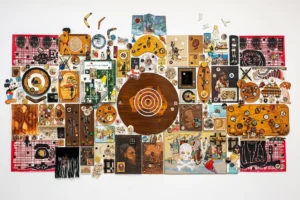
When you first enter Albert’s exhibition, Not a Souvenir, showing at Sydney’s Museum of Contemporary Art, you are met with a wall of Aboriginalia reminiscent of the domestic display for which many were originally created.
Accompanying this wall is a glass display, resembling a colonial museum exhibit, that features a further assemblage of items. The sheer volume, variety, and span of time this vast assemblage represents is intentionally arresting. It’s a reminder of how diverse the public’s fascination with Aboriginalia once was.
Aboriginal people of my vintage grew up surrounded by Aboriginalia in the form of kitsch everyday objects, often depicting racist stereotypes that showed what Australia thought about us.
From wall hangings to tea-towels, to drink coasters and ashtrays, they were ever present. Later, when they began to be regarded as cringe-worthy, they were relegated to the op-shops frequented by a young Tony Albert.
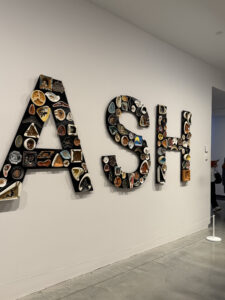
Aboriginalia describes mass-produced objects that depict Aboriginal people s and culturesi simplisiic of stereotypical ways. It includes bric-a-brac which to me seemed once harmless a. However today i see the damage it did It reinforced the fiction of the people as a people being cenigrated, belittled and erazing thie reality. There are nine sections in the exhibition and the first ASH ON ME
And the question,
What does it mean to butt out a cigarette
on someones’s face,
on someone’s culture, their life and humanity ?
I found this very confronting. Some are angry about this exhibition. Some say these objects are harmless, some say they are from an ‘different time’ .
but this really only demonstrates how deeply colonial violence has been normalised and how its effects continue to be felt in the present day.
however i am pleased Albert concludes . . .” this is not about Guilt , its about taking these objects and turning them into something that celebrates our survival and our vibrancy as the world’s oldest living culture” Tony Albert