hildegard of bingen
The Song Company: Circle of Virtue by Hildegard of Bingen
November 2020 During Covid this wonderful young company have rehearsed and are ready to present The Circle of Virtues: A Morality Play by Hildegard of Bingen.
I have added two of my poems telling some of the background story of Ordo Virtutum said to be the first morality play by a woman in Western musical repertoire. Ordo Virtutum is really an allegorical morality play or sometimes called a liturgical drama composed by Hildegard in 1151 AD
Special Announcement
The Song Company presents
Circle of Virtue by Hildegard of Bingen
The Song Company invites vocal music lovers back into concert halls in Newcastle, Wollongong and Sydney as they present Ordo Virtutum (Circle of Virtue), the oldest surviving music drama, by 12th-century visionary, Hildegard of Bingen.
Abbess, visionary and natural philosopher
One of the earliest-named composers in Western musical history and outspoken in her dealings with princes and popes in mediaeval Europe, Abbess Hildegard of Bingen (1098-1179) created the earliest-known opera or music drama, Ordo Virtutum (c.1151), for the female inmates of her Abbey at Rupertsberg.
The fight for the salvation of the Soul (Roberta Diamond) by the Virtues (led by their Queen, Jessica O’Donoghue) from the Devil (Koen van Stade) is set to the most sumptuous chant for women’s voices for which Hildegard is known, and accompanied by drones, medieval organ and other atmospheric effects.
The Song Company presents a semi-staged performance of Hildegard’s story of the internal struggle of a Soul battling for her mental well-being with seventeen Virtues on one side and the Devil on the other…
Be excited for an evening of wonderful music combined with a transcending and atmospheric stage presentation.
Circle of Virtue is the perfect way to support your national vocal ensemble’s return to the stage and to experience Australia’s finest vocalists in live performance.
CastRoberta Diamond – Anima |
|
Antony Pitts – Artistic Director Thanks to Timothy Chung and Santa Sabina College for loan of Portative Organ (made by Ron Sharp)
|

A few poems from my recently published book
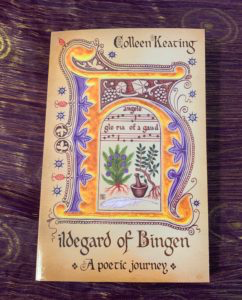
Hildegard of Bingen: A poetic journey by Colleen Keating
First Opera
In a vision
Hildegard has her sisters
sing as personified Virtues
in song and action.
She sees struggle
against the devil,
visualises it played out as drama.
Volmar can take the part of the devil.
He will not sing, she ponders aloud.
All abuzz, she hastens to tell Richardis.
With Volmar as scribe
they create their first opera.
Hildegard writes the words and notes,
Richardis plucks the psaltery
sings softly,
her radiance caught in a stream of light
Their eyes catch
mirror harmony of purpose.
Hildegard’s thoughts drift back
to the eight year old Richardis,
who looked to her as mother,
and the one
whose tender hands held her,
cared for her, in her sickness.
Now at twenty two a grown woman.
Showcasing the Abbey
An early spring afternoon
illumines vividness of robes and gowns.
Hospitality of the new Abbey
welcomes lively entourages,
Bishops, Priests, monks, dignitaries, clerics.
The Marchioness Von Stade,
a rare visit to her daughter at Rupertsberg,
and the largest audience
ever seen in Bingen arrive.
After the Bishop’s blessing of the Church
Hildegard and her sisters,
walk, poised and noble
in splendid procession
down the aisle in long flowing gowns of silk
singing glorious, heavenly music.
They circle the altar
dazzling brides of Christ,
singing their opera,
a morality play,
virtues triumphant, vices subdued,
the struggle of the human soul
with the wiles of the devil.
Hildegard catches
the Marchioness’ shocked gaze
focused on her confident beautiful daughter.
When the sisters harmonise in a chorus
and Richardis sings the solo
to end the opera
tears fill her eyes,
she bows her head.
After Vespers that evening
the last meal before Lenten fast
their excitement and pride is palpable.
Admonishment rains down like the Rhine
after a snow melt.
This domineering woman holds my daughter back,
Marchioness Von Stade stabs at Volmar.
Her sisters too free, says another angrily.
Her sisters too visible, says another .
Outside her window the oak resists the wildest storms.
Hildegard stands defiant,
against all criticism.
Viriditas and Hildegard

Thanks to Healthy Hildegard for the photo and the idea to feature Viriditas.

Viriditas
After the rains
Hildegard tends the garden
knee deep
in wet grass,
up to her elbows in soil,
worms, snails
and ruff of leaf compost.
Marvels at the ramble
of a young squash vine,
a stray seed gone free.
Lingers in the fragrance
of chives and basil,
coriander, lavender and mint,
and the smell of parsley.
Savours their bouquet.
Being jubilant
with the flirt of white moths,
and the canticle of bird song
from an oak branch above.
Dwells on her knees
as if in prayer.
Hildegard stands
her hands on her lower back
stretches and arches
skywards.Wisping clouds
ruffle. Light whispers,
I am the breeze that nurtures all things green.
I encourage blossoms to flourish with ripening fruits
I am the rain coming from the dew
that causes the grasses to laugh
with the joy of life.
Fearful of her own mystery
she clams shut this Light
into the tight knot of her gut.
*Viriditas means “greenness” – vitality, lushness, verdure, fecundity, growth. It has its earliest connection to Hildegard von Bingen.
It seems a perfect expression of the living green captured by the soul as the light dances over grass and leaf life.
With the term Viriditas, Hildegard of Bingen meant to describe a fundamental force in nature and the cosmos that binds people with animals, minerals, and plants.
Viriditas, the power of nature
A greening power, as Hildegard described it, exists in all things and is the basis for all healing in people and of the earth.
This greening powere exists as a symbol of prosperity and vitality, with plants blooming, growing, germinating and bearing fruit.
We lose our greening power through apathy, monotony and stress in everyday life.
We lose our greening power when
However, we quickly restore and preserve it through prolonged time and movement in nature.
Spring explodes
like a paint box come to life
spilling across
the browned winter-wearylandscape.
In Australia we wait for regeneration after the unprecedented fires we have experienced . We observe the tiny moments of viriditas return.
I give thanks to all the wonderful people who are being proactive to save species that are threatened. eg the rare life of the green Corroboree Frog from the Snowy Mountains. My daughters who send hopeful photos of new life and promise me the trees will recover.

New life bursting into our lives.


Book Review by Dr. Christine Cameron. Hildegard of Bingen:A Poetic Journey
AFFIRMING REVIEW – by Dr Christine Cameron
Hildegard’s life sings and dances across the pages of this engaging harmony of her works, set out in this poetic journey that commences at the twilight of her life and then rewinds back through the lens of time. There is the separation from family to “entombment” in an anchorage with Jutta and another; words that then envelop the reader in frigid emotions of isolation and confinement – words that explore the lack of warmth amidst sanctity and penance! Nevertheless, an inner glow returns with the descriptive analysis of freedom becoming a reality, when there is a re-emergence into the light and life of the monastery – its interior and exterior – its undulating fields and its healing life-giving plants.

While engaged on the journey the foremost characters are given personalities that leap lifelike from the pages – Jutta is a living saint who projects perfection; the personality clash with the Head Abbot Kuno simmers and grows; the bond between Hildegard and her sisters is as a mother with her daughters; Hildegard’s incredible friendship with the ever faithful Volmar and her undying but questionable love for the young Richardis when there was a need to treat all equally – demonstrate a logical progression of words and ideas leading to a climax. As magistra – teacher Hildegard’s awareness of the confinement of the monastery leads her to respond to the “divine call” for change and meeting the challenges she creates new foundations with her group of nuns.
A mystical writer, a visionary, a healer, a scientist, a writer of plays, a musician – what a woman! In this Poetic Journey Hildegard’s genius is explored with cadences and rhythms that flow from verse to verse and page to page. There is the illness that plagues her through her long life which ends in pain and sanctified silence but is expertly shown by the writer that Hildegard’s life has really only just begun for as a saint and Doctor of the Universal Church her life is immortalised in the annals of the Church. The many gifts of Hildegard – including her charisma – are expertly embedded in this “Poetic Journey” that gives voice to the “Living Voice”. A very enjoyable and fascinating read!
Dr Christine Cameron – 15 March 2019.
Christine is a seasonal lecturer with the Australian Catholic University. She has served as Principal and in administrative positions in Catholic primary schools in NSW Australia. Christine’s books are based on her successful PhD research into Women Doctors of the Catholic Church: A Study in servant Leadership.
Her first book Leadership as a Call to Service (2012) explores the then three female Doctors. Her second book, on the The Life and Works of Hildegard of Bingen (2013) shows her a regarded scholar of Hildegard and 12th century mystical writings, as she
“seamlessly weaves the golden thread of SERVANT LEADERSHIP through the life and works of St. Hildegard

Hildegard of Bingen: A Poetic Journey 18th July 2019
Just from the publisher the first copy of my new book . It is in my hand .
Hildegard of Bingen: A Poetic Journey .
So exciting
Already up on the web site for purchase.
www.ginninderrapress.com.au
Internationally it is available on Amazon Books


Hildegard of Bingen Named one of the Most Loved Composers
Classic 100: Composers most loved of all time.
![]()
Our ABC classical radio, a few months ago, put out a call for listeners to vote for their most loved Composer. Well you know Beethoven, Bach, Mozart, Tchaikovsky, and Handel will be there as Vivaldi and Elgar and Chopin will be there too.
Of course I voted for Hildegard as my No. 1 and Mahler as my 2nd most loved composer . We waited a few months for the tally and over last weekend – a National Holiday Weekend in Australia, we prepared to hang around house cooking, gardening, reading knitting , to listen to magnificent music as we counted down from 100.
Many of the great names fell all day Saturday. Their gorgeous music came lifted us and left. Composers fell away . . . Grieg, Ravel, Haydn, Wagner, Bizet and it took another sleep .
On Sunday with the count 40 and down . . . Hildegard arrived at 33. There was an eruption of excitement. There was cheering all around our apartment. . . friends were texting me and we popped the champagne ( a bit later) To think the people have taken her ecstatic, heavenly music to their hearts.
You can still hear it all on www.abc.net.au/classic – 100
To think her music was silenced by the hierarchy for nearly a year, the year before she died and now today, 900 years later she is listened to and loved by people all over the world and today in the ABC Classical Countdown of the top 100 most loved Composers of all time Hildegard rates 33rd and one of the few woman.
It is extraordinary that the voice of Hildegard has returned at this time of history with her music, her health and healing , her understanding of the environment and her call for our need to be stewards and custodians of our Mother Earth for she is our life line.
For me Hildegard is a woman who sees through hypocrisy and cannot abide with the patriarchy of church or state . She acts as if she is doesn’t see it. She acts on her intuition and what her inner voice tells her. To do this of course she had to listen and listen and listen.
Listen to the heart beat of the earth and the thrum of the tree and the wind and the messages that are with us constantly in nature and in our very being.
My story of her life written in poetic verse is with the publishers Ginninderra Press and will be launched in a few months.
And hence I am thrilled to see Hildegard of Bingen named
and for all the world ,
well for all of Australia,
(at least but I know my daughter in England was jumping up and down with joy and some Hildegardeans in America and a few in Germany were filled with joy )
to stop and listen to her exquisite music today.
![]()
Stop Press; Hildegard is journeying well.

The birth of my new book Hildegard of Bingen: A Poetic Journey like this fresh bud moist with morning dew is being birthed.
It was exciting to receive the manuscript from Ginninderra Press for my first read and edit.
Stephen and Brenda Matthews, from Ginninderra Press have worked very sensitively with my manuscript, that was accepted by them last year for publication.
Every step has its mix of excitement and challenge.
Now for the decisions about cover and blurb.

Hildegard receiving one of her visions .

This photo is taken in the ruins of Disibodenberg where Hildegard lived for nearly 40 years, firstly in an anchorage which opened up to become a convent as more girls and women even widows asked to come and live. Michael took this photo of me sitting in the area which is thought to have been Hildegard’s Kapelle.

Some of the items from Bingen that helped to inspire me on my writing journey.
Last Swallows: A Poetic Journey
For Hildegard, health and healing sought balance in all aspects of life. She honoured interconnectivity – of spirit, mind, body; of humanity, the earth and the universe. This is the heart of Hildegard’s healing philosophy, though not unique to her. Buddha emphasised the middle way as the path of moderation and the path of wisdom. The Tao always reminds us to move towards finding the balance as with dark and light.
What would eventually set her apart, however, was how she chose to embrace the middle ground set forth in the Rule of St. Benedict. This enabled her to engage in her individual passion while serving the stringent institutionalism of the Church.
It was within this middle ground that she pressed her will and intellect into the interconnectivity of the physical and spiritual worlds, culminating in her foundational work in natural medicine.
From her early years Hildegard worked with garden plants and herbs for healing. This can be seen in the following poem when Jutta is dying. ( from Book 111 of Hildegard of Bingen: A Poetic Journey)

Some of the books of the 21st century I have that are inspired by Hildegard of Bingen
Last Swallows
Hildegard’s world stands bleak,
bare. The last swallows long gone.
In cold light
dew drops hang on a blade of grass.
Lingering dread
knots her stomach.
She enters the anchorage
sighs deeply,
lights Advent’s second candle.
Its smoky glow
reveals the pale beauty of Jutta’s face,
she lies stilled.
Hildegard puts down some bowls,
kisses her forehead.
Jutta, my mother,
your ascetics are too harsh.
Your imprisoned cell here
is mortification enough.
Let our spirits give praise
with rhythm of music,
with song of jubilation.
Our God, the Just One, is she who offers life
with all its bountiful gifts.
She nurtures Jutta,
urges with sips of fennel tea,
warmed broth, mulled honeyed wine.
Oil from the olives, freshly pressed,
she heats over the smouldering hearth,
gently massages Jutta’s hands and feet.
Her flesh wasted.
Jutta has her mind only
on heaven,
to be remembered as a saint.
Hildegard kneels beside her
holds her cold hands,
listens to her trailing breath.
She loves this broken woman.
Colleen Keating
from Hildegard of Bingen : A Poetic Journey

Later Hildegard came to understand everything is given us
for our wellbeing. She would write later about the interconnection of all things.
There is no creation that does not have a radiance,
be it greenness or seed, blossom or beauty,
it could not be creation without it. Hildegard of Bingen
In 1150, Hildegard left the Monastery at Disibodenberg and led her sisters to set up the new Abbey at Rupertsberg. There she embarked on deep and valuable work in lifestyle, nutrition, and well being for her sisters. Word spread around the of her healing ways.
When Hildegard left the Monastery at Disibodenberg and led her sisters to set up the new Abbey at Rupertsberg in 1150 she embarked on deep and valuable work in lifestyle, nutrition, and well being for her sisters. And word spread around the Rhineland of her healing ways.
Hippocrates, the father of modern medicine, declared “let food be thy medicine, and medicine be they food.” The concept of food as medicine is ancient. Hildegard was one of the first in Mediaeval Western civilisation that connected health and nutrition.
Food as medicine is the core for Hildegard of Bingen. Her notion that a kitchen is also a pharmacy reflects a common theme among ancient traditions of healing: food is the first medicine. Medicines at the time were all plant based or specific combinations of foods prescribed according to their unique healing qualities.
Hildegard’s original work, was eventually split into two treatises, Physica and Causae et Curae –
“Physica” represents the history of natural remedies, which Hildegard had intended for public use. and in Causae et Curae Hildegard describes healing and treatment methods using humoral techniques along with traditional creation teachings, combined with ancient mystic Cosmologies.
i
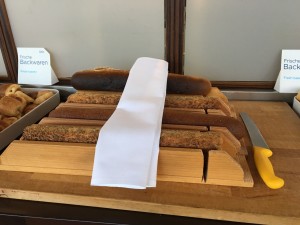
The wonderful selections of breads at breakfast, in our Bingen Hotel overlooking the Rhine. It felt very much as if hildegard is present.
Today especially in Germany, Hildegard’s healing treatments have found a resurgence in holistic health and wellness.
Within this renaissance Hildegard’s philosophies around health and nutrition provide concrete ways to achieve a healthy spirit, mind, and body, which ultimately lead to a healthy lifestyle. From this healthy lifestyle we harvest many benefits, not the least of which is avoiding illness and unnecessary suffering.

Expansion to Eibingen: A Poetic Journey

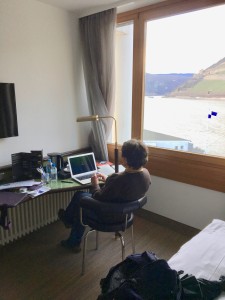
From my writing desk, in Bingen, looking down the Rhine

At Bingen, looking down the Rhine.
Expansion to Eibingen
Hildegard’s fingers tap restlessly
on the refectory table.
A new plan consumes her mind.
She moves to the podium
tucks back some loose strands of grey hair,
smoothes her veil
waits for her sisters to end supper.
She looks around.
A hundred sisters sit close in lines
share their own produce,
freshly baked spelt bread,
honey, warmed grape wine.
Hildegard breathes the aroma
of the delicious broth,
a recipe she has created
for their health.
Her mind holds a bold horizon
as the shape of Rupertsberg
grows its silhouette into the sky.
Its soul is their singing, her music.
Hildegard inspires their hearts
again with the bravery of St Ursula.
Her voice lowers,
My gaze is drawn across the Rhine
to the hamlets and people of Eibingen.
To a destroyed, abandoned convent.
How the local people beckon
for our sisters.
Chatter buzzes, hums
like a hive of Odelia’s bees.
Excitement palpable.
They imagine the old buildings
brought to life again
by their efforts.
On the first Sunday of Lent
Hildegard crosses the busy Rhine
with thirty volunteer sisters
to found a new convent
amongst the people of Eibingen.
Sister Inez, chosen the new Magistra.
The monk Volmar comes to bless them.
Carpenters and stone masons
follow, enthusiastic about a new project.
On the return journey,
the smell of the river captivates Hildegard.
Undeterred by the rough swell,
she turns to Volmar,
We will visit twice a week
to encourage and support them
The buildings and spires of Ruperstsberg
from the perspective of the Rhine
catch warm rays of a sun, deep in their hearts.

Touch of Silk: A Poetic Journey

A happy photo of a Benedictine sister picking the grapes at the Eibingen Abbey.
This poem in Hildegard’s poetic journey Touch of Silk is a transitional moment when she is inspired to showcase her sisters, singing, and her music, with her sisters dressing in beautiful gowns and flowers. It is a fact many of the women were quite wealthy and did bring jewellery maybe as part of a dowry,which they used to adorn themselves on special feast days. One must remember the 12 th century was a moment of Renaissance. Many frowned on her actions but it was still able to be done. In less then 100 years this would not be allowed.
Touch of Silk
There must have been a moment
when the idea arose.
Maybe it was the visions
when holy virtues spoke to her.
Maybe when all fifty sisters spent time
laughing together as they picked grapes,
for the winepress,
to make the sacramental altar wine,
and their sweet wine
to give warmth and strengthen blood,
as Hildegard says.
Maybe it was the day
the cousins Bertrude and Agnes
from a noble family joined her sisters,
proudly announcing they were seamstresses,
and donating reams of silk
for priestly albs and vestments.
Just maybe, the touch of the silk
gave Hildegard the idea.
Excitement drives her thoughts and words,
as she muses and then reflects out loud,
My sisters will wear silk gowns
as they sing our opera.
We will have it ready to perform
for the Bishop and his entourage
at the consecration of our new Church.
After Matins,
Hildegard gathers her sisters,
My sisters, God loves beauty.
For our concert we will dress,
as noble regal souls.
We will wear silk gowns that flow.
Gold wreaths and flower-circlets will crown us.
Let our hair loose under light translucent veils.
Our hair is our glory,
not a temptation to cut or hide.
Feverish as excited children
the sisters sing and sew
and with every practice
Hildegard watches their confidence grow.
Below is some special mementos I brought home from Bingen.
The wines I shared with Michael were special and my Hildegard candle energises me and the whole room while I write.

Hildegard’s wines from Eibingen