after the deluge the track was heavy hard-going shoes muddied bogs to be side-stepped
yet there was grace in the morning walk
light was breaking throughunzipped clouds making the bush smile a thousand welcoming smiles dazzlingand bright eyed
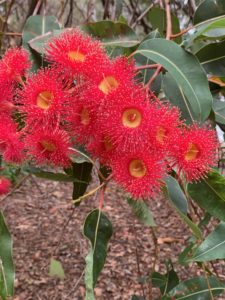
a slow waltz shimmered through leaves vibrant red gums stood friendly sentinels mossy rocks verdantly green palms washed clean
i leant against the familiar trunk of a gumtree reassured by its sturdy cool presence a shadow crossed my path i looked up – a yellow-crested cockatoo
ferns caught my eyedripping with dew as tears
* * *
they are walking too today along coldcorridors on frozen earth they can’t hurry although it’s urgent– a matter of life and death
they are pressed no time for a last glance back their homes their precious things surrenderedfordesecration
the air cries silently for their wounded homeland they are slow burdened with babies children elders pets no comfort of saucepans tea pots books music
a shadow crosses their path they cower huddle whimper
* * *
she is walking now not like me she is walking for her life and the life of her child her track is short to safety but it ‘s not she sees a welcome sign just ahead but she doesn’t let us imagine people welcoming her with warm souphot bread reassured by soldiers like sentinels many who reach out to help
let someone kindease her burden let smiling eyes greet her tired and sad and give her shelter
when a shadow crosses her path let her and her child be safe and its noise not exacerbate her fear
her words i cannot decipher but i understand the language she is everywoman
This photo is not 1942. This photo is taken this week in Ukraine March 2022 with the colour taken out. Thank you to a brave war journalist who I will research to find the name.
Ukraine
“ . . man learns nothing from history” Hegel
“I think it better that at times like these we poets keep our mouths shut for in truth we have no gift to set a statesman right “ W.B. Yeats from (‘On being asked for a war poem’ 1919)
can’t help being pessimistic but but. . .I cannot be silent in this sorrow of war
the enemy has risen its monstrous head again where human decency gives way to rage that leads to war that leads to rage
. . . and this too will end leaders will make deals shake hands some will put aside vicious propaganda and become allies
once again trenches filled in old war tanks disassembled in time they will build a cenotaph engrave the names of heroes not the womenold menchildren displaced and broken not victims who paid the price
as the English FTSE and Russian MOEX surge with share holder profits and each trumpets themselves winner
no-one gains land for there is nothing to gain it’s all an illusion that sabotages despots yet there is a lot to lose mostly humane values sadness in a mother’s eyes fear in a child’s heart hate and revengereplacing a teenager’s dreams the loss of human decency in the soldier.
meanwhile the sun anchors this tiny dot in the ocean of sky and its lens blinks another ‘lest we forget’
Sending spirit of peace, of bright starlight over fields of barley
These are horrible, tragic times and my heart and love go out to the people of Ukraine, and to the many people of Russia who have the courage to stand up and oppose this brutal invasion.
The tragic and unnecessary invasion, which has already displaced more than 2 million people that have fled across Ukraine’s borders with neighbouring countries, is not only killing and wounding the lives of so many -but also attempting to kill the dreams of a future that so many hold dearly.
Former U.S president Barack Obama’s 2011 speech before the British Parliament said:
‘the longing for freedom or human dignity is not English, American, or Western, but universal, and beats in every heart’.
We are all Ukrainians. Our destinies are intertwined with the destines of all others on the planet
as monk and social activist Thomas Merton once observed:
“we do not exist for ourselves alone’.”
A friend has researched and shared Ukrainians icons that are very touching and I would like to share them here
‘Nativity’ by Ukrainian iconographer Ulyana Tomkevych
Sending love and hope to all the pregnant women and mothers caught up in the atrocities of war
* * * * * * * * * *
‘Crossing the Red Sea’ by Ukrainian iconographer Ivank Demchuk.
Sending safe passage to all those trying to find safe passage through and out of Ukraine May you be sheltered in thisexodus.
* * * * * * * * * *
The Visitation by Ulayana Tomkevych
Sending love to all women in Ukraine who are looking after older parents and young children and having to make decisions of staying or leaving their beloved war-torn homeland.
* * * * * * * * * *
“The Protection of the Mother of God”
by Ukrainian iconographer Ulyana Tomkevych . How can we imagine what it would be like to live in a n ancient and beloved and beautiful city and be told it is going to be bombed and destroyed for no reason. How does one cope with this?
” One cannot but be in awe when one contemplates the mysteries of eternity, of life, of the marvellous structure of reality. It is enough if one tries to merely comprehend a little of this mystery each day. Never lose a holy curiosity. – Albert Einstein
afternoon rain
dewdrops dazzle like
dangling fairy lights
rainbows
dew drops corralled
by sun beams
Tanka
morning Mozart plays
from a sleepy place I wake
with new energy
to face any curve ball
that is thrown my way
killing fields
the only sound aside from first wind rising
was the occasional brush of my footsteps
against soft cushion of earth
i looked out across the lake
the early dawn light
lay like a silver mirror
broken now and then
as several black cormorants
broke the surface and redived
in the far distance
the black swans grazed in sea grasses
and lone pelicans glided by
I watched the silver light of jumping fish
catch insects
then the pelican saw its opportunity
struck with violent grasp
grabbed the fish
its pouch beak
stretched and wriggling
while it shook its neck
and gulped the fish
I turned my attention to the paperbarks
and the symmetry
of the native miner’s wings
as it flies into a paperbark
and stand in shock
as it flew out
with the agonised death screech
of a cicada in its beak
is this place
that appears so tranquil
actually a killing field?
Merriment of Frogs after the Rain
As the sun comes up
i walked towards the stand of swamp paperbarks
a sound like a freight train racing
through a country town
filled the air
closer it became more individual
like hearing each individual carriage clanking past
and then individual rumbling croaks
yes the swamp was alive with frogs
all carousing and courting and
chatting
here was a living field
vibrant and alive
A Tree Kinship
over the curve of my thoughts
comes a sound
amidst a stand of Paperbarks
they were not only breathing together
they were conversing
my heart wells up to bursting
every tree has such character
twisted and curved
not a straight line anywhere
all seem to be aware of each other
a tree kinship
each with unique characters
that breathe life and meaning
and sanctity
the textured bark glistens with the
wash of the recent rain
in all the tones
of cream – coffee caramel tawny and wheat
desert ochre copper topaz and brown
A plaque on a seat at a lookout
How very lucky are we
to breathe salty air
and sit here by the sea
Life as we know it
changed this past week
yet the nankeen kestrel
hovered above us
just as before
Each day is beautiful and precious
even amidst these cloudy times
some days of heavy metallic sky
some days of grey straggling fog
with the horizon lost
nature tells us
it will turn for it has many sides
a stretched-out horizon
wider then our dreams
is still there
Today the clouds give us
feathers and angels and flying kites
all uplifting light and full of joy
so different to the metaphoric clouds
that hang thickly over us
pounding at our hearts
fogging our minds
suffogating our bodies
lapping waves
our footprints disappear
we do not look back
Our second day
out walking
nothing has changed
trees still stand as mystics
their whisperings
pointing the way
Just before first light we rose
the lunar moon
was due
we watched we waited
the hearth of a new day
burst firing the waves
the lunar moon
travelled into its tiger destiny
invisible
not even a whisper
or scintella of light
but one with the air
lunar moon
we search the darkness
on the horizon
light dawn sunrise
for a wild water tiger
i was surprised
by its gentle silent entry
like a dew drop on a rose
or the tear drop of blood
from the pierce of a thorn
60 years for its return
1962 the year I left
the cocoon of school
for the world
2022 is it the year I bow out
and return
to the cocoon of my world
in nature
lunar new year
the morning glory
are full of welcome
association
paperbark and purple
morning glory
Bird walk today
Can you see the two cormorants hanging out by the lake in the photo?
just hanging out
they know we are here
two pied cormorants
and
two cormorants
hanging out by the lake
social distancing
How many kookaburras
makes a coven
waiting for their prey
The 10th and final issue of the much-loved journal, Windfall: Australian Haiku, was released in January 2022.
Windfall is an annual journal edited by Beverley George and published by Peter Macrow at Blue Giraffe Press. The cover artwork is by Ron C. Moss, with design and layout by Matthew C. George.
Originating in Japan, the popularity of this short poetic genre has spread widely around the globe. Australian interest in haiku dates as far back as 1899 when an Australian haiku competition was conducted(1). Subsequently, in the 1970s, Janice Bostok produced Australia’s first haiku magazine, Tweed(2).
More recently, the Australian journal, paper wasp, ran for 20 years until ceasing publication in 2016 and, with the internet leading to growing interest in the genre, other print and online journals have encouraged and supported the writing of haiku.
For the past ten years, Windfall has focused solely on haiku about Australian urban and rural life, written by Australian residents. These poems have incorporated many elements of our landscapes, seasons, flora and fauna into the haiku form.
spring equinox over the moonlit creek a pobblebonk chorus
Mark Miller
leading into sundown dingo tracks
Tom Staudt
virgin rainforest ninety-four rings on a fresh cut stump
Andrew Hede
Nature haiku such as these enable Australians and others to appreciate images and sounds associated with the birds, animals and plants of this country.
waning moon in the mangroves fireflies stir
Maureen Sexton
rising heat a jabiru crosses the sun
Cynthia Rowe
winter afternoon — golden wattle glows on black sky canvas
Sheryl Hemphill
Windfall has chronicled some of the best Australian haiku for a decade. Issue 10 presents haiku by 63 poets. By my count, 20 of these poets also appeared in Issue 1, which suggests around 40 of the current Windfall poets have emerged in the intervening period. The growing Australian haiku community certainly includes a healthy influx of fresh voices and fresh ideas.
Some poems in Windfall relate to the interaction between nature and the human environment.
opera house steps a long-nosed fur seal soaks up the sunshine
Vanessa Proctor
rainforest glade an empty packet of Smith’s catches the sun
Nathan Sidney
While others use local flora and fauna to portray aspects of Australian behaviour and culture.
black cockatoos in tree shadows he stops treatment
Earl Livings
beachside walk the roughness of banksia pods
Nathalie Buckland
dunny without a door . . . the Milky Way
Leanne Mumford
Credit for Windfall’s success must go to editor, Beverley George, and to publisher, Peter Macrow. Beverley’s deep knowledge of the haiku form has enabled her to assemble a marvellous selection of Australian haiku for each edition of Windfall, while Peter has supported the journal throughout its life.
Beverley George selected the following haiku to conclude the 10th issue of Windfall. It was a wonderful choice, with the poem capturing a quintessentially Australian scene. But, more than that, the poem does not despair about ending. Rather, the poem celebrates the vitality of birth and renewal.
sheltered paddock the udder punch of a newborn
Glenys Ferguson
For ten years, Windfall has made an important contribution in recording the work of Australian haiku poets. Now, we all look to the future.
Review by Gregory Piko
A limited number of back issues of Windfall (No. 4 to No. 9) and of the final issue (No. 10) are available for $10 per copy, postage included. Cash or stamps are welcome, as are cheques payable to Peter Macrow. Please address to:
Peter Macrow 6/16 Osborne Street Sandy Bay TAS 7005
sometimes it takes sadness loss an empty room
to painfully be aware of presence
sometimes it takes stillness of breath
to remind us to breathe deeply
consciously with gratitude
sometimes it takes silence
to remind us to sing
and find
presence
breath
song
we did today
our first bush walk since our world changed
and we take time to adjust
to a new life without Pat in our world
an amazing eucalypt stopped us in our tracks
a grand old lady holding forth
fully present
from each angle she commandeered our attention
the light played beautifully along her trunk
adding to her starling presence
colours and tones of nature
naturalness
messiness
especially the scruffy banksia men
trunks, bark, brambles decay
ant-eating bores seed pods
humus of leaf litter
were catching my eye
with a chaotic beauty that satisfied me
still feeling close to the out of control
and sense of rawness that is reality
when we experience the threshold of transition
for it takes time to find
ways to close off and re-protect ourselves
yet the music of birds
the baby wren that flew out
on a branch to greet us
the kookaburras,
the goanna that stayed for a photo
the blue and stunning black butterfly that didn’t stay
a few straggler flannel flowers
reminding us of our lockdown spring walks
where we marvelled at their abundance
and their star-light quality
At the top of Crackneck Mountain
we stopped to have a cuppa and muesli bar
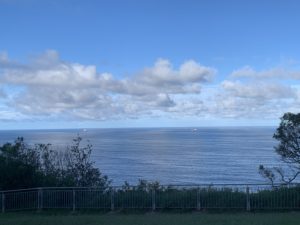
marvelled at the grandeur of the ocean spread out
in all its glory
never ceasing to amaze and delight
we walked down the mountain
taking the outer less worn track
where we were reminded of new life
as fresh lime-green candles of banksia
brightly shone
and young callow sprigs of Xanthorrhoea *
their flounce like ballerinas in their grass shirts
the first breath of wind will have them dancing.
*’Xanthorrhoea’is the name for what we mostly call the grass tree. It means ‘yellow flow’ in ancient Greek and refers to its resin. This resin was much prized by Aboriginal people, being used as a glue or as a coating/waterproofing material. The early settlers also found it extremely useful, as a glue, a varnish, polish and a coating of tin materials. It was used in the sizing of paper, in soap and perfumery and even in the manufacture of early gramophone records.
i visit my special tree
a regular confidante
and ponder
what this new year may bring
rooted in place
sturdy stronger calmer
than i remember
it gazes upwards
out over the valley
as if it could see
far beyond our horizon
one thing changed
last visit its bark was pink
sleek inviting my hand
to run across its dimply skin
today its bark is splitting
letting go
peeling in strips and curls
burnished as an old rusty drum
exposing chartreuse rawness
i nod and thank
tree wisdom
for its perfect message
The magic colours of the trunk .
Totem
The Angophora Tree
Totems are a natural object or creature that is believed to have spiritual significance and can be adopted by particular groups as an emblem or symbol. This special tree like others before me who declared it the hugging tree is my special tree
The angophora tree is a special tree to the Darug people who are the Traditional Custodians of the area. The angophora is an ascension tree, a place where the spirits go up and down from this earthly plane.
In pre-colonial days at the time of pregnancy, a woman would sit at the base of the tree and wait for the spirit of her child to enter her belly into her unborn child. At the other end of the life cycle, when someone passes, the body is wrapped in bark and placed in the large branches up the tree, to allow the spirit of the person to return to the heavens.
On a recent visit I felt the spirit is still there. There is a parallel world here in this Loreto forest .
I am writing my next poem on that at present.
(Angophora Costata Sydney Red Gum or Smooth Bark Apple Gum)







 A
A