Launch of Tintinnabulum by Judith Beveridge

Tintinnabulum  by Judith Beveridge

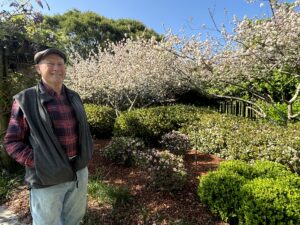
Tintinnabulum was launched by poet Audrey Molloy at Gleebooks on  a delightful warm winters Sunday afternoon. 25th August  2024.

It was done in a conversational mode. Audrey’s questions helped Judith to open up about her writing .

Firstly the title. Judith explained, it is always difficult to come up with an interesting title. 

Tintinnabulum  means ‘little bell’ in Medieval Latin . As a verb it refers to a  ring or sound like a small bell,  peal, ring, sound sonorously . eg the tintinnabulation of wind chimes blowing in the breeze. or I always look forward to the joyous tintinnabulation at church during the christmas season. 

Judith makes a list of possible names for a title and slowly narrows it down.  In this book she explores what poetry can uncover through musicality and analogy  and how these elements can open up sacred space . The title Tintinnabulum is an onamatopeia word ( the naming of a thing or action by imitation  of natural sounds as buzz or hiss ) and that title became the final choice as one or two poems include that word .  Robert Frost says, ‘sound is the gold in the ore of poetry’ 

“I chose the title meaning ringing of little bells  to suggest celebration and to indicate that many poems in the collection,  engage in almost ritualised observance of precise aspects of the physical world . 

Judith would like to be called an imagist poet.

In this book she looks specially at animals, landscape and at people in certain environments.” 

Sacred space comes into being  with the idea of relationships and the idea of apprehending the interconnections  with  them especially  through the use of metaphor. 

Walking with the poet  captures this.  A poem in memory of Dorothy Porter.  She often uses water landscape . Rilke says ‘praising is what matters ‘

Judith is interested in the ways which simile and metaphors can create relations that previously might have been unnoticed. 

“My poetry centres around this core aspect of poetic language. ‘

She has been influenced  by Seamus Heaney , Robert Frost, Hopkins, Amie Clapton , Walcott, Plath . 

Sound

Sound affects the  reader  – when it hits our gut our feeling centre. For a poet  human emotions are full of potential. 

Love the sound of Plath  “A bird flits nimble-winged in thickets”  Sound is a great tool to get feelings rippling through the poem.  

Using poetic devices to give surprise and visceral response

Peppertree Bay  is pure adventure using metaphor, simile and imagination.  They are tools to connect  – dissolve boundaries to connect things in our gut  – healing, restoring,  and helping to open up sacred spaces .Pictures in your head she wants them to curl into your imagination and stay.  eg Breakwall octopus and ballet shoe, 

a kite letting down . . .  

A writer needs to balance imagination and reality.  

“You can have an imaginative garden but you need real toads in it” 

The poem The Light on Marine Bay  began with something real. Light on water at North Parramatta Park !

James Dickey says it is alright to lie in poetry  . It is a literary strategy to delve deeper into deeper truth . 

Empathy  

is an important quality. eg Cruelty of animals is appalling 

However sentimentality  can undermine the real feeling of a poem .  and sentimentality can be caused by a lack of attention.   Read The Dancing Elephant  There is an iron bell resonance between the animal and reader. 

Attentiveness is the natural prayer of the soul.

Assonance 

She loves Wallace Stevens  and works with his poetry in one section. 

His poems Snowman and 13 Ways to look at a Black Birds.

“One must resist the intellect almost obsessively . Forget the context, get the music . Failed poetry is when the content takes over. 


JUDITH SIGNING MY BOOK > I BELIEVE SHE IS ONE OF OUR GREAT LIVING AUSTRALIAN POETS .


Judith Beveridge: a note on Tintinnabulum

The renowned Australian poet Judith Beveridge reflects on her much-anticipated new collection of poems Tintinnabulum (1 July 2024), the first since her prize-winning Sun Music in 2018. Read an extract from the book here.


Tintinnabulum explores what poetry can uncover through musicality and analogy, how these elements can open up sacred spaces. I have chosen Tintinnabulum as the title (which means the ringing of little bells) to suggest celebration and to indicate that many poems in the collection engage in an almost ritualised observance of precise aspects of the physical world. I look specifically at animals, landscapes, and at people in certain environments.

Sacred spaces, I believe, come into being when we perceive relationships and apprehend interconnections. I have always been interested in the ways in which similes and metaphors can create relations that formerly might have been unnoticed. My poetry has centred around this core aspect of poetic language and Tintinnabulum continues this with perhaps more urgency and power, but also with humour and surprise.

I also love to use language that is distinctly focussed on sound as a way of enhancing meaning and providing pleasure for the reader. My animal poems, which make up the book’s first section, delve into how we often interact with cruelty and insensitivity to non-human animals, but I also look at ways in which encounters with animals throw their ‘otherness’ into stark relief such as the distinctly alien lives of cicadas, leeches, bluebottles.

The second section focusses on the human world and brings to bear a sense of compassion for the difficulties that people encounter: surfers on a high sea, a waitress unhappy in her job, two brothers suffering racist cruelty, as well as elegiac poems about friends and family members.

The third section consists of imaginative/hallucinogenic scenarios, and is my most poetry at its most weirdly inventive. This section culminates in a joyous romp through sonic repetitions and is a homage to the poetry of Wallace Stevens.

The poet Edward Hirsch has said that ‘Attentiveness is the natural prayer of the soul.’ I believe the final section of the book attempts this level of worshipful attention evoking the beauty and awe to be found in landscapes. It is my aim that readers, after reading Tintinnabulum, will find the world less fragmented and more interconnected, that language can be felt as an activating mechanism for wonder, joy and revelation.

— Judith Beveridge, May 2024

Spring haiku by Colleen Keating

 mountain mist ~
from our chairlift
the sound of cow bells
Colleen Keating
______________________-

two lorikeets
on my sun-lit deck
catch-up coffee

crowded festival
the shin shin
of falling blossoms

Colleen Keating

–––––––––––––––––––––––––––


school assembly
her first public speech
scent of jasmine

Colleen Keating
––––––––––––––––––––––––

ripple on the pond
as a koi surfaces. . .
falling leaves

Colleen Keating

–––––––––––––––––––––––

spring blossoms
soften stone
and hearts

Colleen Keating

______________________

wind chimes ~
southerly breeze
wild bamboo

Colleen Keating

________________________

winter memory ~
crisp red apples
locally grown

Colleen Keating

–––––––––––––––––––––––––––

old age…
propped-up cherry tree
blossoms

Colleen Keating

Mosaics in the portico of the National Art Gallery London by Colleen Keating

Mosaics in the Portico

tread gently
you walk
on sacred ground

The first picture that greets visitors to the National Gallery is not an Old Master, nor an Impressionist. Nor does it even hang on a wall. Set into the floor of the first landing in the Gallery’s Portico entrance is ‘The Awakening of the Muses’, a marble mosaic laid in 1933 by the Russian-born artist Boris Anrep (1885-1969).

Between 1928 and 1933, the National Gallery commissioned Anrep to lay two mosaic pavements in the vestibule of the Main Hall to illustrate ‘The Labours of Life’ and ‘The Pleasures of Life’. In 1952, Anrep laid a third pavement, ‘The Modern Virtues’.  The resulting mosaics are a celebration of everyday life, which lies underfoot in a busy public place.

Anrep was an associate of the Bloomsbury Group of artists and writers, who notoriously championed modern art and modern attitudes. His Muses are not heavenly immortals, but portraits of people from his own world. Many of the characters are played by Anrep’s Bloomsbury friends.  I love that. And the photos dont do justice to the beauty of all these fine old tiles that people walk on and many not even noticing . 

Lucidity, Astronomy, Compromise, Delectation,
Humour, Folly, Dance, Sixth Sense,
Pursuit, Art, Football, Defiance.
Defiance

Compromise

Rest

Curiosity


Philippa Holland Poetry Award for 2024 winner Colleen Keating

I am honoured and excited to win the Philippa Holland Poetry Award for 2024 for my poem Two Canticles It was announced in the Fellowship of Australian Writers  Eastwood/Hills Poetry Competition, Saturday afternoon 3rd August 2024  on a Zoom meeting to  avail us all  shortlisted candidates to come together from all over Australia.  Thank you to the judges and hard working organisers Carolyn Eldridge-Alfonzetti and Frances moon

I had two poems Shortlisted for the selection, Two Canticles and Ungraspable.

It was also exciting to have my second poem Highly Commended.

Results

Winner of the Philippa Holland Poetry Award 2024   for the poem Two Canticles.  Colleen Keating

Highly commended in the Philippa Holland Poetry Award 2024 for the poem Ungraspable  Colleen Keating

Annual Literary Competition Results 2024

AUGUST 3, 2024 / HILLSFAW


Eastwood/ Hills FAW has completed judging for our Annual Literary Competition. We are very pleased to congratulate the following 2024 Category Winners and place-getters.

pastedGraphic.png


I feel my winning poem is appropriate for today August 2024 as it is a cry for peace , still a cry  over the hundreds of years from St Francis in the 12th century to Francis Webb who lived in the late 20th century dying in Sydney in 1973 and now I wrtie in 2024 and it is acknowledged with an award.

Last night my award became a reality when i heard from my poetry group Pennant Hills Poet   receiving congratulations even before I could find a list of the winners. Thank you to David and the group for their constant support and positive  edits of our work  each week.

Dear Friends
I have learnt some wonderful news; please excuse me piggy backing on earlier emails.
The results of the annual competitions convened by the Eastwood/Hills FAW have been announced. Our own Colleen has won First prize in the Philippa Holland Award (for poetry) with her poem “Two Canticles”. And Colleen had another poem Highly Commended as well.
Congratulations, Colleen!
Best wishes
David

Eastwood/Hills Fellowship of Australian Writers

Dear Colleen Keating,

I am pleased to announce that your entries ‘Two Canticles’ and ‘ungraspable’ have been shortlisted in the Poetry category of our literary competition.
The Presentation is scheduled to be held via Zoom on Saturday the 3rd of August, 2024 at 2.30pm.  Shortlisted entrants will need to have their entry/entries handy to read out should they be awarded First or Second Place.
The Zoom link will be emailed the day before the event.  Please let us know via return email if you are able or unable to attend.
Thank you for entering our competition.
Regards,
Carolyn Alfonzetti
Competition Secretary
Eastwood/Hills FAW

Poetica Christi Press Poetry for 2024 Anthology A NEW DAY DAWNS

pastedGraphic.png

13 Alexandra Crt, Woori Yallock, 3139. website : www.poeticachristi.org.au   

email:poetica@iprimus.com.au

Dear Colleen,                 July 2024

I’m delighted to let you know that your poem

Fifth Symphony

was awarded Highly Commended by our judge Tru Dowling for our 2024 Annual Poetry Competition – A New Day Dawns. 

As well, your poem Polynesia, le ciel was one of the top 25 poems selected by her to go into the anthology.

The list of poems selected by the judge, together with her report, will appear on our website in early August.

Our book committee has also been through all the poems submitted and we have chosen your poem From my balcony to be included in the collection.

Well done on having all three of your poems chosen for the book!

When we begin publishing the anthology we’ll keep you informed of its progress. The launch of A New Day Dawns is set for Sunday, September 22nd at 2 pm at the Box Hill Community Arts Centre in Melbourne.

Once again, congratulations and best wishes.

Janette Fernando

Managing Editor

Poetica Christi Press


Poetica Christi Press Poetry Competition 2024

Judge’s Report

I so enjoyed the taxing but rewarding task of choosing from this year’s 196 entries. Poems varied in length, topic, and depth; all were true to the enlightened theme. There were many worthy, beautifully-made poems. Free verse outnumbered the few formal poems (villanelles, sonnets, haiku and prose poems, an acrostic poem, and a delightful concrete hybrid in Sudoku form!). Honest tributes to family, faith & nature dominated, as did literal dawn descriptors. It’s a challenge to write about ‘The Dawn of a New Day’ – such a universal, known and written theme. Some poems told (rather than showed the reader through sensory details and fresh images), slipping into cliches that undermined the unique lines. Poetry invites and opens us to possibilities, revealing the world and ourselves in new ways. The better poems explored these possibilities with nuanced expression.

Poetry distils language and ideas. Its clarity and brevity captures, surprises and explores. (Webster defines the verb explore: ‘to travel in or through’). The finalist poems travel rhythmic trails through scrub and sky, on bikes and waves, in the past and other lands, where ‘bells fill our heads’ and ‘stars glint like enamel’, where a ‘cat sits with dreams’  and we are ‘lost in…raven’s hue’, as ‘the future hides behind the moon’ and ‘we wake to everything’, ‘with probing beak(s)’. These are some of the stunning lines that held me with their woven originality and sealed my 25 choices.

The winning poem, Ellen Shelley’s ‘Wild With Scrub’, wowed with its surprising turns of phrase and direction. Shelley tracks the narrator’s challenges through concrete and abstract images, metaphor and paradox, ‘turning hours like a sleeve up and over’ – beautifully exacting the effort of being a mum –  to ‘I have done enough (walking/ escaping) to turn around’ towards the poem’s end. ‘A new day dawns’ at each effort, as momentum marries flow throughout. It’s a tight, meandering and carefully-crafted poem that demonstrates its meaning through expert wordplay. It causes me to wonder and feel, and speaks to other, universal journeys of culture and gender.

Second place was hard won, since three poems particularly took my attention: again, Ellen Shelley excels as runner-up with ‘A Cool September Eve’ –her surprising prose poem. I have taught short story for 16 years so am quite skeptical towards this hybrid form, but Shelley’s mastery of well-placed words that enlighten realization within the setting won me over. The structure supports content via word choice, and sensory action and reaction. The subject’s running pastime in past time, ‘around an oval’, along with the ‘bike …being held by a/ stranger… (I) felt strange/ unease’ hints at a skewed experience. Again, the poet takes us far, from home safety to threat, and through the redeeming sustenance of habit. It’s a highly original poem that evokes theme all the way through.    

Colleen Keating’s ‘Fifth Symphony’ balances an artist’s response to the destruction around him, and  the poet’s response – both witnesses to the ongoing ‘music that plays like a mountain brook tumbling’.  It’s a deceptively simple, nuanced poem. The poet contrasts fire watch to water music, amidst sounds that ‘cry for’ an eventual new dawn, transforming the moment and beyond along with the lyricist’s crucial work. Keating’s exacting metaphor exposes a paradox, conjuring beauteous composition out of the chaos of war. It was a strong contender for second place, as was ‘High Jinx’ by Laurie Keim. Keim’s structure riffed on and overtook the poetic subject – watching (and becoming) birds. Lines like wings extended imagination to see these avian ‘signs’ resulting in the narrator’s realization that ‘it’s all in your fingertips/feel the breeze/ like a tremble/ through your feathers’. It’s uplifting, in every sense. There’s a touch of Mary Oliver about this poem, a complexity through simplicity as thought and sight explore and expand meaning in air, flight in birds, knowing power in unknowing. These gifts are so carefully and care-freely rendered by form.  All three were well-wrought poems.

It’s been my pleasure to engage and immerse myself in these poems of laughter, intensity, care, and fruitfulness. What a humbling, inspiring exercise. Congratulations to all poets involved – long may your art and craft continue to grow and affect. Thank you for the experience.

Tru Dowling 2024

POETICA CHRISTI PRESS

13 Alexandra Crt, Woori Yallock, 3139. website : www.poeticachristi.org.au

email:poetica@iprimus.com.au

Dear Colleen, July 2024

I’m delighted to let you know that your poem

Fifth Symphony

was awarded Highly Commended by our judge Tru Dowling for our 2024 Annual Poetry Competition – A New Day Dawns.

As well, your poem Polynesia, le cielwas one of the top 25 poems selected by her to go into the anthology.

The list of poems selected by the judge, together with her report, will appear on our website in early August.

Our book committee has also been through all the poems submitted and we have chosen your poem From my balcony to be included in the collection.

Well done on having all three of your poems chosen for the book!

When we begin publishing the anthology we’ll keep you informed of its progress. The launch of A New Day Dawnsis set for Sunday, September 22nd at 2 pm at the Box Hill Community Arts Centre in Melbourne.

Once again, congratulations and best wishes.

Janette Fernando

Managing Editor

Poetica Christi Press

Women’s Ink Winter Issue 2024


I am very excited to receive the latest Women’s Ink , Winter Issue 2024,  in the mail and find 3 of my  poems   on the themes of  art and artists  make a double page spread..

Escaping with Cézanne  and sunflowers both published in my anthology Fire on Water , H.Commended in the SWW Book Awards 2017

and Le Ciel to be included in my up and coming collection, Ring with the Bells to be published  in 2025

Thank you to the editor Josephine Shevchenko, and to the President Maria McDougall for their work for writers . .


Echidna Tracks July 15th 2024

Site logo image
Exciting to be included in the new Echidna Tracks and with some wonderful Haikists.
ECHIDNA TRACKS : Australian haiku edited by Lynette Arden

left behind
in sand beside the creek
yesterday’s footprints

Jan Dobb

desire path
to the river bend
cicada song

Lyn Reeves

by the river
corellas scramble for space
solitary ironbark

Colleen Keating

a palace
of crimson rosellas
sunlit conifer

Robyn Cairns

setting sun a black cockatoo’s tail feathers

Marilyn Humbert

Site logo image


Our visit to Bruges City in 10 pictures by Colleen Keating


Bruges

Michael and I chose Bruges  to spend a few days while we were overseas. We read  that Burges is one of the most walkable friendly cities in the world  and I have always longed to see it. It is announced as  one of the most well-preserved medieval city in  Europe and it is seen as a welcoming destination for travellers from all over the world.

The whole city emanates an appreciation of the past, a love of the present, and enthusiasm for the future.
Bruges, the capital of West Flanders in northwest Belgium, is distinguished by its canals, cobbled streets and medieval buildings. Its port, Zeebrugge, is an important center for fishing and European trade. In the city center’s Burg square, the 14th-century Stadhuis (City Hall) has an ornate carved ceiling. Nearby, Markt square features a 13th-century belfry with a 47-bell carillon and 83m tower with panoramic views. There are ancient churches, old buildings and wonderful shops  parks , canals and plenty of places to sit and watch the people wandering along. Bikes, scooters, horses and carriages clip-cloppinh   along on the cobbled stones was a familar sound. 

Getting there 

Elizabeth helped us get the travel details organised. She  booked us seats on the Eurostar. We had to travel by train to St Pancreaes International Railway station and we caught the 7am  Channel-tunnel train. It was very exciting. We were only just on time, as we needed to go through security as it was like flying and  leaving the country.

The journey was great fun out of England 30  or so minutes  by train under water and into France and Belgium . At Brussels we changed trains to a local train for and hour to Bruge and then Michael and I walked to our accommodation which we had planed. 

We were in a fairy tale city. We found our booked apartment which was grander than we had expected and quickly enjoyed walking. . .and of course getting lost . We were lost a lot but I guess that is how one explores.

And when Elizabeth joined us  two days later the fun really began with waffles and  Belgium chocolate and beer  and lots of walking , a ride on the canals and discovering lots of little corners of amazing stories like the Lovers bridge , the Beguines quiet world and many colourful experiences.


Elizabeth went off by herself to climb the The Belfry of Bruges. It soars high above the city’s medieval skyline to 83 metres. It’s now a veritable icon of the town – just look up and you’ll be able to see it from virtually all corners of the old centre. What’s more, its location on the main Market Square means it’s easy to get to on foot. Dating back to the 13th century, the mighty tower hides a winding spiral staircase of 366 steps. At its top, sweeping vistas of the town and the countryside beyond unfold. But there are other secrets within, like the old municipal treasury rooms and music rooms. Others will recognise the belfry from the 2008 hit flick In Bruges.  A few steps further on you will see the impressive music drum that operates the carillon and the keyboard used by the city carilloneur to play the tower’s 47 carillon bells. 

An amazing surprise to experience a new Michaelango sculpture. The Madonna of Bruges is a marble sculpture by Michelangelo of the Virgin and Child. Michelangelo’s depiction of the Madonna and Child differs significantly from earlier representations of the same subject, which tended to feature a pious Virgin smiling down on an infant held in her arms. In this scuplture the son is stepping away and the madonna is just still touching his arm  allowing him to step forth.


It was special for Elizabeth and I to sit and ponder the mother and child.

Michael and I have experienced  other Michaelangos  and found them highlights and this experience was no exception.

We experienced  La Pièta, in the Vatican,
We have seen Moses  in  the St Peters in Chains  just out of Rome,
We have loved David in Florence
and now the Madonna and Child  here in the  Museun of the Chapel of Our Lady Bruges.

The ‘Beguinage Ten Wijngaarde’ with its white-coloured house fronts and tranquil convent garden was founded in 1245. This little piece of world heritage was once the home of the beguines, emancipated lay-women who nevertheless led a pious and celibate life. For centuries, the Bruges beguinage has been inhabited continuously. Today, some nuns from the Order of Saint Benedict and Order of Vincent de Paul live there, as well as single women from Bruges.


London City in 10 pictures . . . with a few extra 2

Michael and Elizabeth out the frount of our Hotel in Bloomsbury

A new and perfect day in London. Our drem was to walk carefree around London with Elizabeth and that is exactly what came to pass. Our dream  together on Facetime from Australia was a reality. We walked across the Thames and along the bank. I noticed Liz spying for a spot to get down on the bank and give me the opportunity to experience mudlarking in reality. She coaxed us down onto the not so muddy bank tide way out and we walked along with our head down gazing at the rocky bank . It became quite mesmerising . I found a nail from a very old ship and a bone from when the butchers used the river as their drain  . History is amazing you could write chapters on the few things I picked up. There was also a group down there picking up rubbish and it was the experience Liz wanted us to have. We recovered  . . . back up on the bank and walked on to Tate Modern.  Michael  and I had been here once but it was closed and so our first experience walking into this grand old electical  or water plant  and seeing how it has been modified. It took awhile to orient ourselves and then Liz gave me the opportunity to experience the special exhibitions as she is a member and has a Tate card.  

Expressionists: Kandinsky, Munter and the Blue Rider the ones who led the road to Modern Art

Now You see Us Women Artists in Britain 1520 -1920  Women who forged a path silently for generations to come

Yoko Ono : Music of the Mind

Elizabeth was excited to show us The Snail by Henri Matisse. What fun , What an amzing picture.

Elizabeth with The Snail    (Why is Matisse’s snail so famous?   “The Snail” is furthermore considered a particularly profound Modernist statement because the spiral pattern on a snail shell, what Matisse referred to as the “unrolling,” references The Golden Ratio, a compositional strategy frequently used in early abstract art that is considered an expression of universal harmony in)

Why a snail?  Dali used them as images of impotence, while medieval painters included them in paintings of the Virgin Mary, due to the belief that their shells meant that their modesty was protected and they reproduced without sex.


From the members room and from the shop we enjoyed a wonderful view of St. Pauls Cathedral. Here  is a good photo shoing the Thames and St Paul’s with Elizabeth and Michael in the Tate.

It is a commonplace, but we cannot help repeating it, that St Paul’s dominates London. V. Woolf.

Admittedly Virginia wrote that is an essay about London  harkening back to a time when London, and St Paul’s, was surrounded by ‘sheep grazing on the greensward; and inns where great poets stretched their legs and talked at their ease.’  


The Poetry Pharmacy

Today, we like flaneurs  wandered along the London streets back home to our accomodation  and Elizabeth led us along a busy vibrant Oxford Street.  And we came across The Poetry Pharmacy which I have followed on line for sometime and I wexcited to visit the actual new shop. 


https://www.instagram.com/poetry_pharmacy_/#

@ poetry_pharmacy_

What a wonderful oasis in a bustling street in a fast moving city in a overwhelmed world .

It was so lovely to drop in and see all the books and jars, and the little café! Such a creative use of the space and love the whole concept✨

We sat sipping tea with nibbles,  enjoying  the wonder selection of books  and poetry reminders around us , noting all the poetic medicines  to assist us in  our needs in this days.
Welcome to the world’s first walk-in Poetry Pharmacy!

“Here, instead of sleeping pills and multivitamins, customers will be offered prescriptions of Derek Walcott and Elizabeth Bishop” – Alison Flood, The Guardian.

https://www.instagram.com/p/C9PJ__RtbPj/


I love the reminder about the medicine:

Handmade – No Bitter Pills

No adverse reactions

Easy to swallow (Metaphoriaclly) 

Pill capsules are filled with Poetic Solace

(Not suitable for children)

My choice to bring home to Australia was a bottle of Poemcetamol