Our Coffs Harbour Adventure

Coffs Harbour is a jewel on the east Pacific Coast of Australia 5 hours north of Sydney, and we are blessed to have some of our children and hence grandchildren living in this picturesque town.
We are calling this time in Coffs an adventure, as it included Michael and I having a Van-life Experience – yes living in a van nearly as romantically as portrayed in the movie when a van is a fun thing and not permanent!
Unfortunately it was not the time or space to dwell on the simplicity, the freedom, and the fun of Nomad life.
It was not the time or space for re-discovering ourselves on the road.
It was not the once-in a lifetime adventure longed for, by many city people locked in their routine.
For we were here to support our four and a half year old gorgeous little one get ready for school.
However it was in a wonderful HAWK van that Jessica and Nathan have invested in, that they set it up in a gorgeous resort in Coffs near the beach, with pools and gardens, shady trees and a haven I called a bird sanctuary every morning as I woke to the most wonderful canticle of bird song.
We had two experiences of accomodation. The first was minding a very beautiful home of neighbours of our family, while they were travelling, and that was luxury. Then back to Sydney for awhile to fulfil obligations .
It had been an exciting week in Sydney with my writing awards at the Gala Luncheon and we returned to Coffs on a high.
And our van venture began. With Jessica and family it was our first time to take stock and realise what a wonderful fulfilling writing year it had been
We opened a bottle of champas and toasted another successfully year. My Highly Commended Award for a Poetry Book 2022 with Olive Muriel Pink and the Highly Commended Certificate and a few hundred dollars (which will go towards my new computer next year) in the National Writing Award (poetry) was lovely to celebrate with Jessica and family especially Jessica, who keeps saying how proud she is of me .


Our first celebration after the Gala Luncheon and Award Ceremony in Coffs with Jessica.
Grandchildren


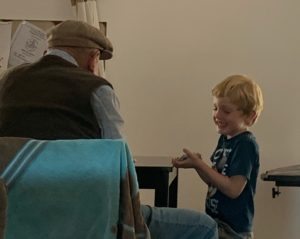
It has been a lot of fun spending time with our grandsons in Coffs Harbour.
The main purpose for the month here has been to assist in getting 4 year old Darcy ready for big school next year. This has entailed taking him to orientation days at big school and shortening his days at child care to help calm, reinforce some expected preschool knowledge. . . . .spending some quality time with him in preparation.
We have worked the time to give us some quality time with his 9 year old brother, Edison. We were firstly lucky to be here for St. Augustans Grandparents Day and so we could spend time in his classroom see his very talented art – see below his self -portrait for The Archy


Picking him up from his bus, listening to his music, going to his cricket on Saturdays, which was very exciting. At one stage holding our breath hoping he would get a hat trick and having to share the out field with a Kangaroo. We enjoyed his company when they came to have tea with us, watching him in the pool, on the jumping pillow, playing basket ball shots with Pa and family cricket. We have been very proud of his Merit Awards leading up to his second Principal Award.

Note: the big Grey Kangaroo in the out-field.
Our two older grandsons Lachlan and Doc Cameron are out of town but we had a great Saturday barbecue with them and a full day on Sunday of helping 12 year old Lachlan create his project for Year 7 on planning an ecological and sustainable village for a population of 20.000 . What a project! It took him a lot of brainstorming with everyone and then a lot of butcher-paper planning and a final drawing to scale on some good white cardboard Michael and I bought on our way to their place. We are awaiting on our result . . . . Hoping for, expecting an A+


Our Leisure time
In between times Michael and I have enjoyed some lovely experiences.
Of course it included poetry readings, walks, sunsets, picnics . Note in photo below I cannot go very far without my bibles of Mary Oliver and Rumi.


1. Watching the sunset each evening with a relaxing glass of Shiraz


2. Our drive to see the Jacarandas in their full glory in Grafton. Unfortunately it was a Saturday of the Jacaranda Festival so was a bit too crowded for us but still a very special experience to be part of. And we did finally find a seat for our thermos picnic in the shade of a jacaranda tree so purple petals could rain down in us


3. Our long coastal walk from our van, out onto the beach and then a walk to Mutton Bird Island, out to its far headland on the edge of the Pacific.


4. Picnic lunch at the Botanic Garden . Observed the whole courtship dance and song of the Blue Satin Bower Bird. Had two very close encounters with a swooping kookaburra which got part of Michaels chicken sandwich and part of my less tasty cheese and corn thins .and enjoyed a wonderful display with the Scrub Wren the fairy blue and his harem of brown wrens all flitting about and then noticed the small red Finches also in the same area.


5 Visited the Coffs Harbour Fish Markets on the Mariner and bought wonderful freshly cooked fish and chips – snapper and salmon. and had a lunch picnic in a shady sea scape spot.


6. Enjoyed a leisurely drive home with a little stress to get back to our world in Sydney. We tried to remember it was the journey not the destination. We took the Waterfall Way over the Mountain Range and had our picnic brunch at Ebor Falls, one of our special vortex places.


We had a lovely visit in Scone with my dear friend Sharon.
She had prepared a yummy lunch from her garden.
We never stopped chatting and laughing and amazing how we can not see each other for months at a time and pick up where we left off last visit. Her garden struggles with drought and flood and high wind of country but she perserveres.

Because of the land slides on the mountains and the flood damage and road works on the New England Highway, it was a slow journey and we arrived home late and tired.
Fun things we did with the boys


Beach walk to be the first to spot the full moon. A bit windy and the moon snuck up without us seeing it.
BBQs here in the park and playing cricket.
Bird watching. Lots of wonderful bird song especially in the mornings. brush turkey, Ibis, yellow-winged black cockatoos, seagulls, top knot pigeon, koels, magpies, plovers, galahs .
Here in our park playing on the jumping pillow, basketball, climbing frames, cricket, and swimming pool, water slides and spurting water fun.


Playing bingo and cards with Pa: painting and magnetic sand play with Grandma.


Bush walks to the nearby green koala corridor and Botanic Gardens.


Reading stories


Kicking the ball with Pa and listening to and identifying local birds.
The greatest of these discoveries was observing two Yellow winged black cockatoos and the Blue Satin Bower Bird.
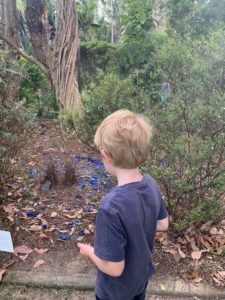
Our little Pikachu