White Pebbles Haiku Group Autumn Ginko by Beverley George

White Pebbles Haiku Group Autumn Meeting Report

March 11th 2023

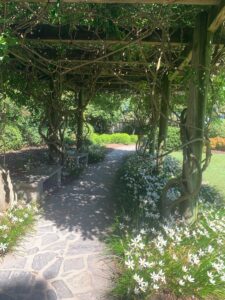
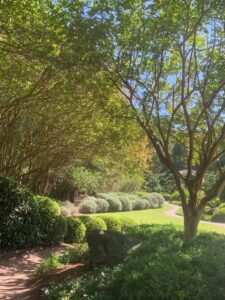
As soon as we met up for this meeting we knew it was going to be a very special one indeed. The sun was gently shining and all the diverse shades of green in the garden were sparkling. Soon we were off for our ginko and silent jotting.  Smiles across the ponds and along the pathways.

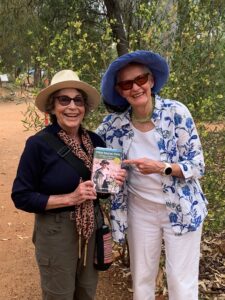
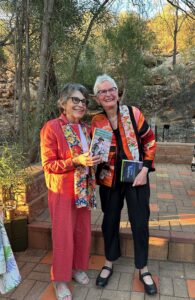
At 11 o’clock we gathered at the round table in the downstairs room we hire, which has glass doors that overview a quiet end of the garden. We were very sorry that two of our regular members, Samantha Hyde and Maire Glacken, were unable to attend this time, but were pleased to greet two visitors, Meredith Ferris and Frances Carleton, and our guest presenter, Carole Harrison, each of whom joined in congenially with our group and enhanced the day. Carole was one of the organisers and presenters of ‘Haiku Down Under’ on-line conference October 7-9 2022 and editor and cover-illustrator of ‘Poetry From The Edge’ the conference anthology. Members present at our meeting were Marilyn Humbert, Kent Robinson, Gwen Bitti, Colleen Keating, Verna Rieschild, Michael Thorley and Beverley George.

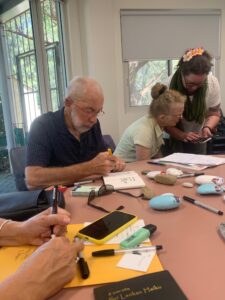
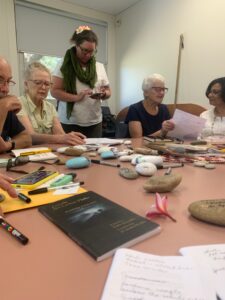
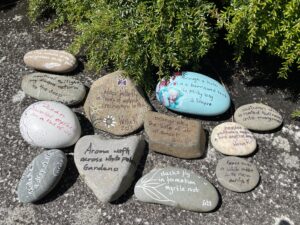
We shared a haiku we had each brought with us and one we had jotted on our ginko. Then it was time for our main session led by Carole Harrison, who had kindly journeyed up from Jamberoo, as she did for a Bowerbird tanka group meeting in the Pearl Beach Arboretum last year.  Her presentation was to show us how we might write haiku on stones, some of which were partly painted, others left plain. To this end Carole brought with her the stones we would use and Kent brought some dark river stones he had gathered for the purpose. Carole also brought the writing implements we needed and we wrote on two stones each – a lovely way in which to further share and enjoy haiku. It was relevant to add a simple drawing such as a leaf or feather to some of the haiku.


Kent Robinson had prepared and distributed an article about writing rengay and spoke briefly about this interesting genre. His thoughts were helpful and appreciated.

At 12:30 our meeting ended and it was up to each person whether to share lunch, journey home or enjoy the Art Gallery, or another garden stroll.  This is an aspect of our meeting location that works well for everyone, especially those who have travelled long distances to be there.

Group photo
seated left to right: Colleen Keating, Michael Thorley, Marilyn Humbert, Carole Harrison, Frances Carleton
standing left to right: Kent Robinson, Meredith Ferris, Beverley George, Gwen Bitti, Verna Rieschild

I am looking forward already to our winter meeting in June.
Beverley George
Convenor
White Pebbles Haiku Group


Author: leanneausthaiku

Secretary, Australian Haiku Society

Seeking escape in nature by Colleen Keating


waiting out a storm 

when wild weather is forecast                                         
we set out to escape 
plan things to wile away the time 
rather than waiting for it to hit

when clouds blow in dark and threatening 
we pack a picnic 
seek out nature 
and find consolations

in the shadow of 
doctors reports  tests 
verdicts more tests and treatments 
nature is the antidote

the sun on our back 
the wind in our hair
the balmy smells of the outdoors                                              
we find the secret to living. 

Colleen Keating


Ku-Ring-Gai Wildflower Garden  for a walk in nature and picnic. It was a hot , balmy day and although we walked a lot in shade the eucalypt aroma was wonderful.

The  heady, healing  eucalypt aroma as we walked  made us feel very positive.

Into the Living Light, composed by Anne Boyd, with thanks to Hildegard by Colleen Keating


O fleeting soul, be strong.
Clothe yourself in the armour of light.
You are surrounded
With the embrace of Divine mysteries.

It is affirming when I hear Hildegard of Bingen, a Poetic Journey, my book published a few years back has an effect on the reader. Because my story is read mostly in USA with book groups and retreats, I love hearing of experience from a distance but when it is from home and from a friend that it has been inspiring for her through grief and lost and deep sadness  into  new creative musical writing,  I feel very affirmed and give thanks to Hildegrad who is with us today in 2023 to lead us in  this broken world.

Thank you  professor Anne Boyd. I feel very honoured to be included in your creation and so happy you are being praised as one  of the top women composers at this time.  And congratulations being on the new CD of music Women of Note Vol 5. published this month March 2023 for International Womens’ Day

Short Programme Note

Into the Living Light

For me, composing is deep listening, seeking a presence beyond the Self, an activity akin to prayer. Grieving the recent loss of two family members, one of whom was my older sister Helen, who died on Christmas Day, I discovered the loss of a sibling leaves a strangely hollow place in one’s sense of being. My very special friend David Iverach was similarly affected with passing of his elder brother Don a few days later.

Seeking comfort and meaning, I found myself drawn to the vividly colourful imagery in the verse novel by Sydney writer Colleen Keating Hildegard of Bingen. One verse stood out in the Section she titled ‘Unearthing Heaven’:

O fleeting soul, be strong.

Clothe yourself in the armour of light.

You are surrounded

With the embrace of Divine mysteries.

I had been looking forward to composing a work for flute, viola and harp and in the context of the grieving process one of Hildegard’s antiphons O rubor sanguinis inspired by the martyrdom of St Ursula floated into my mind.

The image of Light so important to Hildegard’s sense of the Divine presence, reaches across many spiritual beliefs. I sometimes think of Australia as the land of living light.My sister, to whom the vibrant colours of Nature were soul food,believed her onward journey to be ‘to a place beyond the stars’; Don had no doubt that his resting place would by with his wife in the loving arms of Jesus. Light is central to and connects both their personal beliefs. This music, resting upon inspiration from Hildegard, reaching across the centuries, is a kind of prayer to accompany them both into eternity.

Vale Helen and Don, both so loved by your families and friends in this life, may you now rest in peace.

Anne E. Boyd

Sydney

20.02.23

Anne Boyd leading a walk in the Olive Pink Botanic Garden
and Anne and I at the launch of Olive Pink : her radical & idealistic life.
The evening before Anne Boyd’s Opera of Olive Pink set in the garden.

AUSTRALIAN DEBUSSY TRIO

The sumptuous combination of flute, viola and harp unites three soloists as they deliver a thoughtfully curated program. The newly established Australian Debussy Trio has crafted an illuminating blend of tranquil dreams, pastoral scenes and deep, introspective music for this unique instrumental combination. Imbued with flickers of light, Debussy’s second sonata is told in a fragrant language of ambiguity and fleeting suggestion. In a masterful display of timbral manipulation, Japanese composer Tōru Takemitsu pays homage to Debussy with his own trio “And then I knew ’twas Wind” – a musical depiction of the human subconscious played out across interconnected musical episodes. Amongst the intriguing lineup of works, the programme features two Australian works, by Ross Edwards and Anne Boyd, written especially for the trio. This thoughtful programme will engross audiences from start to finish.

ARNOLD BAX
Elegiac Trio
TORU TAKEMITSU
And then I knew ’twas Wind
ROSS EDWARDS
Three Mystic Dances
JEAN-PHILIPPE RAMEAU
Pieces de clavecin en concerts No. 5
ANNE BOYD
Into the Living Light
CLAUDE DEBUSSY
Sonata for flute, viola and harp, L.137

Granger, Wannan and Henderson impressed with some spectacular playing, both skilled technically and emotionally poignant.

Limelight Magazine


EMILY GRANGER

Harp

See profile

American-born, Australian-based Emily Granger effortlessly straddles the worlds of classical, popular, and art music – including glittering appearances with Yo-Yo Ma, Sarah Blasko, and Renée Fleming. Emily’s considerable talent finds her equally at home in intimate chamber recitals and thrilling performances of daring new works. Emily has performed recitals from Carnegie Hall to the Kennedy Center and has appeared with the Chicago, Sydney, and Tasmanian Symphony Orchestras. Her debut solo album, In Transit (AVIE Records), was Featured Album on ABC Classic and praised by BBC Music Magazine as “beautiful” and Limelight Magazine as “an impressive debut”.

JAMES WANNAN

Viola

See profile

Violist James Wannan is a founder of the Australia Piano Quartet (APQ), Co-Artistic Director of the Ensemble in Residence at the University of Technology Sydney, a member of Southern Cross Soloists and an Artistic Associate of Sydney Chamber Opera. He teaches chamber music and viola at the Sydney Conservatorium’s Rising Star program and has been a guest teacher at the Australian National Academy of Music. He explores his passion for music from ancient to contemporary on a number of instruments. James enjoys exploring the possibilities of other instruments including violin, oud and viola d’amore. He has commissioned many new works, including a concerto by Jack Symonds that was premiered at the Bendigo Festival of Experimental Music.

JONATHAN HENDERSON

Flute

See profile

Flutist Jonathan Henderson trained with Europe’s leading flute professors and has carved out a multifaceted performance career spanning from Australia to the Nordic countries. Jonathan was appointed Principal Flute of the Estonian National Opera Orchestra at age twenty-four, whilst still a student at the Hochschule für Musik Freiburg. He has performed with the Australian Chamber Orchestra, Queensland Symphony Orchestra, Helsinki Philharmonic Orchestra, Nordic Symphony Orchestra and MDR Leipzig Radio Symphony Orchestra under the direction of conductors such as Sir Mark Elder, Neeme Järvi, Paavo Järvi, Richard Tognetti, Klaus Mäkelä and Leif Segerstam.

The Rickety Bridge by Jacinta v. An exercise in creative writing


The Rickety Bridge

Crash! I heard the loud gushing water as I walked towards the ancient unstable rickety bridge.
I heard the creaking timber planks as I stepped my shaky legs onto the bridge. I saw the splintered wood and the jagged, rigid rocks as i carefully tiptoed across the bridge. I felt frightened and terrified as I thought of what would happen if I fell. I felt the sharp, spiky nails stab my feet. The frothy water like a cappacinno crashed against the sharp rocks 
by Jacints v


Jacinta’s year 5 class are working on descriptive writing .
Her teacher gave the class the image of the rickety bridge
and the class planned their paragraph .
They were encoureged to use similes, descriptive words and  onomatopoeia in their writing .

So proud of our granddaughter Jacinta who had her desriptive writing chosen for the school newsletter.

She loves life, netball, dancing running,  singing, and is always breathtakingingly joyful, light hearted and fun.


Blue Heron Review, so excited to be included in #16 Spring 2023 by Colleen Keating


BLUE HERON REVIEW

“An awake heart is like a sky that pours light.” ― Hafiz

Dear Colleen,

Thank you so much for your wonderful submission to Blue Heron Review!  I am very pleased to accept your beautiful poem, “Winter Days,” for our upcoming Spring 2023 issue on the theme of SANCTUARIES AND PLACES OF PEACE, BHR #16.


Our next issue is due to be published online in late spring (approx. mid-May 2023).  I will send a link to the issue to all contributors when it is released.

Congratulations again, and thank you for being a Blue Heron poet!

With kind regards,

Cristina M. R. Norcross, Founding Editor

Blue Heron Review

www.blueheronreview.com

See More from Colleen Keating

Cristina M. R. Norcross, Editor

Blue Heron Review

www.blueheronreview.com

Windows for Miracles (Türkiye and Syria) by Colleen Keating

 windows for miracles

After a baby was rescued  from the rubble 150 hours
after the  Türkiye and Syria earthquake 

windows for miracles
open hands dig
exposed in corruption and winter freeze
brute force against crushed
walls of concrete 

windows for miracles
rimy pictures extort tears   
tiny pockets of air save
and in renascence we all 
breathe humanity’s ache

windows for miracles
closed hard as steel shutters
trapped against meaning  
we scramble under rubble of news
grass and birds stone-walled

Colleen Keating


reminder an elegy by Colleen Keating

reminder

air is riven with grief quiet
staccato of words like whispers
spread a low slow pall shroud
our small communal world

yet in this laden torpor
cicadas still ring their song
timid blue-hearted pansies nod
and in the Harmony garden
a young hibiscus bursts
into flower it’s yellow suns
quiver with meaning

today at the funeral
words of comfort search
dragonflies on the mirrored–
surface of our loss

from a screen memories draw us in
their toasting with wine laughter
arms lovingly encircled
hugs of celebrations
to a backdrop of our tended garden
multi-coloured petunias
the white magnolia
rambling  roses that give and give

this is life it is beautiful
it reminds us of the fable
where a fish asks ‘where is the sea?’
and the wise fish answers ‘you’re in it!’

back at home  sweet scent
of friendship wafts from the garden

Di Yerbury Residential Award 2023 has a vibrant winner by Colleen Keating

                                       Congratulations to Belinda Murrell  

                                                          on winning this year’s

                                   Di Yerbury Residency in Barnstaple, Devon.

Judges’ Report:
The applications shortlisted for the 2023 Di Yerbury Residency were outstanding. They each demonstrated a solid background of writing and publishing, study and research, accomplished writing skills and a publishing track record. All have received various writing and publishing awards.
The writing samples were of a high standard, demonstrating the applicants’ command of the necessary attributions for publication. Research and writing plans were detailed and showed how the Di Yerbury Residency would assist their current writing and research.
It made our task of selecting a winner extremely difficult. It took several weeks of considering and assessing the applications to come to a decision.
We believe that our chosen winner meets the residency criteria and the spirit of the Di Yerbury Residency. We feel sure that she will make the most of her opportunity to research and write her novel while overseas.
The award this year for a proposed novel with the working title The Shadow Girl goes to:
BELINDA MURRELL
Belinda plans to research and write the first draft of a proposed novel set during the 1930s and 1940s, ‘shining a light on the courage and achievements of a forgotten Australian woman war correspondent … inspired by the remarkable true-life story of Margaret Gilruth’ and the ‘fascinating World War II history of young English and Australian women working for the secret Y listening stations in Abbots Cliff, near Dover, decoding enemy messages from German pilots and naval vessels’.
We congratulate Belinda Murrell and wish her all the best with her research and look forward to reading her novel The Shadow Girl when it is published.

Colleen Keating and Sharon Rundle

Judges, Di Yerbury Residency 2023

Australian biographer
Dianne Yerbury AO is an Australian university administrator and company director. She was the Vice-Chancellor of Macquarie University, Sydney, Australia from 1987 to 2005. She was Australia’s first female Vice-Chancellor, and was also the longest serving Vice-Chancellor of Macquarie University.Wikipedia

Women’s Ink and review of Olive Muriel Pink by Beatriz Copello

Compulsive Reader

pastedGraphic.png

http://www.compulsivereader.com/

A review of Olive Muriel Pink by Colleen Keating

Reviewed by Beatriz Copello

I do not think there is a better way to honour a woman of the calibre of Olive Muriel Pink than to write a book of poetry about her life.  Colleen Keating has done just that, she has written a poetic journey about this unsung Australian heroine. 

With a sharp eye and lyric touch, the world of Olive Pink becomes alive, it is a passionate story told with knowledge. It is evident that the poet has invested years researching the life of Olive Pink. The poet says: “I have been researching, writing and thinking about Olive Pink for over a decade now.  The discoveries that come along the way – the portraits unveiled – are very stirring.”  

This collection covers many years in the life of Pink, it starts in 1884 and finishes in 1975. The book also has a foreword, a prologue and a chronology as well as notes and bibliography. The labour of love that went into writing this book would grant the author a doctorate.

The author in Notes explains that she aimed to write a book that fell between an accurate scholarly presentation of Olive Pink’s life and her own personal interpretation of it.

Olive Pink was a fighter for justice who advocated for the rights of First Nations People, she was also an anthropologist, artist and gardener. Keating from the first poem in the book alerts the readers about what they will encounter throughout the pages, in this excerpt from “Olive the pioneer” she writes:

Who is Olive?

She defied the silence

caused discomfort

annoyed the authorities.

Her letters shouted from the edge.

She heard budgerigar dreaming

and drummed to a different tune.

She pushed against the colonial tide.

If the answer is ‘eccentric’

in her death she will be twice dismissed. 

Who is Olive? History asks.

She broke the silence

her voice for the voiceless 

remembered the forgetting.

She visioned justice in the courts.

Her feet knew country.

She carried red dust

under the fingernails of her heart.

She listened to elders, learnt language

wrote down stories, sketched arid plants

medicinal, nutritional, ritual.

If the answer is ‘anthropologist’

in her death she will be twice honoured. 

If Keating wrote music, I would say she does not miss a beat, when she raises issues about Olive’s past, she does it with conviction and poignant comments, like in the following excerpt from “A new lodestone”:

The grim spectre of injustice

towards Aboriginal tribes

taunts Olive out of her grief

jolts her from self pity.

Like a silk petticoat pulled over her hair

the air is static in its darkness.

It bleeds through a colander of whitewash words

  • progress jobs, growth.

Its handprint blood-red.

The poet also utilizes very vivid imagery, the readers become Olive, we can see, smell, hear what she experiences.  Keating appeals to the senses, the following poem “Restless” illustrates this: 

In her dingy office Olive yearns

for the vast open country, large skies,

hazy horizons, a slung kettle hissing

and spitting its leak over the fire.

Burnt flesh and sizzle

of goanna still fill her nostrils.

Olive walks country in her sleep –

the pungent smell of camels

sweaty bodies, blazoned glare, flies

dust-blown storms.

That red dust under

the colour of her heart

and patter of Pitjantjatjara children

still running giggling beside her

lingers like the balm of an Indian summer.  

The poet has the skill to write about Olive’s powerful emotions without sentimentality or corniness, through these strong emotions readers can form a picture in their mind of Olive’s personality. The following excerpt from the poem titled “Heady days” is a good example of the Keating’s ability:

Olive is energised by academia.

The scissor-cut horizon

of her desert experience

challenges like a mirage.

She seizes every chance to argue,

‘The root cause is not malnutrition or disease –

They camouflage facts, treat the wrong symptoms.’

Heated discussion rises.

Angrily she fights for breath.

‘Even the most ignorant know the problems –

White man’s aggression, sexual abuse

fear, venereal disease, land dispossession.

We like to deride these facts.’

She flushes, her neck prickles as she continuous,

‘Full-bloods need their own protected country

not mission reserves.’

Her tone is strident.

‘Daily handouts from stations

Keep them tied to white man power.’

Olive Pink struggled all her life to be able to do what men were able to do, in the following poem “High Hopes” Keating captures this desire but also very cleverly imagines her mood in such a difficult situation.

Over dinner her enthusiasm bubbles.

‘After my thesis I plan

a full year of research among the Arrernte’

she confidently tells the Professor

and others grouped around the table.

‘I would like to be included

in your next museum expedition.

It will reduce my research expenses 

and my anthropology will enhance the group.’

Silence.

Unease around the room

as lightening awaits a clap of thunder.

Awkward shifts and exchanged glances

the embarrassed clearing of throats.

From her left in a deep tone,

‘That would not be possible …

‘But you took Ted Strehlow on your trip last year!’

‘… for a woman,’ mumbles the professor.

Exposed, Olive’s heart races.

She hopes they don’t notice the burn

of her cheeks.

She avoids eye contact

gazes out as one with miles to go

restless to be on her way.

She needs desert air.

‘Why does gender cause such heart break?’

she broods into the night.

‘Why wasn’t I born a man.”

I would like to congratulate Colleen Keating not only for writing this incredible book but also for honouring a woman from the past which like many other Australian heroines are often forgotten or not given credit for their achievements. 

Reading about Olive Muriel Pink will inspire you and give you strength to struggle to achieve your aims.

About the Reviewer: Dr Beatriz Copello is a former member of NSW Writers Centre Management Committee, she writes poetry, reviews, fiction and plays. The author’s poetry books are: Women Souls and Shadows, Meditations At the Edge of a Dream, Flowering Roots, Under the Gums Long Shade, and Lo Irrevocable del Halcon (In Spanish).  Beatriz’s poetry has been published in literary journals such as Southerly and Australian Women’s Book Review and in many feminist publications.  She has read her poetry at events organised by the Sydney Writers Festival, the NSW Writers Centre, the Multicultural Arts Alliance, Refugee Week Committee, Humboldt University (USA), Ubud (Bali) Writers Festival.


And here is the abridged version for Women’s Ink Spring/Summer 2022


Excited today to receive in the mail, the latest SWW journal Women’s Ink with a very affirming review of my book
Olive Muriel Pink: A Poetic journey.
Lots of thanks due: Beatriz Copello la for her dedicated reviewing ; Jacqui Brown for a very profesional journal, Maria McDougall, President of SWW and of course Stephen Matthews and Ginninderra Press..
This is an abridged review. The full length of Beatriz Copello’s review can be read on my blog


Olive Muriel Pink

Her radical and idealistic life

A poetic journey

Colleen Keating

Publ. Ginninderra Press

Review by Beatriz Copello

I do not think there is a better way to honour a woman of the calibre of Olive Muriel Pink than to write a book of poetry about her life.  Colleen Keating has done just that, she has written a poetic journey about this unsung Australian heroine. 

With a sharp eye and lyric touch, the world of Olive Pink comes alive. It is a passionate story told with knowledge. It is evident that the poet has invested years researching the life of Olive Pink. The poet says: “I have been researching, writing and thinking about Olive Pink for over a decade now.  

The labour of love that went into writing this book would grant the author a doctorate.

The author in Notes explains that she aimed to write a book that fell between an accurate scholarly presentation of Olive Pink’s life and her own personal interpretation of it.

With vivid imagery, the readers become Olive, we can see, smell, hear what she experiences. with the skill to write about Olive’s powerful emotions without sentimentality or corniness,

Olive Pink struggled all her life to be able to do what men were able to do and Keating captures this desire but also very cleverly imagines her mood in such a difficult situation.

I would like to congratulate Colleen Keating not only for writing this incredible book but also for honouring a woman from the past which like many other Australian heroines are often forgotten or not given credit for their achievements.

Dr Beatriz Copello is a former member of NSW Writers Centre Management Committee. Beatriz writes poetry, reviews, fiction and plays. Beatriz’s poetry has been published in literary journals such as Southerly and Australian Women’s Book Review and in many feminist publications.

Her latest poetry book is Witches, Women and Words. 2022.